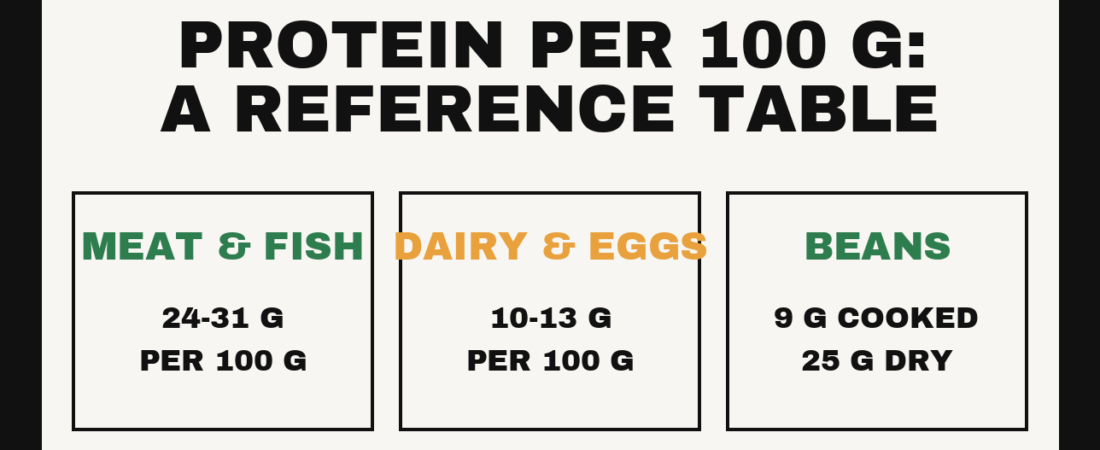
Short answer: cooked chicken breast, canned tuna and lean beef sit around 25 to 31 g of protein per 100 g. Eggs, Greek yogurt and cottage cheese land near 10 to 13 g. Cooked beans and lentils are about 9 g. Protein powders run 75 to 90 g. The number that trips people up is raw versus cooked: the same chicken breast reads 22 g per 100 g raw and 31 g per 100 g cooked, because water left, not because protein appeared.
Set your daily target or split it across meals.
Protein per 100 g, by food
Values are rounded from USDA FoodData Central and are given as the food is normally eaten. Meats and fish are cooked unless noted; legumes are boiled; powders are as sold.
| Food | Protein per 100 g | Group |
|---|---|---|
| Whey protein isolate (powder) | 85 g | Powder |
| Soy protein isolate (powder) | 81 g | Powder |
| Whey concentrate (powder) | 78 g | Powder |
| Parmesan | 36 g | Dairy |
| Chicken breast, cooked | 31 g | Meat |
| Pumpkin seeds | 30 g | Nuts and seeds |
| Turkey breast, cooked | 29 g | Meat |
| Beef sirloin, lean, cooked | 29 g | Meat |
| Pork loin, cooked | 27 g | Meat |
| Ground beef 85/15, cooked | 26 g | Meat |
| Canned tuna in water, drained | 25 g | Fish |
| Salmon, cooked | 25 g | Fish |
| Cheddar | 25 g | Dairy |
| Seitan | 25 g | Plant |
| Shrimp, cooked | 24 g | Fish |
| Peanut butter | 23 g | Nuts and seeds |
| Chicken breast, raw | 22 g | Meat |
| Almonds | 21 g | Nuts and seeds |
| Tempeh | 19 g | Plant |
| Tofu, firm | 17 g | Plant |
| Whole egg, cooked | 13 g | Egg |
| Oats, dry | 13 g | Grain |
| Cottage cheese, 2% | 11 g | Dairy |
| Egg white | 11 g | Egg |
| Edamame, cooked | 11 g | Plant |
| Skyr | 11 g | Dairy |
| Greek yogurt, plain 0% | 10 g | Dairy |
| Lentils, cooked | 9 g | Legume |
| Black beans, cooked | 9 g | Legume |
| Chickpeas, cooked | 9 g | Legume |
| Bread, white | 9 g | Grain |
| Pasta, cooked | 6 g | Grain |
| Green peas, cooked | 5 g | Vegetable |
| Quinoa, cooked | 4 g | Grain |
| Whole milk | 3 g | Dairy |
| White rice, cooked | 3 g | Grain |
Two things stand out. Cooked meat and fish cluster tightly between 24 and 31 g, so swapping chicken for tuna for pork changes very little. And cooked legumes are diluted by water: dry lentils are about 25 g per 100 g, but they roughly triple in weight when boiled, which is why the cooked figure lands near 9 g. For a fuller look at plant sources, see hitting a high target on a vegan or vegetarian diet.
What 25 g of protein looks like
Twenty to 30 g is a normal per-meal amount, and it is the range most dose-response studies used before landing on their conclusions.
| Food | Amount for 25 g of protein |
|---|---|
| Chicken breast, cooked | 80 g |
| Canned tuna, drained | 100 g (about one can) |
| Whey isolate powder | 30 g (about one scoop) |
| Firm tofu | 150 g |
| Whole eggs | 4 large |
| Cottage cheese, 2% | 230 g |
| Greek yogurt, plain 0% | 250 g |
| Cooked lentils | 280 g |
| Whole milk | 750 ml |
What 90, 115 or 140 g looks like across a day
If a calculator handed you a number like 90 g or 115 g, that is a daily total, not a single meal. Divide it into three or four blocks and it stops looking intimidating.
| Daily target | Per meal (3 meals) | A day that gets there |
|---|---|---|
| 90 g | 30 g | 3 eggs plus yogurt, 100 g chicken, 150 g salmon with lentils |
| 115 g | 38 g | Above, plus one 25 g shake and 200 g cottage cheese |
| 140 g | 47 g | Four 35 g meals: 120 g meat or fish at each of two, dairy and a shake at the others |
Where your own number should sit is covered in how much protein per day, and the 2026 revision of the guidelines is in the RDA update.
Raw versus cooked is the biggest source of error
Cooking drives off water. A 150 g raw chicken breast comes off the pan at roughly 110 g, but it still holds the same 34 g of protein it started with. Per 100 g the figure jumped from 22 to 31 g; nothing was created. Two rules keep this straight:
- Pick one state and stay in it. Weighing raw is more consistent because cooking losses vary with heat and time.
- Match the database entry to what you weighed. Logging 150 g of cooked chicken against a raw entry undercounts by about a third.
Protein quality: where per-100 g misleads
Grams on a label are not all equally usable. DIAAS scores a protein on how much of each indispensable amino acid actually survives digestion. FAO treats a score of 100 or higher as an excellent-quality source and 75 to 99 as good.
| Source | DIAAS (approx.) |
|---|---|
| Milk and casein | 1.14 |
| Egg | 1.13 |
| Beef | 1.10 |
| Chicken breast | 1.08 |
| Whey | 0.96 to 1.09 |
| Soy protein | 0.90 |
| Potato protein | 0.85 |
| Lentils | 0.75 |
| Chickpeas | 0.69 |
| Pea protein | 0.66 |
| Black beans | 0.61 |
| Rice | 0.52 |
| Peanuts | 0.47 |
| Oats | 0.44 |
| Wheat | 0.39 |
The practical read: if most of your protein comes from legumes and grains, add roughly 10 to 20 percent to your total to land in the same place as an animal-protein diet, and mix sources so that lysine from legumes covers what grains lack. Mixing matters more than any single score. Whey versus plant protein goes into the amino acid detail.
Where these numbers are soft
- They are averages. USDA entries pool multiple samples. A given chicken breast or yogurt tub can sit 10 to 15 percent either side of the table value.
- Labels round. US nutrition labels round protein to the nearest gram, and small per-serving errors compound across a day of packaged food.
- Plant values are inflated slightly. Food composition tables estimate protein by measuring nitrogen and multiplying by 6.25. Plant foods carry non-protein nitrogen, so the true figure is often a few percent lower than printed.
- Powders vary by brand. The 78 to 85 g range for whey depends on the concentrate-to-isolate ratio and any added carbohydrate. Read your own tub rather than a table. Concentrate versus isolate covers what that changes.
None of this is a reason to stop counting. An error of 10 percent on a 120 g target is 12 g, which is inside the noise of what daily protein needs to be. Precision to the gram is not the goal; hitting the range consistently is.
FAQ
How much is 25 g of protein?
About 80 g of cooked chicken breast, one can of tuna, four eggs, 250 g of Greek yogurt, 150 g of firm tofu, or one scoop of whey isolate.
How much is 90 g of protein?
A day, not a meal. Three 30 g meals gets you there: eggs and yogurt at breakfast, 100 g of cooked chicken at lunch, 150 g of salmon with lentils at dinner.
How much is 115 grams of protein?
Roughly four blocks of 30 g. In practice that is three protein-anchored meals plus either a shake or a 200 g tub of cottage cheese.
What food has the most protein per 100 g?
Among whole foods, hard cheeses like parmesan at about 36 g and cooked chicken or turkey breast at about 30 g. Isolated powders reach 80 to 90 g, but they are ingredients rather than foods.
What are high protein vegetarian foods per 100 g?
Seitan 25 g, pumpkin seeds 30 g, tempeh 19 g, firm tofu 17 g, cheddar 25 g, cottage cheese 11 g, cooked lentils and beans about 9 g each.
Should I weigh food raw or cooked?
Raw is more consistent, since cooking losses change with method. Whichever you choose, log it against a database entry in the same state.
Sources
- USDA FoodData Central. Agricultural Research Service, US Department of Agriculture.
- Herreman L, Nommensen P, Pennings B, Laus MC. Comprehensive overview of the quality of plant- and animal-sourced proteins based on the digestible indispensable amino acid score. Food Science and Nutrition, 2020.
- FAO. Dietary protein quality evaluation in human nutrition: report of an FAO expert consultation. FAO Food and Nutrition Paper 92, 2013.
- Jager R et al. International Society of Sports Nutrition position stand: protein and exercise. JISSN, 2017.
- Morton RW et al. A systematic review, meta-analysis and meta-regression of the effect of protein supplementation on resistance training-induced gains in muscle mass and strength. British Journal of Sports Medicine, 2018.
- Moore DR et al. Ingested protein dose response of muscle and albumin protein synthesis after resistance exercise in young men. American Journal of Clinical Nutrition, 2009.
General information, not medical advice.
GramGoal Team. We build nutrition calculators and price-check the supplement market monthly. General information, not medical advice. See our methodology and affiliate disclosure.