Updated for the 2026 guidelines: in January 2026 the 2025-2030 Dietary Guidelines for Americans raised the general-population recommendation from 0.8 g/kg to 1.2-1.6 g/kg. Active people and anyone in a deficit still sit above that range. Full breakdown of what changed.
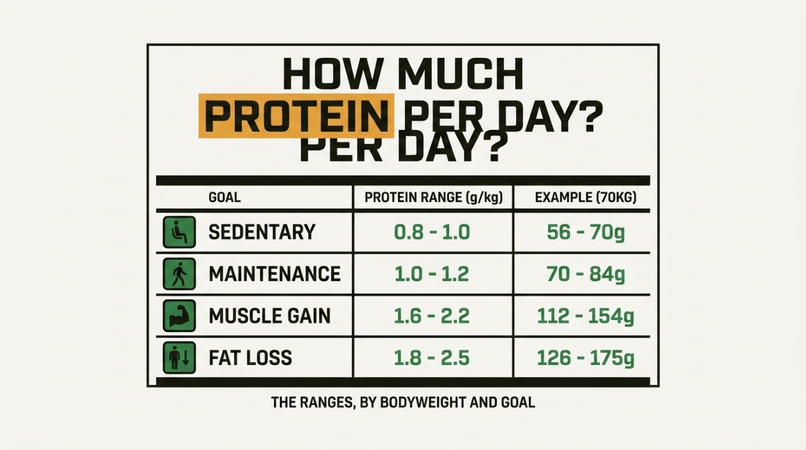
Short answer: most adults need 1.2 to 2.2 g of protein per kg of bodyweight per day, depending on what they are doing. Sedentary maintenance sits near the bottom of that range; active people and anyone in a calorie deficit sit near the top. For an 80 kg person that is roughly 96 g to 176 g per day.
Get your exact number with the Full Plan calculator, which also splits it per meal and shows the gap your food is not covering.
The ranges, by situation
- General health, not training: 1.0 to 1.2 g/kg.
- Training 2 to 4 times a week: 1.4 to 1.8 g/kg.
- Losing fat while keeping muscle: 1.6 to 2.2 g/kg. Higher intake protects lean mass in a deficit.
- Body recomposition: around 2.0 to 2.2 g/kg. See the recomp calculator.
- Older adults: generally higher than the old RDA, because the muscle-building response to protein weakens with age.
Why per kg and not a flat number
Advice like “eat 100 g of protein” ignores that a 55 kg person and a 100 kg person have very different needs. Protein requirements scale with bodyweight, and more precisely with lean mass. Per-kg targets travel across body sizes; flat numbers do not.
How to split it across the day
Total daily intake matters most. That said, spreading protein across three to five feedings of roughly 25 to 40 g each appears slightly better for muscle retention than one or two large servings, and it is easier to digest.
Hitting the number in real food
- Chicken breast, 100 g: about 31 g
- Canned tuna, 100 g: about 25 g
- Greek yogurt or skyr, 170 g: about 17 g
- Eggs, 2 large: about 12 g
- Lentils, 100 g cooked: about 9 g
- Whey scoop: about 25 g
Most people fall 40 to 60 g short of a high target on food alone. Where food falls short, whey is usually cheapest per gram: see our cost per 20 g ranking.
Can you eat too much?
For healthy people, intakes across the studied ranges are considered safe. Beyond roughly 2.2 g/kg there is no added muscle benefit in the research, so it mostly wastes money. If you have kidney disease or another medical condition, protein targets are a conversation for your doctor.
FAQ
How much protein per day to build muscle?
1.6 to 2.2 g/kg, paired with progressive resistance training. Protein supplies the material; training supplies the signal.
How much protein per day for women?
The same per-kg ranges apply. Because average bodyweight is lower, the absolute gram target is usually lower, not the ratio.
Is 100 g of protein a day enough?
For a 60 kg person training regularly, yes. For a 90 kg person in a deficit, no. That is exactly why per-kg targets beat flat numbers.
Worried a higher target is hard on you? What the kidney research actually shows.
General information, not medical advice.
Once you have a number, see what that many grams looks like in real food.
GramGoal Team. We build nutrition calculators and price-check the supplement market monthly. General information, not medical advice. See our methodology and affiliate disclosure.