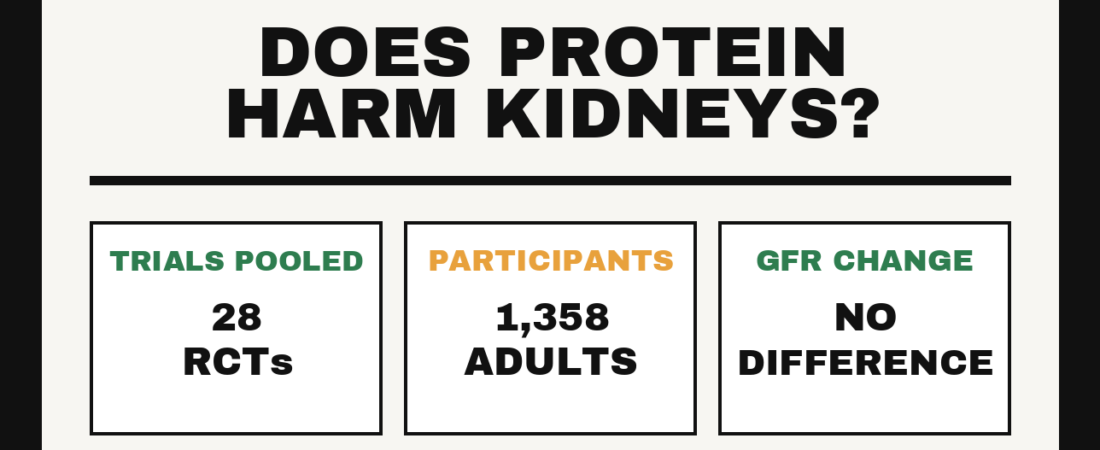
Short answer: in people with healthy kidneys, no controlled trial has shown that a high-protein diet damages them. A meta-analysis of 28 randomised trials covering 1,358 adults found no difference in how kidney function changed between higher and lower protein diets. The honest caveat is that those trials were designed to measure body composition, not kidney safety, and none of them ran for decades. Existing kidney disease is a different question entirely and belongs with a clinician.
Set a sensible target with the protein calculator, or read how much protein per day for the ranges by bodyweight and goal.
Where the worry came from
Protein is not stored. The nitrogen left over from what you eat is processed and excreted, and the kidneys do that work. Eating more protein raises glomerular filtration rate, the standard measure of how much blood the kidneys are processing.
In people who already have kidney disease, a persistently raised filtration rate is associated with faster decline. The inference that followed, and became fitness folklore, was that raising it in healthy people must cause the same harm. That step is the part the evidence does not support. A rise in workload is not the same as injury, in the same way that a raised heart rate during exercise is not a heart problem.
What the trials found
| Study | Design | Protein intake | Kidney finding |
|---|---|---|---|
| Devries 2018 | Meta-analysis, 28 randomised trials, 1,358 adults | Higher vs normal or lower | No difference in change in GFR (SMD 0.11; 95% CI −0.05 to 0.27; P = 0.16) |
| Antonio 2016 | One-year randomised crossover, 14 trained men | 2.51 to 3.32 g/kg for six months | No harmful change in kidney or liver markers, or blood lipids |
| Poortmans 2000 | Cross-sectional, bodybuilders and other athletes | Up to about 2.8 g/kg habitually | Creatinine clearance and albumin excretion within normal limits |
The Devries analysis is the one that carries the most weight, because it compared the change in kidney function rather than a single snapshot. Comparing snapshots between groups is confounded by ordinary variation between people; comparing changes within people is not.
The Antonio crossover is small at 14 men, but it is unusually long. Those men ate two and a half to three times the old RDA for six months, in a design where each man served as his own control, and their kidney and liver blood markers did not move adversely.
Where the evidence is thin
A 2024 review in Sports Medicine makes a point worth taking seriously rather than dismissing. Most of the athlete studies used to reassure people were designed to measure body composition, not kidney outcomes. Blood markers were secondary measures, sample sizes were small, and follow-up was short.
- No long-term data. The longest controlled intervention is one year in 14 people. Nobody has run a twenty-year trial, and nobody will.
- Healthy participants only. Trials screen out kidney disease, so they cannot tell you what happens to someone with undiagnosed early impairment.
- The sustained hyperfiltration question is genuinely open. The reviewers argue it has never been properly tested in athletes eating above 1.5 g/kg for years on end.
- Small samples. Fourteen men cannot rule out an effect that appears in one person in fifty.
So the accurate statement is not “protein is proven safe forever”. It is that the specific harm people fear has been looked for repeatedly in healthy adults and has not turned up, while the long-horizon question remains unanswered.
What this means in practice
- If your kidneys are healthy, the intakes used in fitness — typically 1.6 to 2.2 g/kg — sit well inside the range that has been tested without incident.
- If you have kidney disease or a family history of it, protein intake is a clinical decision, not a calculator output. Restriction is sometimes prescribed, and the target depends on stage and other factors.
- Drink to thirst. Higher protein raises urea excretion, which raises water needs modestly. The water intake calculator gives a rough starting figure.
- Eating more protein is not free of trade-offs, but the trade-offs are cost and displacing other foods rather than organ damage. The protein cost calculator covers the first.
One practical note on testing. Creatinine is a breakdown product of muscle, so people with more muscle, or who supplement creatine, can show a raised serum creatinine and a lower estimated GFR without any kidney problem. A raised reading in a lifter is a reason to ask about the method used, not a diagnosis. Creatine side effects covers that specific confusion.
FAQ
Does protein damage kidneys in healthy adults?
No trial has shown that it does. Pooling 28 randomised trials in 1,358 healthy adults found no difference in how kidney function changed between higher and lower protein diets.
Does whey protein damage kidneys?
No differently from protein in food. The trials above did not find kidney harm at intakes far above normal, and powder is not treated differently by the body than chicken or dairy.
Does protein affect kidneys or liver?
Both process it, and both were measured in the one-year crossover study. Neither kidney nor liver blood markers moved adversely at 2.51 to 3.32 g/kg.
How much protein is too much?
No kidney-based upper limit has been established in healthy adults. The practical ceiling is that protein above roughly 2.2 g/kg stops adding muscle benefit, so more becomes an expensive way to hit the same result.
Can protein damage kidneys over many years?
Unknown, honestly. The longest controlled trial is one year. Reviewers have flagged sustained hyperfiltration in lifelong high-protein eaters as an open question that existing studies were not built to answer.
Why did my kidney blood test look off after starting the gym?
Estimated GFR is usually calculated from serum creatinine, which rises with muscle mass and creatine use. That can shift the estimate without kidney function changing. Take it to whoever ordered the test rather than interpreting it alone.
Sources
- Devries MC, Sithamparapillai A, Brimble KS, Banfield L, Morton RW, Phillips SM. Changes in kidney function do not differ between healthy adults consuming higher- compared with lower- or normal-protein diets: a systematic review and meta-analysis. The Journal of Nutrition, 2018;148(11):1760–1775.
- Antonio J, Ellerbroek A, Silver T, Vargas L, Tamayo A, Buehn R, Peacock C. A high protein diet has no harmful effects: a one-year crossover study in resistance-trained males. Journal of Nutrition and Metabolism, 2016;2016:9104792.
- Poortmans JR, Dellalieux O. Do regular high protein diets have potential health risks on kidney function in athletes? International Journal of Sport Nutrition and Exercise Metabolism, 2000;10(1):28–38.
- de Lorenzo A, Bomback AS, Mihic N. High protein diets and glomerular hyperfiltration in athletes and bodybuilders: is chronic kidney disease the real finish line? Sports Medicine, 2024;54(10):2481–2495.
General information, not medical advice. If you have kidney disease or are concerned about your kidney function, speak to a doctor.
GramGoal Team. We build nutrition calculators and price-check the supplement market monthly. General information, not medical advice. See our methodology and affiliate disclosure.