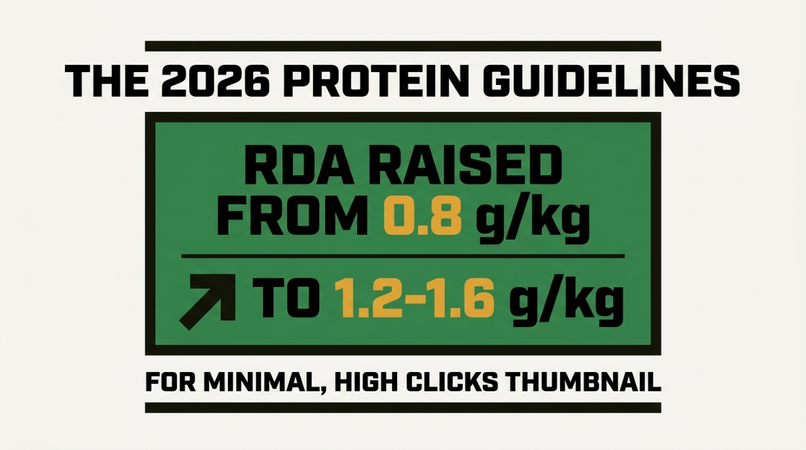
The short version: in January 2026 the USDA and HHS released the 2025-2030 Dietary Guidelines for Americans, which raised the recommended protein intake from 0.8 g per kg of bodyweight to a range of 1.2 to 1.6 g per kg. For a 70 kg adult that moves the target from about 56 g to roughly 84-112 g per day.
Work out your own target under the new guidelinesFree calculator →Get your own number with the Full Plan calculator, which applies these ranges to your weight, goal and training load.
What actually changed
The 0.8 g/kg figure had stood for over 70 years. It was calculated to prevent deficiency across a population, not to support training, muscle retention, or healthy aging. The 2026 revision raises the floor and brings official guidance closer to what sports-nutrition researchers have recommended for years.
Why the number still is not your number
The new range is a general-population guideline. Three groups have well-documented reasons to sit above it:
- People in a calorie deficit. Research supports 1.6 to 2.2 g/kg for preserving muscle while losing fat. See the cutting guide.
- People doing body recomposition. Around 2.0 to 2.2 g/kg. Recomp calculator.
- Older adults. After roughly age 60, muscle responds less strongly to the same dose of protein, so needs rise rather than fall.
The honest counterpoint
More is not automatically better. Population survey data suggests many adults already eat inside the new range: men in the US average roughly 90 to 100 g per day and women 65 to 75 g. For a sedentary adult, moving from 0.8 to 1.6 g/kg may change very little. And a 2026 University of Wisconsin review argues that very high intakes, particularly from red meat and dairy, carry trade-offs worth weighing. Protein is a lever, not a magic input, and it only converts into muscle when resistance training gives the body a reason to keep it.
What to do with this
- Sedentary and healthy: the new 1.2-1.6 g/kg range is a reasonable target.
- Training, cutting, recomping, or over 60: use the higher research ranges, not the population floor.
- Check what you actually eat before buying anything. Most people are closer than they assume, and the gap is usually 40 to 60 g, not 100.
- If there is a gap, whey is normally the cheapest way to close it: cost per 20 g ranking.
FAQ
Is the RDA now 1.2 g/kg?
The 2025-2030 guidelines give a range of 1.2 to 1.6 g/kg for healthy adults, replacing the single 0.8 g/kg figure.
Does this mean I was under-eating protein?
Not necessarily. National intake data suggests average consumption already sits inside the new range for many adults.
Should athletes follow the new range?
Treat it as a floor. Sports-nutrition guidance for trained people in a deficit still runs to 2.2 g/kg.
General information, not medical advice. Guidelines change; check current official sources for the latest.
GramGoal Team. We build nutrition calculators and price-check the supplement market monthly. General information, not medical advice. See our methodology and affiliate disclosure.