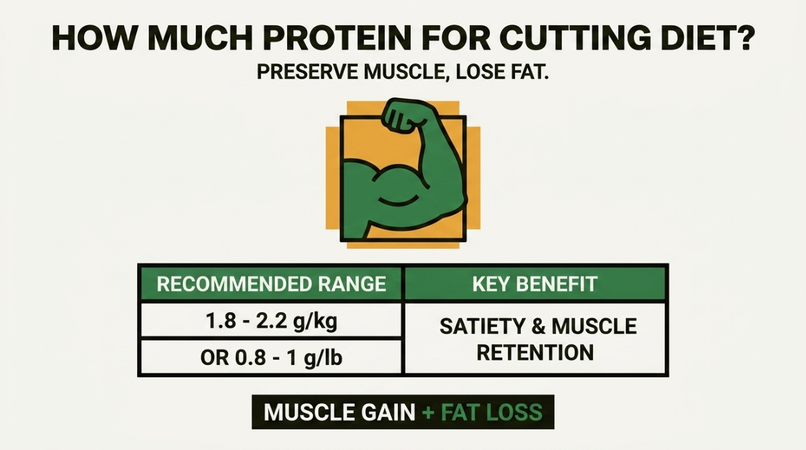
In a calorie deficit, most sports-nutrition guidance lands between 1.6 and 2.2 g of protein per kg of bodyweight per day, noticeably higher than the general-health minimum. The leaner you already are and the bigger your deficit, the closer to the top of that range you should sit.
Set a deficit that protects muscleFree calculator →Skip the math and get your exact number in 60 seconds with the Full Plan calculator.
Why cutting raises your protein needs
In a deficit your body looks for energy everywhere, including muscle tissue. Higher protein intake supports muscle-protein synthesis while training supplies the signal to keep what you have built. Protein is also the most filling macronutrient per calorie, which makes the deficit easier to hold.
- Deficit size matters. Aggressive cuts need the top of the range.
- Training matters more. Protein protects muscle; lifting tells your body the muscle is worth protecting.
- Spread it out. Three to five feedings of 25 to 40 g each beat one giant dinner.
Worked example: 80 kg, training three times a week
Target range: 80 x 1.6 to 80 x 2.0 gives 128 to 160 g per day, midpoint about 145 g. Across four meals that is about 36 g per meal. If your normal food covers about 90 g, you are short roughly 55 g, which is about two whey scoops.
Hitting the number on a small budget
Whole food first: eggs, canned tuna, lentils, chicken, and skyr are the usual value picks. Where food falls short, whey is almost always the cheapest supplement per gram of protein.
FAQ
Can I eat too much protein while cutting?
Within studied ranges it is considered safe for healthy people. Going far above 2.2 g/kg mostly wastes budget.
Does protein timing matter?
Total daily intake matters most. Spreading it across three to five feedings appears slightly better for muscle retention.
Whey concentrate or isolate?
Concentrate is usually cheaper per gram; isolate has less lactose and sits lighter. If concentrate agrees with your stomach, buy by price.
General information, not medical advice. See our methodology and affiliate disclosure.
GramGoal Team. We build nutrition calculators and price-check the supplement market monthly. General information, not medical advice. See our methodology and affiliate disclosure.