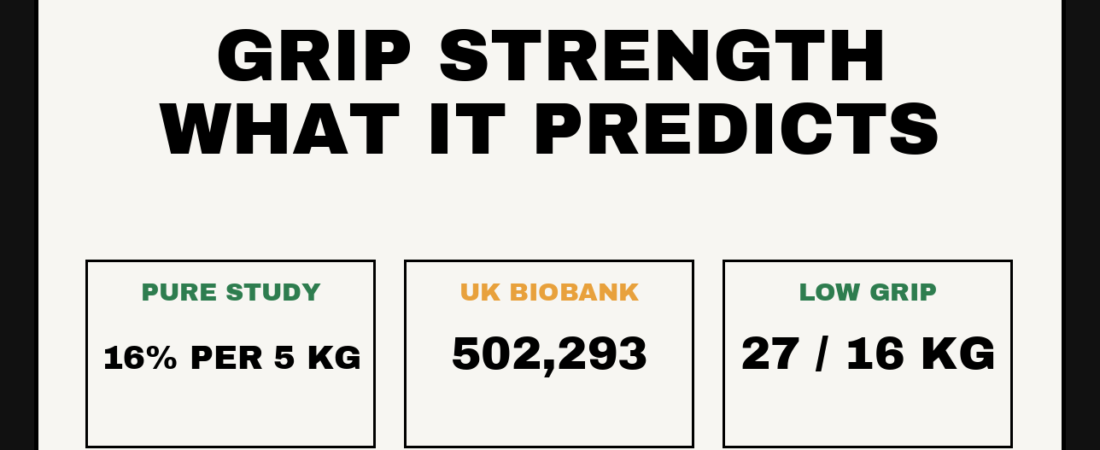
Short answer: grip strength is one of the best-validated cheap predictors of early death we have. In 139,691 adults across 17 countries, every 5 kg of extra grip strength tracked a 16 per cent lower risk of dying from any cause, and grip predicted mortality better than systolic blood pressure did. What it is not is a lever. Grip is a readout of whole-body strength and general health, so squeezing a hand gripper does not buy you the years.
The thing that actually moves the number is the same thing that moves everything else: loaded training and enough protein. Set the second with the protein calculator and benchmark the first with the strength standards calculator.
What the big cohorts found
Two studies carry most of the weight, and they agree closely despite very different populations.
The PURE study followed 139,691 adults aged 35 to 70 across 17 countries for a median of four years. Per 5 kg lower grip strength:
| Outcome | Increase in risk per 5 kg lower grip |
|---|---|
| Death from any cause | 16% |
| Cardiovascular death | 17% |
| Non-cardiovascular death | 17% |
| Stroke | 9% |
| Heart attack | 7% |
UK Biobank then measured 502,293 people and followed them for a mean of 7.1 years. Same direction, similar size, and now split by sex.
| Outcome | Women, HR per 5 kg lower | Men, HR per 5 kg lower |
|---|---|---|
| All-cause mortality | 1.20 (1.17–1.23) | 1.16 (1.15–1.17) |
| Cardiovascular death | 1.19 (1.13–1.25) | 1.22 (1.18–1.26) |
| Respiratory death | 1.31 (1.22–1.40) | 1.24 (1.20–1.28) |
| Cancer death | 1.17 (1.13–1.21) | 1.10 (1.07–1.13) |
These compound. A man 15 kg below a comparison point is three 5 kg steps down, which at a hazard ratio of 1.16 works out to roughly 56 per cent higher all-cause risk, not 48 per cent.
A dose-response meta-analysis of 48 studies and 3,135,473 participants then mapped where on the scale the benefit sits. For all-cause mortality the relationship was close to linear between about 26 and 50 kg. For cardiovascular death it ran from about 24 to 40 kg. For cancer death it was U-shaped, with the significant reduction between about 16 and 33 kg.
What counts as low
There is no single agreed normal, which matters more than most charts admit. The two cut-offs in wide clinical use disagree with each other on the same construct.
| Reference | Low grip, men | Low grip, women |
|---|---|---|
| EWGSOP2 sarcopenia criteria | Under 27 kg | Under 16 kg |
| German National Cohort, 200,389 adults | Under 29 kg | Under 18 kg |
For context rather than as a target, the same German cohort found grip peaked at a mean of 52.1 kg at age 38 in men and 32.5 kg at age 39 in women, then declined. Those are population means from one country on one protocol, so treat them as a rough scale, not a standard to hit.
Where the evidence is thin
- It is all observational. Nobody has randomised people to stronger grips and counted deaths. Grip strength is associated with living longer; it has not been shown to cause it.
- Reverse causation is a real problem. Undiagnosed illness weakens people before it kills them. PURE’s median follow-up was four years, which is short enough that some of the effect is disease that was already present at measurement.
- Grip is a proxy, and a crude one. It stands in for total muscle mass, nutritional status, nerve function and general vitality all at once. That is exactly why it predicts well, and exactly why improving the proxy in isolation is unlikely to move the thing it proxies for.
- Protocols are not interchangeable. Dynamometer model, elbow angle, whether you take the best of three or the mean, dominant hand or both: all change the number. That is why two large datasets land on different cut-offs. A reading from a cheap spring gripper is not comparable to a Jamar reading at all.
How to actually raise it
Because grip tracks whole-body strength, whole-body training is the route. Heavy pulling does most of the work: deadlifts, rows, pull-ups, farmer’s carries and anything held rather than strapped. Dropping the lifting straps on your working sets is the single cheapest change most lifters can make.
The supporting inputs are the familiar ones. Enough weekly hard sets, which is 10 to 20 per muscle for most people, and protein around 1.6 g per kg of bodyweight. Grip declines with age alongside everything else, so for older adults and through menopause the training matters more, not less. How muscle growth actually works covers the mechanism.
FAQ
What is a good grip strength?
There is no universal good. Clinically, under 27 kg for men and under 16 kg for women is the EWGSOP2 threshold for low strength. Above that, higher is associated with lower mortality up to roughly 50 kg, after which the curve flattens.
What is a normal grip strength in kg?
In a 200,389-adult German cohort the peak mean was 52.1 kg for men in their late thirties and 32.5 kg for women. Your own number depends heavily on the device and protocol used, so compare a reading only against another reading taken the same way.
Does grip strength predict how long you live?
It predicts mortality risk in very large cohorts, better than systolic blood pressure did in PURE. Predicting is not causing, and no trial has tested whether raising grip extends life.
How do I improve grip strength?
Train heavy pulls without straps, add loaded carries, and progress them like any other lift. Direct gripper work will raise your gripper score faster than it raises anything that matters.
Does grip strength decline with age?
Yes, from the late thirties onward in population data. Resistance training slows that decline, which is the main practical reason to care about the measurement at all.
Sources
- Leong DP, Teo KK, Rangarajan S, et al. Prognostic value of grip strength: findings from the Prospective Urban Rural Epidemiology (PURE) study. The Lancet, 2015;386(9990):266–273.
- Celis-Morales CA, Welsh P, Lyall DM, et al. Associations of grip strength with cardiovascular, respiratory, and cancer outcomes and all cause mortality: prospective cohort study of half a million UK Biobank participants. BMJ, 2018;361:k1651.
- López-Bueno R, Andersen LL, Koyanagi A, et al. Thresholds of handgrip strength for all-cause, cancer, and cardiovascular mortality: a systematic review with dose-response meta-analysis. Ageing Research Reviews, 2022;82:101778.
- Huemer MT, Kluttig A, Fischer B, et al. Grip strength values and cut-off points based on over 200,000 adults of the German National Cohort: a comparison to the EWGSOP2 cut-off points. Age and Ageing, 2023;52(1):afac324.
- Cruz-Jentoft AJ, Bahat G, Bauer J, et al. Sarcopenia: revised European consensus on definition and diagnosis (EWGSOP2). Age and Ageing, 2019;48(1):16–31.
General information, not medical advice.
GramGoal Team. We build nutrition calculators and price-check the supplement market monthly. General information, not medical advice. See our methodology and affiliate disclosure.