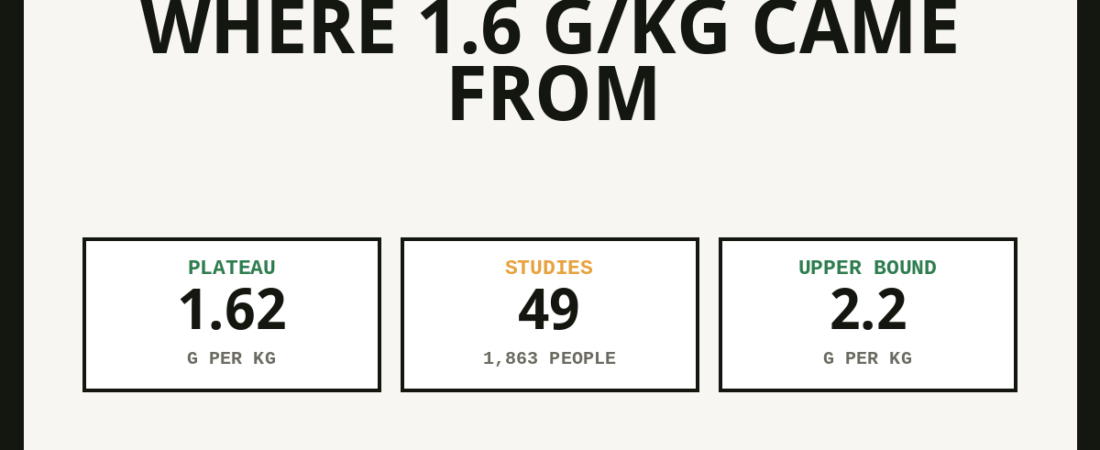
Short answer: Morton and colleagues 2018 meta-analysis in the British Journal of Sports Medicine pooled 49 studies and found that protein supplementation significantly increases muscle mass and strength during resistance training, with benefits plateauing at around 1.62 g per kg of bodyweight per day. That figure is where the widely quoted 1.6 g/kg recommendation comes from.
What the study did
It was a systematic review, meta-analysis and meta-regression of randomised controlled trials in which participants performed resistance training with or without protein supplementation. Forty-nine studies and 1,863 participants were included, making it one of the larger analyses in the field.
The meta-regression is the part that mattered. Rather than simply asking whether protein helps, it modelled the relationship between total daily protein intake and gains, which is how the plateau was identified.
The findings
- Protein supplementation increased fat-free mass by roughly 0.3 kg on average against control across the training periods studied.
- Strength increased, measured as one rep max, by a meaningful margin.
- Benefits plateaued at about 1.62 g per kg daily, with a confidence interval extending to roughly 2.2 g/kg.
- Training status mattered. Trained individuals showed a smaller relative benefit than untrained.
- Age mattered. Older adults showed attenuated responses, consistent with anabolic resistance.
- Timing did not emerge as a significant factor once total intake was accounted for.
What the 1.6 figure actually means
This is the most commonly misread part. The plateau does not mean protein above 1.6 g/kg is harmful or wasted for all purposes. It means the meta-regression found no additional muscle-building benefit from higher intakes in these trial conditions.
The upper confidence bound reaching 2.2 g/kg is why practical recommendations often quote a range rather than a single number, and why guidance for people in a calorie deficit sits higher. In a deficit, protein serves an additional purpose: preserving existing muscle rather than only building new tissue. More on protein while cutting.
How it fits with the ISSN range
| Source | Figure | Population |
|---|---|---|
| Old RDA | 0.8 g/kg | Preventing deficiency, general population |
| Dietary Guidelines 2025-2030 | 1.2-1.6 g/kg | General population |
| Morton 2018 plateau | 1.62 g/kg | Resistance training, muscle gain |
| ISSN position stand | 1.4-2.0 g/kg | Exercising individuals |
The convergence is notable. An independently conducted meta-analysis and a society position stand arriving at overlapping ranges is stronger evidence than either alone. What the ISSN stand says.
Limitations worth knowing
Meta-analyses inherit the weaknesses of their inputs. Included studies varied in duration, training protocol, protein source and how intake was measured, much of it by self-report. The 0.3 kg average effect is modest, and it represents the added benefit of supplementation over training alone rather than total possible gain.
It is also worth noting the plateau applies to the population average. Individual responses varied considerably.
FAQ
What did Morton 2018 find?
Protein supplementation increases muscle mass and strength during resistance training, with benefits plateauing around 1.62 g per kg daily.
Is 1.6 g/kg the maximum useful protein?
For muscle building in the trials analysed, roughly. The confidence interval extended to about 2.2 g/kg, and higher intakes serve other purposes such as muscle preservation in a deficit.
How many studies were included?
Forty-nine randomised controlled trials with 1,863 participants.
Did it find protein timing matters?
Timing did not emerge as significant once total daily intake was accounted for.
Sources
- Morton RW, Murphy KT, McKellar SR et al. A systematic review, meta-analysis and meta-regression of the effect of protein supplementation on resistance training-induced gains in muscle mass and strength in healthy adults. British Journal of Sports Medicine, 2018.
- Jager R et al. ISSN Position Stand: protein and exercise. JISSN, 2017.
- Helms ER et al. A systematic review of dietary protein during caloric restriction in resistance trained lean athletes. IJSNEM, 2014.
- US Departments of Agriculture and Health and Human Services. Dietary Guidelines for Americans, 2025-2030.
General information, not medical advice.
Part of The Research — studies and position stands explained plainly.
GramGoal Team. We build nutrition calculators and price-check the supplement market monthly. General information, not medical advice. See our methodology and affiliate disclosure.