Short answer: muscle grows in response to mechanical tension applied progressively over time, with enough weekly volume, sets taken reasonably close to failure, and adequate protein and calories to build with. Load matters less than most people think. Sets that end near failure build muscle across a wide range of weights, from about 30 to 85 percent of your one rep max.
Estimate your 1RM and training percentages and set your protein target. For the volume side specifically, see how many sets per week build muscle.
The mechanism
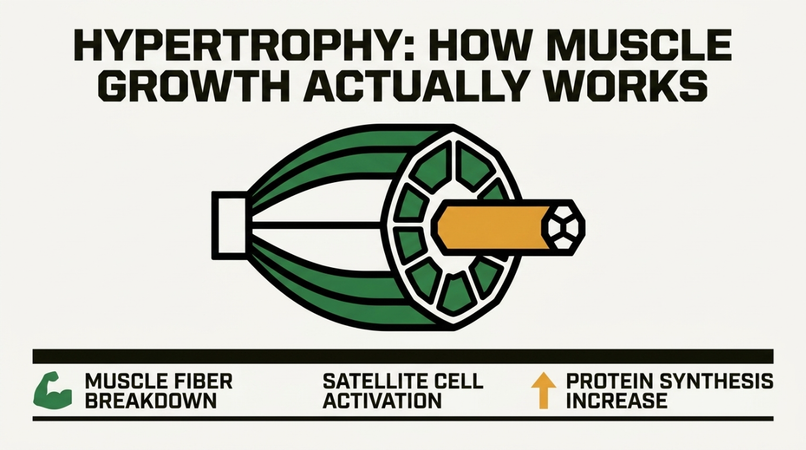
Mechanical tension is the primary driver. When a muscle fibre contracts against meaningful resistance, mechanosensors in the cell trigger signalling pathways, principally mTOR, that increase muscle protein synthesis. Repeated over weeks, with synthesis exceeding breakdown on average, the fibre adds contractile protein and grows.
Two secondary mechanisms are often cited, metabolic stress and muscle damage. Current thinking treats both as largely incidental. Soreness is not a measure of growth, and chasing damage through novel exercises mainly costs recovery capacity.
Volume: the variable with the clearest dose-response
Weekly hard sets per muscle group is the strongest predictor of growth in the literature. Meta-analyses have repeatedly found a dose-response relationship, with returns diminishing rather than disappearing as volume rises.
| Weekly sets per muscle | Typical outcome | Suits |
|---|---|---|
| Fewer than 5 | Maintenance, minimal growth | Time-limited periods, deloads |
| 10 to 12 | Solid growth for most people | Beginners and most intermediates |
| 12 to 20 | Higher growth, higher fatigue cost | Intermediates with recovery capacity |
| Above 20 | Diminishing returns, rising injury and burnout risk | Advanced, short specialisation blocks only |
A hard set means one taken close to failure, not a set performed with weight you could have doubled. Counting warm-up sets and easy work inflates the number without inflating the stimulus.
Load: wider than the folklore suggests
The traditional hypertrophy range of 8 to 12 reps is a reasonable default, but it is not a requirement. Research comparing heavy low-rep training with lighter high-rep training, when sets are taken to or near failure, generally finds similar hypertrophy. Strength gains favour heavier loads; muscle size does not discriminate as much.
- 5 to 10 reps: efficient, builds strength alongside size, joint-demanding.
- 10 to 20 reps: equally effective for size, easier on joints, more uncomfortable.
- Above 30 reps: effectiveness falls off, and sets become limited by discomfort rather than muscular capacity.
The practical implication is freedom. If your knees dislike heavy squats, higher-rep leg work builds the same muscle.
Proximity to failure
This is the variable that makes load flexible. A set stopped five reps short of failure provides much less stimulus than one stopped one or two reps short. Reps in reserve, or RIR, is the common way to express this: 2 RIR means you could have done two more.
Most evidence suggests training within roughly 0 to 3 reps of failure captures nearly all the available stimulus, with 1 to 3 RIR being a sensible working range. Repeatedly going to absolute failure on compound lifts raises fatigue substantially without proportionate benefit.
Frequency
When weekly volume is matched, frequency matters less than people assume. Splitting volume across two sessions per muscle per week tends to edge out a single session, mainly because it allows better quality work and spreads fatigue. Beyond twice weekly, matched-volume comparisons show little additional benefit.
Muscle protein synthesis stays elevated for roughly 24 to 48 hours after a session, which provides the physiological rationale for training each muscle about every three to four days.
Progressive overload
The single most neglected principle. Muscle adapts to a stimulus and then stops adapting to that same stimulus. Progression can come from several routes:
- More weight at the same reps
- More reps at the same weight
- More sets, up to the point of diminishing returns
- Better technique and range of motion at the same load
- Shorter rest, though this trades against performance on later sets
Recording your sessions is what makes this possible. Without a log, most people repeat similar workouts for months and conclude that their genetics are the problem.
The nutrition side
- Protein: 1.6 to 2.2 g per kg daily, split into servings of 25 to 40 g. Per-meal dose.
- Calories: a small surplus of around 10 percent supports growth without excessive fat gain. Beginners and those returning after a break can grow at maintenance. Recomp calculator.
- Creatine: the best-evidenced supplement for training output, at 3 to 5 g daily. Dosing.
- Sleep: short sleep reduces the muscle you keep and the quality of the work you can do.
Realistic rates
Worth setting expectations honestly. Untrained beginners can gain roughly 1 to 1.5 percent of bodyweight in muscle per month in the first year under good conditions. That rate roughly halves in the second year and continues falling. Advanced trainees may add a couple of kilograms of muscle in a year of dedicated work.
Any programme promising far more than that is describing water, glycogen, fat, or a photograph taken in better lighting.
FAQ
How many sets per week to build muscle?
Roughly 10 to 20 hard sets per muscle group weekly suits most people, with dose-response evidence supporting the higher end for those who can recover from it.
Do I need to lift heavy to grow?
No. Sets taken close to failure build similar muscle across roughly 30 to 85 percent of 1RM. Heavier loads favour strength specifically.
Is soreness a sign of muscle growth?
No. Soreness reflects unfamiliar work and damage, neither of which is a reliable indicator of hypertrophy.
How often should I train each muscle?
About twice weekly is a practical default when weekly volume is matched, aligning with the roughly 24 to 48 hour elevation in muscle protein synthesis.
Sources
- Schoenfeld BJ, Ogborn D, Krieger JW. Dose-response relationship between weekly resistance training volume and increases in muscle mass. Journal of Sports Sciences, 2017.
- Schoenfeld BJ et al. Effects of resistance training frequency on measures of muscle hypertrophy: a systematic review and meta-analysis. Sports Medicine, 2016.
- Morton RW et al. Neither load nor systemic hormones determine resistance training-mediated hypertrophy or strength gains in resistance-trained young men. Journal of Applied Physiology, 2016.
- Refalo MC et al. Influence of resistance training proximity-to-failure on skeletal muscle hypertrophy: a systematic review with meta-analysis. Sports Medicine, 2023.
- Jager R et al. ISSN Position Stand: protein and exercise. JISSN, 2017.
- Damas F et al. A review of resistance training-induced changes in skeletal muscle protein synthesis and their contribution to hypertrophy. Sports Medicine, 2015.
General information, not medical advice. Seek guidance from a qualified coach or clinician if you have injuries or medical conditions affecting training.
GramGoal Team. We build nutrition calculators and price-check the supplement market monthly. General information, not medical advice. See our methodology and affiliate disclosure.