Short answer: roughly 10 to 20 hard sets per muscle per week captures most of the growth available to most lifters. Under about 5 sets you are leaving gains on the table. Past 20 the curve flattens sharply. The largest analysis to date never found a volume at which growth stopped improving, but the return per extra set gets small enough that recovery and time become the real constraints rather than the muscle.
Volume only pays if the other inputs are in place. Set your protein target with the protein calculator, and see how muscle growth actually works for the mechanism underneath.
What counts as a set
Every number below means a hard set: a working set taken to within roughly one to three reps of failure. Warm-ups do not count. Neither does a set you stopped five reps early. This matters more than the number itself, because two people reporting 15 weekly sets can be doing completely different amounts of work.
Sets are counted per muscle, not per exercise. A bench press set trains chest, front delts and triceps, so it counts toward all three, usually as a full set for chest and a partial one for the others. This is why people who count only direct arm work tend to underestimate their true triceps volume.
The dose-response evidence
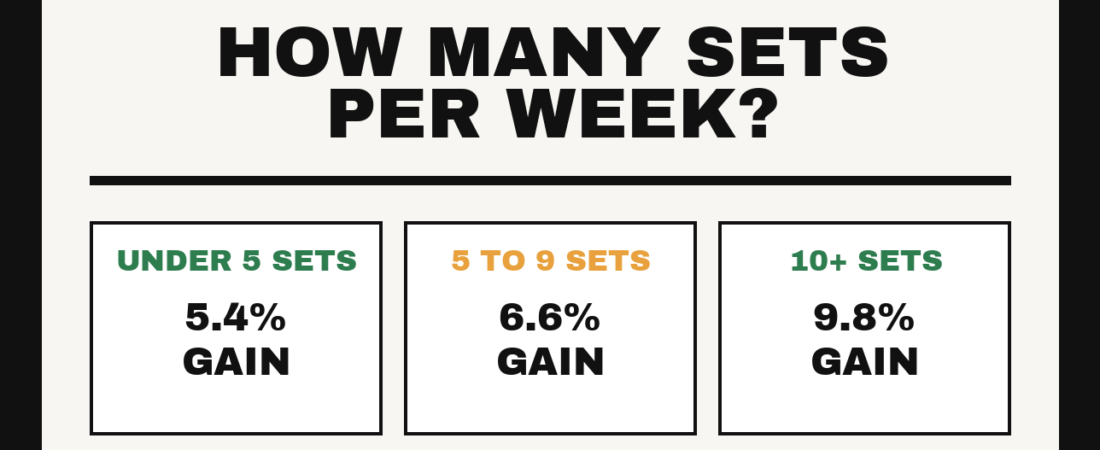
Schoenfeld, Ogborn and Krieger pooled 34 treatment groups from 15 studies and sorted them by weekly sets per muscle.
| Weekly sets per muscle | Effect size | Average muscle gain |
|---|---|---|
| Fewer than 5 | 0.307 | 5.4% |
| 5 to 9 | 0.378 | 6.6% |
| 10 or more | 0.520 | 9.8% |
The gap between the lowest and highest category is 4.4 percentage points of muscle gain, which is a large difference over a training block. Across the whole dataset each additional weekly set was worth about 0.37 percentage points of extra growth.
That per-set figure is a straight-line average, and the straight line is the weak part. It says nothing about where the curve bends, because the top category was open-ended: everything from 10 sets to 30 sat in one bucket.
What the newest analysis adds
Pelland and colleagues modelled the curve directly rather than binning it, pooling 67 studies and 2,058 participants. Two findings are worth carrying away.
- More volume kept helping. The probability that the volume slope was above zero was 100 percent for both hypertrophy and strength. There was no dose at which the model said stop.
- The returns diminish. Each extra set buys less than the one before, and the flattening is far more pronounced for strength than for size.
- Frequency is mostly a strength variable. Spreading the same weekly sets over more sessions had a negligible effect on muscle size, but clearly helped strength.
The practical reading: if size is the goal, hit your weekly set total however it fits your schedule. If strength is the goal, split it across more days.
Practical numbers
A separate review restricted to trained men with at least a year of lifting landed on 12 to 20 weekly sets per muscle as a working recommendation. Combining that with the dose-response work gives reasonable starting points.
| Experience | Sets per muscle per week | Why |
|---|---|---|
| First year | 6 to 10 | Low volumes still produce near-maximal gains early, and recovery capacity is untrained |
| Intermediate | 10 to 16 | The range where most of the pooled evidence sits |
| Advanced or a lagging muscle | 16 to 20+ | Diminishing, but still positive, returns |
| Maintaining through a busy stretch | Roughly a third of usual | Holding size costs far less than building it |
Add volume in steps of two to four sets per muscle and hold the new total for several weeks before judging it. Jumping from 10 to 20 in a week produces soreness and missed sessions, not growth. Soreness is not a progress signal in either direction.
Where the evidence is thin
- Almost all of it is short. Most included trials ran 8 to 12 weeks. Whether a 20-set week is sustainable for a year is untested.
- Mostly young men. The 2,058 participants were 79.1 percent male, average age around 25. Extrapolating to older or female lifters is an assumption, not a finding.
- Set definitions vary between studies, which is the single biggest source of noise in this literature.
- No upper bound has been established. That the model finds no plateau is a statement about the data range studied, not a licence to do 40 sets.
Training volume also sits downstream of everything else. Protein at around 1.6 g/kg and adequate sleep move the needle more than the difference between 14 and 18 weekly sets. Track strength over time with the one rep max calculator or the strength standards calculator.
FAQ
How many sets per week per muscle group for hypertrophy?
Ten to twenty hard sets covers most of the available gain. Twelve to twenty is the range a review of trained lifters settled on.
How many sets per week to maintain muscle?
Considerably fewer than it took to build it. Reduced-dose training has been shown to retain resistance training adaptations, so a third of your usual volume is a sensible target through a busy period, provided intensity stays high.
How many sets per week for chest or biceps?
The same range applies, but count indirect work. Pressing already loads the triceps and front delts, and rows already load the biceps, so direct arm sets are additions to that total, not the whole of it.
Is more volume always better?
On paper the slope stays positive. In practice each set costs recovery, and the studies behind that slope were short. Adding volume you cannot recover from reliably makes things worse.
Does splitting sets over more days build more muscle?
For size, the evidence says frequency barely matters once weekly sets are equal. For strength, more frequent sessions did help.
Sources
- Schoenfeld BJ, Ogborn D, Krieger JW. Dose-response relationship between weekly resistance training volume and increases in muscle mass: a systematic review and meta-analysis. Journal of Sports Sciences, 2017;35(11):1073–1082.
- Pelland JC, Remmert JF, Robinson ZP, Hinson SR, Zourdos MC. The resistance training dose response: meta-regressions exploring the effects of weekly volume and frequency on muscle hypertrophy and strength gains. Sports Medicine, 2026;56(2):481–505.
- Baz-Valle E, Balsalobre-Fernández C, Alix-Fages C, Santos-Concejero J. A systematic review of the effects of different resistance training volumes on muscle hypertrophy. Journal of Human Kinetics, 2022;81:199–210.
- Bickel CS, Cross JM, Bamman MM. Exercise dosing to retain resistance training adaptations in young and older adults. Medicine and Science in Sports and Exercise, 2011;43(7):1177–1187.
General information, not medical advice.
GramGoal Team. We build nutrition calculators and price-check the supplement market monthly. General information, not medical advice. See our methodology and affiliate disclosure.