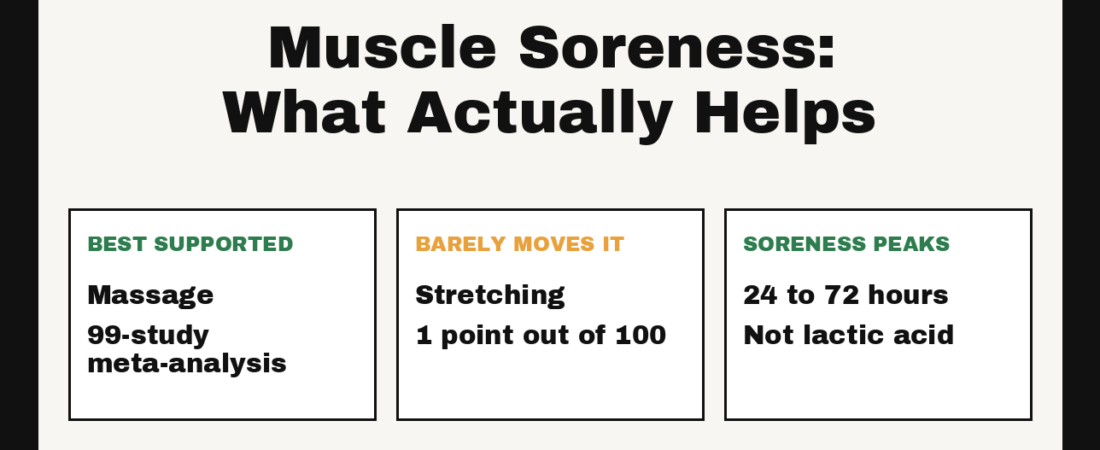
Short answer: massage has the strongest evidence of anything tested, and the effect is moderate rather than dramatic. Stretching moves soreness by about one point on a 100-point scale, which is nothing. Cold water immersion helps modestly. Nothing abolishes delayed onset muscle soreness, and the single most reliable fix is that the same workout hurts far less the second time you do it.
What DOMS actually is
Delayed onset muscle soreness is the stiffness and tenderness that shows up roughly a day after unfamiliar work, peaks somewhere between 24 and 72 hours, and fades over the following few days. Cheung, Hume and Maxwell’s review in Sports Medicine remains the standard description of that timeline.
It is not lactic acid. Lactate clears from blood within about an hour of stopping, long before the soreness starts, so it cannot be the cause of something that peaks two days later. DOMS follows mechanical strain, particularly from eccentric contractions, the lowering half of a rep, and the resulting inflammatory and sensitisation response in the muscle and its connective tissue.
It is also not a scoreboard. Soreness tracks novelty, not stimulus quality. A session that leaves you wrecked is usually just a session you have not done before, which is why progress in the gym tends to come with less soreness over time, not more.
What the recovery research ranks
The broadest comparison is Dupuy and colleagues in Frontiers in Physiology, which pooled 99 studies across the recovery methods people actually use. Active recovery, massage, compression garments, water immersion, contrast therapy and cryotherapy all produced small to large reductions in soreness. Their conclusion was direct: massage seems to be the most effective method for reducing DOMS and perceived fatigue, and massage and cold exposure were the strongest for reducing inflammatory markers.
A dedicated massage meta-analysis by Guo and colleagues put numbers on it: 11 articles, 504 participants. Soreness ratings fell significantly at 24 hours (standardised mean difference -0.61), and the effect was largest at 48 hours (-1.51), with an overall pooled effect of -1.16. Creatine kinase, a marker of muscle damage, also fell.
| Method | Evidence base | Effect on soreness | Verdict |
|---|---|---|---|
| Massage | 11 trials, 504 people | SMD -1.16 overall, -1.51 at 48 h | Best supported |
| Cold water immersion | 44 randomised trials | Better than control at most timepoints | Modest, reliable |
| Active recovery, compression | Part of a 99-study pool | Small to moderate reductions | Worth doing, not magic |
| Stretching | 12 trials, one with 2,377 people | About 1 point on a 100-point scale | Effectively nothing |
Cold water: helpful, with a caveat
Batista and colleagues updated the cold water immersion evidence in the Clinical Journal of Sport Medicine, pooling 44 randomised controlled trials. Immersion beat control for both immediate and delayed soreness, and, usefully, water temperature and protocol did not change the result much. The one subgroup that did not benefit for delayed effects was the longest immersion times, so sitting in cold water for longer is not buying you more.
The caveat is that cold exposure blunts the inflammatory signalling that also drives adaptation. If your goal for the week is to feel good, cold water is a reasonable tool. If your goal is to grow, using it routinely straight after lifting is a trade rather than a free win.
Stretching does not work for this
The Cochrane review by Herbert, de Noronha and Kamper is unusually clear. Across 12 studies, converted to a common 100-point soreness scale, stretching before exercise reduced next-day soreness by an average of half a point (mean difference -0.52, 95 percent CI -11.30 to 10.26). Stretching afterwards reduced it by about one point (-1.04, 95 percent CI -6.88 to 4.79). The largest trial, with 2,377 participants, found stretching before and after reduced peak soreness across a week by around four points.
Half a point out of a hundred is not a treatment. Stretch because you want the mobility, not because you expect it to stop the ache.
The thing that actually works
The repeated bout effect. Do the same unfamiliar workout a second time within a few weeks and the damage, soreness and strength loss are all markedly reduced. Hyldahl, Chen and Nosaka’s review in Exercise and Sport Sciences Reviews covers the mechanisms, which involve adaptations in the nervous system, the connective tissue and the muscle cell itself. No intervention in the recovery literature comes close to it.
The practical version: introduce new exercises at a fraction of the volume you eventually want, then build. The first session buys you protection for every session after it.
Where the evidence is thin
Almost all of this research measures soreness on subjective scales in small groups doing deliberately damaging lab protocols, which is not the same as your Tuesday. Blinding is close to impossible for massage or cold water, so expectation effects are baked in. And the reviews consistently report high heterogeneity, meaning the studies disagree with each other more than you would like. Treat the ranking above as a rough ordering, not a dose chart.
FAQ
What helps muscle soreness after working out?
Massage has the best evidence, followed by light active recovery, compression and cold water immersion. All of them are modest. Keeping moving beats lying still.
What causes muscle soreness?
Mechanical strain from unfamiliar work, especially eccentric contractions, followed by an inflammatory and sensitisation response over the next day or two. Not lactic acid, which has cleared long before the soreness arrives.
How long does delayed onset muscle soreness last?
It usually appears within a day, peaks between 24 and 72 hours, and settles over the following two to three days. Soreness that is sharp, one-sided, or still worsening after three days is worth getting looked at rather than waiting out.
Is muscle soreness good?
It is neither good nor bad. It signals novelty, not effectiveness, and it fades as you repeat a movement even while you keep getting stronger. Judging a programme by how sore it makes you will steer you towards constant variety, which is the opposite of what drives progress.
Should you train when sore?
Light activity generally reduces soreness rather than worsening it. Training the same muscle hard again while it is still markedly weak is the case for waiting, and muscle protein synthesis stays elevated for a day or more anyway, so there is no rush.
If you are dialling in recovery more broadly, sleep and hitting your protein target do more for how you feel between sessions than any of the interventions above.
Sources
- Dupuy O, Douzi W, Theurot D, Bosquet L, Dugue B. An evidence-based approach for choosing post-exercise recovery techniques to reduce markers of muscle damage, soreness, fatigue, and inflammation: a systematic review with meta-analysis. Frontiers in Physiology. 2018;9:403.
- Guo J, Li L, Gong Y, Zhu R, Xu J, Zou J, Chen X. Massage alleviates delayed onset muscle soreness after strenuous exercise: a systematic review and meta-analysis. Frontiers in Physiology. 2017;8:747.
- Batista NP, de Carvalho FA, Machado AF, Micheletti JK, Pastre CM. What parameters influence the effect of cold-water immersion on muscle soreness? An updated systematic review and meta-analysis. Clinical Journal of Sport Medicine. 2023;33(1):13-25.
- Herbert RD, de Noronha M, Kamper SJ. Stretching to prevent or reduce muscle soreness after exercise. Cochrane Database of Systematic Reviews. 2011;(7):CD004577.
- Hyldahl RD, Chen TC, Nosaka K. Mechanisms and mediators of the skeletal muscle repeated bout effect. Exercise and Sport Sciences Reviews. 2017;45(1):24-33.
- Cheung K, Hume P, Maxwell L. Delayed onset muscle soreness: treatment strategies and performance factors. Sports Medicine. 2003;33(2):145-164.
GramGoal Team. We build nutrition calculators and price-check the supplement market monthly. General information, not medical advice. See our methodology and affiliate disclosure.