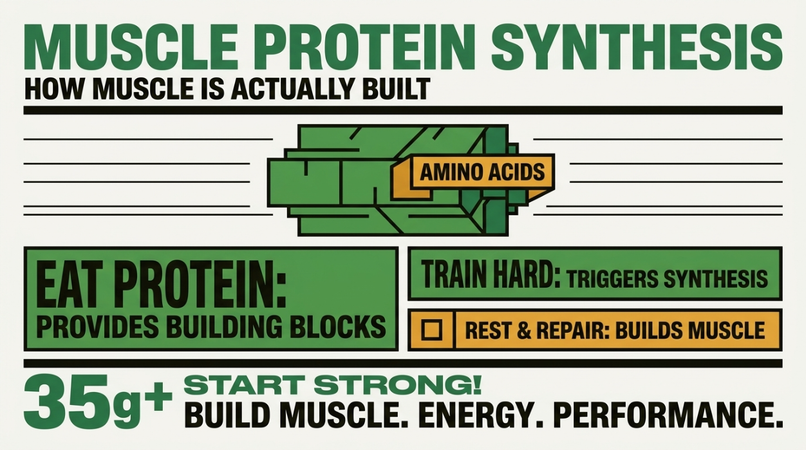
Short answer: muscle protein synthesis is the process your body uses to build and repair muscle tissue. It is triggered mainly by resistance training and by eating enough protein in a single sitting, with leucine acting as the switch. Understanding it explains why total daily protein, per-meal dose and training all matter, and why timing matters much less than people assume.
Calculate the per-meal dose that maximises synthesis for youFree calculator →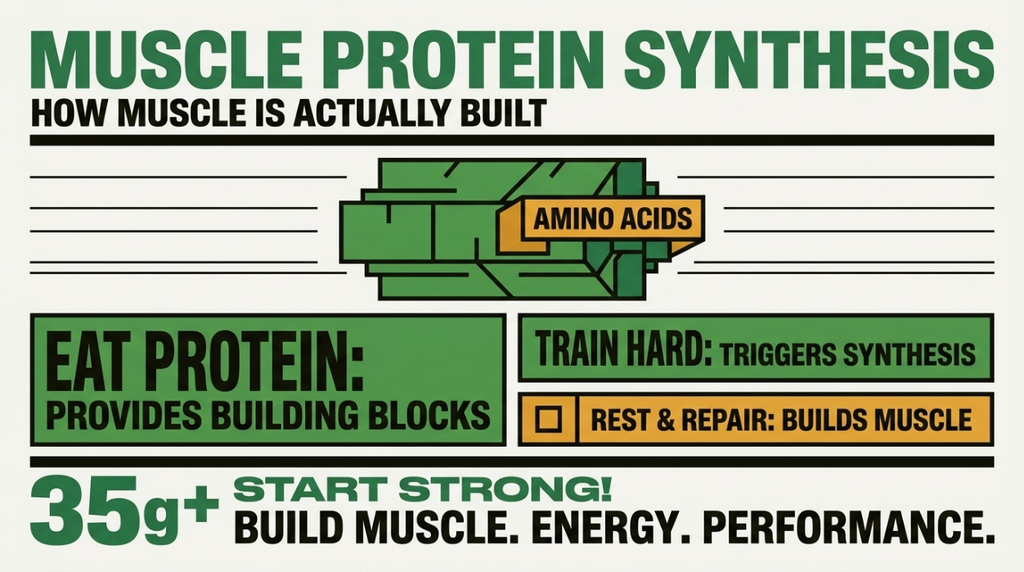
Get your daily target and per-meal split.
The basic mechanism
Muscle tissue is constantly being broken down and rebuilt. Muscle protein synthesis is the building side, muscle protein breakdown is the other. Whether you gain, maintain or lose muscle over months depends on which side dominates on average, a concept usually described as net protein balance.
Two things push the balance toward building: eating protein, which supplies amino acids and stimulates synthesis directly, and resistance training, which raises muscle sensitivity to those amino acids for many hours afterwards. Neither works well alone. Protein without training produces very little muscle; training without adequate protein produces less than it could.
Leucine as the trigger
Of the twenty amino acids, leucine has a distinct signalling role. It activates a cellular pathway known as mTOR, which initiates the synthesis process. Research suggests roughly 2 to 3 g of leucine in a serving is needed to maximally trigger the response, which is why per-meal protein dose matters rather than just daily total.
Leucine content is also why protein sources differ in quality:
- Whey: roughly 10 to 11 percent leucine, the highest common source
- Dairy and eggs: around 8 to 9 percent
- Meat and fish: around 8 percent
- Soy: around 8 percent
- Most other plant proteins: lower, which is why slightly larger servings are advised
- Collagen: very low leucine and no tryptophan, which is why it does not count usefully toward a muscle-building target
How this plays out between whey and plant sources.
The muscle full effect
Synthesis does not scale indefinitely with dose. Beyond roughly 0.25 g per kg of bodyweight in a single meal, or about 20 to 40 g of complete protein for most people, the additional protein does not produce a proportionally larger synthesis response. The extra amino acids are still used for other purposes, but the muscle-building signal is already near maximal.
This is the reason for spreading protein across the day rather than eating it all at dinner. Three feedings of 30 g stimulate synthesis three times; 90 g at once stimulates it once.
How long the response lasts
After a protein feeding, synthesis rises within about thirty minutes, peaks around one to two hours, and returns toward baseline within three to five hours even if amino acids remain elevated. That refractory pattern is why meals every three to four hours are commonly recommended.
Resistance training extends the window considerably. Muscle remains more sensitive to protein for at least twenty-four hours after a session, and in untrained people longer. This is the actual reason the anabolic window is measured in hours rather than minutes. More on timing.
Anabolic resistance and ageing
As people age, the same dose of protein produces a smaller synthesis response, a phenomenon called anabolic resistance. It contributes to sarcopenia, the gradual loss of muscle mass with age, and it is one reason older adults need more protein per meal rather than less.
Practical consequence: where a 25 year old may maximise the response at 20 to 25 g, someone over 60 may need 35 to 40 g per meal. Resistance training also partially restores sensitivity, which is why it matters more with age, not less.
What suppresses synthesis
- Large calorie deficits. Energy restriction reduces synthesis, which is why protein needs rise while dieting. How to protect muscle in a deficit.
- Inactivity. Even short periods of bed rest or limb immobilisation reduce synthesis sharply.
- Poor sleep. Short sleep is associated with reduced synthesis and a higher proportion of weight lost as lean tissue.
- Alcohol. Substantial intake after training has been shown to blunt the post-exercise synthesis response.
What this means in practice
- Total daily protein first: 1.6 to 2.2 g per kg if you train.
- Per meal: 25 to 40 g of a complete protein, higher end if you are older.
- Frequency: three to five feedings, roughly every three to four hours.
- Train against resistance at least twice weekly. This is the amplifier for everything above.
- Sleep, because recovery is when the building happens.
- Do not count collagen toward the target. Why collagen is a poor muscle protein.
FAQ
How much protein maximises muscle protein synthesis?
Roughly 0.25 g per kg of bodyweight per meal, or about 20 to 40 g of complete protein supplying 2 to 3 g of leucine.
Can you build muscle without a calorie surplus?
Yes, particularly for beginners, returning lifters and people with higher body fat. That is body recomposition. Recomp calculator.
Does eating more protein at once build more muscle?
Not proportionally. Past the maximal stimulating dose, the extra protein is used elsewhere rather than producing a larger synthesis response.
Do BCAAs stimulate muscle protein synthesis?
Leucine triggers the signal, but building tissue requires the full set of essential amino acids. Complete protein outperforms isolated BCAAs.
Sources
- Jäger R et al. ISSN Position Stand: protein and exercise. Journal of the International Society of Sports Nutrition, 2017.
- Morton RW et al. Systematic review, meta-analysis and meta-regression of protein supplementation and resistance training. British Journal of Sports Medicine, 2018.
- Mamerow MM et al. Dietary protein distribution positively influences 24-h muscle protein synthesis in healthy adults. Journal of Nutrition, 2014.
- Moore DR et al. Protein ingestion to stimulate myofibrillar protein synthesis requires greater relative protein intakes in healthy older versus younger men. Journals of Gerontology, 2015.
- Atherton PJ, Smith K. Muscle protein synthesis in response to nutrition and exercise. Journal of Physiology, 2012.
- National Institutes of Health, Office of Dietary Supplements. Dietary Supplements for Exercise and Athletic Performance. ods.od.nih.gov
General information, not medical advice.
Work out the per-meal dose that maximises synthesis for you.
GramGoal Team. We build nutrition calculators and price-check the supplement market monthly. General information, not medical advice. See our methodology and affiliate disclosure.