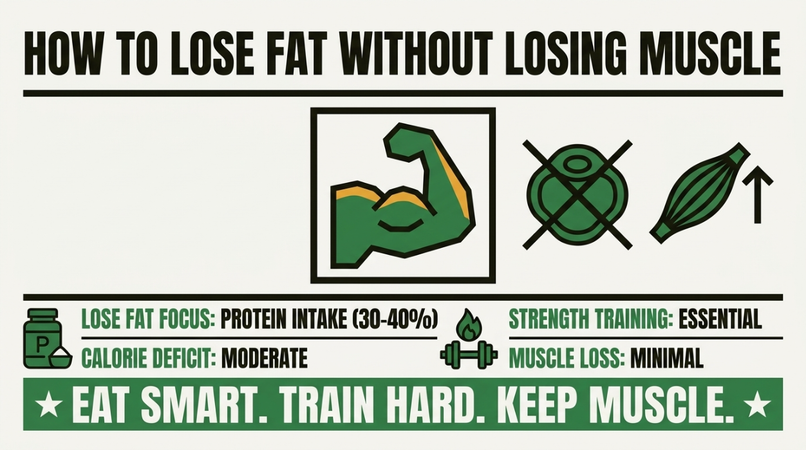
Short answer: a calorie deficit is what causes fat loss, and losing muscle alongside it is what makes people look softer at a lower weight. Three things prevent it: enough protein, resistance training, and a deficit that is not too aggressive. Cardio and supplements are secondary.
Set your deficit and your protein target first.
Why muscle gets lost in a deficit
When energy intake is below expenditure, the body draws on stored energy. It does not exclusively use fat. Without a reason to preserve muscle, some of the deficit is met by breaking down lean tissue, which is metabolically expensive to maintain.
The consequences compound. Less muscle means a lower resting metabolic rate, which means a smaller deficit at the same intake, which slows progress and makes maintenance harder afterwards.
The three levers, in order
- Protein, 1.6 to 2.2 g per kg. The clearest dietary factor. Higher intakes preserve more lean mass in a deficit, and the effect is well replicated.
- Resistance training, at least twice a week. This is the signal. Protein supplies material; training tells the body the muscle is worth keeping. Without it, high protein alone does much less.
- Deficit size. Beyond roughly 1 percent of bodyweight lost per week, a larger share of the loss comes from lean tissue. Slower is genuinely better here.
Secondary factors that still matter
- Sleep. Short sleep measurably shifts the composition of weight lost toward muscle. This is one of the largest non-diet effects.
- Protein distribution. Three to five feedings of 25 to 40 g beats one large meal.
- Diet breaks. A week or two at maintenance after roughly twelve weeks supports adherence and training quality.
- Excessive cardio. Large volumes compete with recovery capacity while calories are already low.
- Creatine. Supports training performance during a deficit, which indirectly helps retention.
How to tell whether it is working
Scale weight cannot distinguish fat from muscle, which is why it is a poor sole measure during a cut. Better signals:
- Strength holding steady. The most practical proxy. If your lifts are maintained on a deficit, you are probably keeping muscle.
- Waist falling faster than bodyweight. Suggests fat loss with lean mass preserved.
- Body fat estimates trending down over four to six weeks. Tape method here.
- Progress photos monthly. More informative than daily weighing.
If strength is falling rapidly, the deficit is likely too aggressive, protein too low, or training volume too high for the calories available.
FAQ
Can you lose fat without losing muscle?
Largely, yes, with adequate protein, resistance training and a moderate deficit. Some lean loss in a large deficit is normal.
How much protein to keep muscle while cutting?
1.6 to 2.2 g per kg of bodyweight daily, at the higher end the leaner you are.
Should I do cardio while cutting?
Some helps with energy expenditure and health. Large volumes alongside a deficit compete with recovery and can accelerate lean loss.
Why is my strength dropping on a diet?
Usually too large a deficit, insufficient protein, poor sleep, or too much training volume for the available calories.
General information, not medical advice.
GramGoal Team. We build nutrition calculators and price-check the supplement market monthly. General information, not medical advice. See our methodology and affiliate disclosure.