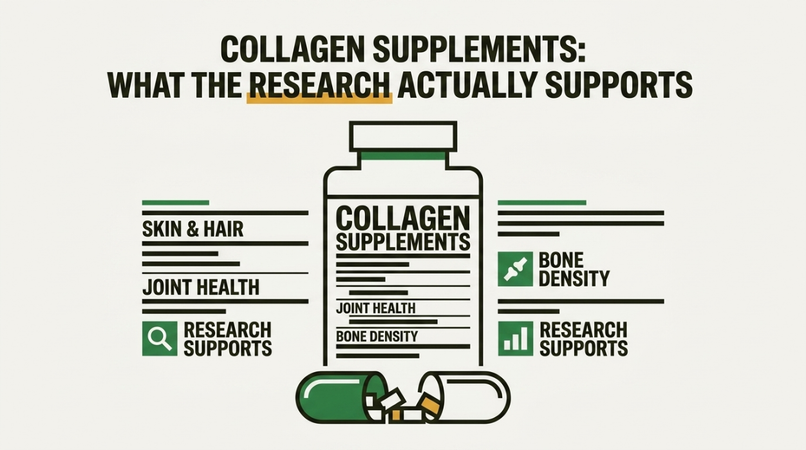
Short answer: collagen supplements have more evidence behind them than most people assume for skin elasticity and joint comfort, and far less than the marketing implies for everything else. The effects reported in trials are real but modest, most studies are short, and a substantial share are funded by collagen manufacturers.
The digestion objection, and why it is not the whole story
The common criticism is that swallowed collagen is broken down into amino acids like any other protein, so it cannot travel intact to your skin. That is basically correct: you do not eat collagen and deposit it where you want it.
The more interesting finding is that hydrolysed collagen produces specific peptides, notably those containing hydroxyproline, that survive digestion in small amounts and appear in the bloodstream. The proposed mechanism is that these peptides act as signals rather than building blocks, prompting cells to increase their own collagen production. That mechanism is plausible and partially supported, but it is not settled science.
What the reviews report
- Skin. Multiple randomised trials and pooled analyses report improvements in skin elasticity and hydration over 8 to 12 weeks at doses around 2.5 to 10 g daily. Effects are modest, and a large share of studies were industry-funded, which is a known source of bias rather than automatic disqualification.
- Joints. Some trials report reduced activity-related joint discomfort in athletes and people with osteoarthritis, typically at 10 g daily over several months. Results are mixed across studies.
- Bone. Early evidence, mainly in postmenopausal women, suggesting possible effects on bone mineral density when combined with other measures. Preliminary.
- Hair and nails. The weakest area despite being heavily marketed. Some nail-growth findings exist; hair evidence is thin.
- Muscle. Collagen is a poor protein for muscle building. It lacks tryptophan and is low in leucine, the amino acid that drives muscle protein synthesis. Do not count collagen toward your protein target.
The protein target mistake
This is the practical error worth avoiding. A 10 g scoop of collagen shows 10 g of protein on the label, and people count it toward their daily total. Because of its amino acid profile, collagen contributes very little to muscle protein synthesis. If your target is 150 g and 20 g of that is collagen, your effective intake for muscle purposes is closer to 130 g.
Set your protein target and fill it with complete proteins. Treat collagen as a separate supplement taken for skin or joints, not as part of the total.
If you decide to take it
- Hydrolysed collagen peptides, since that is what almost all the research used.
- 2.5 to 10 g daily depending on purpose. Skin studies often used lower doses than joint studies.
- Give it 8 to 12 weeks. Trials showing effects generally ran that long. Anything promising results in days is selling something else.
- Type I and III for skin, type II for joints, which is the conventional split, though evidence for the distinction is not overwhelming.
- Vitamin C is required for your own collagen synthesis, so an adequate intake matters more than any bundled formula.
The honest position
Collagen is not a scam, and it is not the anti-ageing intervention it is sold as. If you want to try it for skin elasticity or joint comfort, the evidence supports a reasonable trial at a proper dose for three months. If you are hoping it builds muscle or replaces protein, the amino acid profile says otherwise, and your money does more work as whey or food.
FAQ
Does collagen actually work for skin?
Trials report modest improvements in elasticity and hydration over 8 to 12 weeks. Effects are real but small, and industry funding is common in this literature.
Does collagen count as protein?
Technically yes, practically no for muscle purposes. It lacks tryptophan and is low in leucine, so it does not support muscle protein synthesis well.
How long until collagen shows results?
Studies reporting effects generally ran 8 to 12 weeks at consistent daily doses.
Is marine or bovine collagen better?
Both are used in research. Marine collagen is absorbed somewhat efficiently and costs more; bovine is cheaper and widely studied. Source matters less than dose and consistency.
General information, not medical advice.
GramGoal Team. We build nutrition calculators and price-check the supplement market monthly. General information, not medical advice. See our methodology and affiliate disclosure.