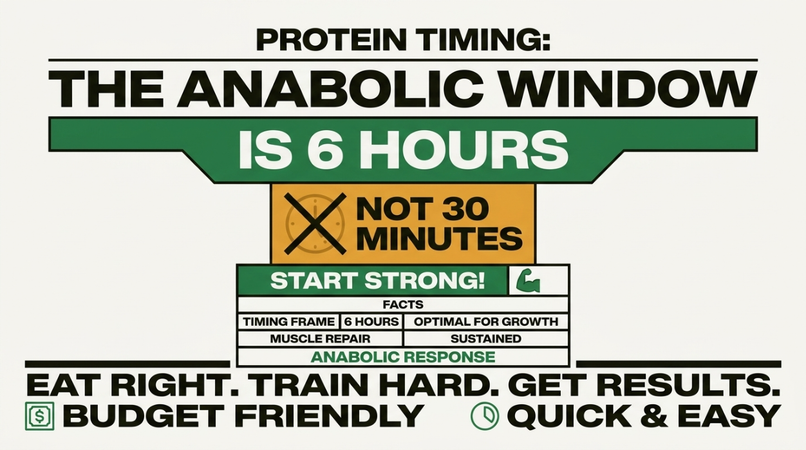
Short answer: the 30-minute anabolic window is a myth. Research puts the nutrient-sensitive period at roughly four to six hours around training, and when total daily protein is held constant, timing effects largely disappear. What does matter is distribution: spreading protein across three to five meals of 25 to 40 g each rather than eating most of it at dinner.
Get your daily target and per-meal split, which is the practical version of everything below.
Where the anabolic window idea came from
The concept took hold in the late 1990s from acute studies showing that amino acid delivery shortly after resistance exercise produced a stronger muscle protein synthesis response than exercise alone. That finding was real. The error was extrapolating from a short-term measurement to a rule that you had thirty minutes to drink a shake or waste the session.
Schoenfeld and colleagues meta-analysed the timing literature and found that once total daily protein intake was controlled for, the apparent timing benefit largely vanished. The ISSN position stand describes a window that remains open for at least four to six hours after training. That is a garage door, not a keyhole.
What actually drives muscle protein synthesis
- Total daily protein. The single most important variable, and it is not close. 1.6 to 2.2 g per kg of bodyweight covers most training goals.
- Per-meal dose. MPS needs roughly 2.5 to 3 g of leucine to be maximally stimulated, which corresponds to about 25 to 40 g of a complete protein.
- Distribution. Mamerow and colleagues found that evenly distributing protein produced meaningfully greater daily MPS than a skewed pattern with most protein at dinner.
- Training itself. Resistance exercise raises muscle sensitivity to protein for many hours. Without it, extra protein does comparatively little.
The distribution problem most people have
A typical Western eating pattern looks like 10 g at breakfast, 20 g at lunch and 60 g at dinner. That totals 90 g, which may be adequate on paper, but it stimulates MPS properly only once a day. The same 90 g split as 30 g, 30 g and 30 g stimulates it three times.
Breakfast is where almost everyone falls short. Cereal, toast or fruit delivers very little protein, which means the longest gap in your day, overnight, is followed by a meal that does not restart synthesis.
Hitting 30 g at breakfast
- 3 eggs plus 100 g cottage cheese: about 29 g
- 170 g Greek yogurt plus 25 g whey in it: about 41 g
- Oats made with milk plus a scoop of whey: about 32 g
- 2 eggs on wholemeal toast plus a glass of milk: about 26 g
The over-30 adjustment
Anabolic resistance is the reduced MPS response to the same protein dose that accompanies ageing. It means older adults need a larger per-meal dose to trigger the same response. Research points to roughly 0.4 g per kg per meal for adults past their thirties, which lands around 30 to 40 g depending on bodyweight, rather than the 20 to 25 g that suffices for younger people.
This matters more than any timing question for anyone over 40, and it is the reason a low-protein breakfast is a bigger problem at 55 than at 25.
So does timing matter at all?
Slightly, in specific cases. If you train fasted first thing in the morning with no food beforehand, getting protein in within an hour or two afterwards makes sense, because you genuinely have no amino acids circulating. If you ate a protein-containing meal two to three hours before training, the post-workout rush is unnecessary; that meal is still being digested.
Pre-sleep protein has some supporting evidence for overnight synthesis, and morning protein appears particularly useful in older adults. Both are refinements worth maybe a few percent, and neither is worth worrying about until the total and the distribution are right.
The practical hierarchy
- Hit your daily protein total. Everything else is a rounding error next to this.
- Split it across three to five meals of 25 to 40 g.
- Fix breakfast first, since that is where most people lose a feeding opportunity.
- Train hard and progressively. Protein without the stimulus does very little.
- Only then think about pre-sleep or peri-workout refinements.
FAQ
Do I need a protein shake right after my workout?
Not if you ate a protein-containing meal within a few hours before training. The window is four to six hours wide.
How much protein per meal for muscle growth?
25 to 40 g of complete protein, enough to supply 2.5 to 3 g of leucine. Older adults should sit at the higher end.
Is it bad to eat most protein at dinner?
It is suboptimal rather than harmful. Even distribution produces more daily MPS from the same total intake.
Does protein before bed help?
There is some evidence for overnight synthesis, particularly with slower-digesting protein such as casein. A small refinement, not a foundation.
General information, not medical advice.
Calculate your per-meal protein dose, adjusted for age.
GramGoal Team. We build nutrition calculators and price-check the supplement market monthly. General information, not medical advice. See our methodology and affiliate disclosure.