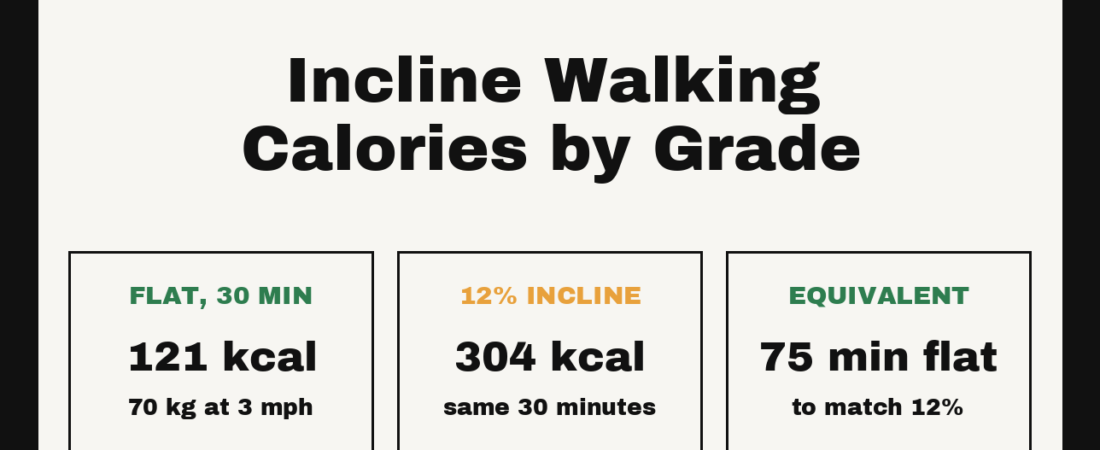
Short answer: at 3 mph for 30 minutes, a 70 kg walker burns roughly 121 calories on the flat and roughly 304 calories at a 12% incline — about two and a half times as much, and the equivalent of walking flat for 75 minutes. Grade, not speed, is doing the work. The numbers below come from the ACSM walking equation, which is well validated for steady treadmill walking at ordinary speeds and gets noticeably less reliable on steep hills.
Run your own numbers with the calories burned calculator, or convert a daily step count with the steps to calories calculator.
Why grade does so much more than speed
Walking on the flat is metabolically cheap. Most of the energy goes into swinging your limbs and absorbing each landing. Almost none of it goes into lifting you, because you finish every step at the height you started it.
Add a gradient and you are lifting your whole bodyweight against gravity, continuously, for the entire session. That is real mechanical work and it has to be paid for. Ludlow and Weyand measured steady-state oxygen uptake in 40 adults across six gradients from −6° to +9°, with and without torso loads, and reported that the energy cost of walking varies more than tenfold depending on speed, surface gradient and load carried.
The equation behind the numbers
The American College of Sports Medicine walking equation estimates oxygen uptake from two things you can read straight off a treadmill console:
VO2 (mL/kg/min) = 3.5 + (0.1 × speed) + (1.8 × speed × grade)
Speed goes in as metres per minute, grade as a decimal, so 12% is 0.12. To turn VO2 into calories, multiply by bodyweight in kilograms, divide by 1,000, then multiply by 5.
The interesting part is the two coefficients. At a 12% grade the vertical term becomes 1.8 × 0.12 = 0.216 × speed, against the horizontal term’s flat 0.1 × speed. The hill is contributing more than twice what the forward motion contributes, before the resting 3.5 is added on top. That is why you can leave the speed alone and still double the cost of the session.
What each grade costs
All rows below: 3.0 mph (80.5 m/min), 30 minutes, 70 kg walker, no handrail support.
| Incline | VO2 | kcal/min | 30 minutes | vs flat |
|---|---|---|---|---|
| 0% | 11.5 | 4.0 | 121 kcal | — |
| 5% | 18.8 | 6.6 | 197 kcal | 1.6× |
| 10% | 26.0 | 9.1 | 273 kcal | 2.3× |
| 12% | 28.9 | 10.1 | 304 kcal | 2.5× |
| 15% | 33.3 | 11.6 | 349 kcal | 2.9× |
A 12% incline is a gradient of about 6.8 degrees. It does not look dramatic on the console, and it multiplies the calorie cost of the same half hour by roughly two and a half.
The same session at different bodyweights
Calorie cost scales directly with the mass you are lifting, so bodyweight matters more on a hill than it does on the flat. Thirty minutes at 3 mph:
| Bodyweight | Flat | 12% incline | Extra |
|---|---|---|---|
| 55 kg (121 lb) | 95 kcal | 239 kcal | +144 kcal |
| 70 kg (154 lb) | 121 kcal | 304 kcal | +183 kcal |
| 85 kg (187 lb) | 147 kcal | 369 kcal | +222 kcal |
| 100 kg (220 lb) | 173 kcal | 434 kcal | +261 kcal |
Where the numbers get shaky
These are estimates from an equation, not measurements of you, and the equation has known boundaries.
- Graded walking is harder to predict than flat walking. Looney and colleagues pooled standing, level and graded walking data from 95 participants across 11 studies, at speeds up to 1.96 m/s and grades from −40% to +45%. Their validated equation carried a standard error of 0.20 W/kg on level walking but 0.42 W/kg once grade was added — roughly double the uncertainty.
- The speed range is narrow. The ACSM walking equation is treated as most accurate between about 50 and 100 m/min, which is 1.9 to 3.7 mph. Above that you drift toward running mechanics and the walking equation stops applying.
- Steep grades need their own maths. Lankford and colleagues had to develop and validate a separate metabolic cost equation for steep incline and decline walking. If the standard equation held everywhere, that work would not have been necessary.
- These are gross calories. They include the roughly 1.2 kcal/min a 70 kg person burns sitting still. Net of resting metabolism, that 304 kcal session is closer to 267 kcal of genuinely extra energy.
- Handrails break the model. The equation assumes you are carrying your own bodyweight. Gripping the rails offloads part of it, and the number on the console no longer describes what you are doing.
Treadmill consoles and wrist trackers apply their own models on top of all this. For how far those can drift, see how accurate fitness tracker calorie counts are. And if you want the other way to make a walk cost more — adding load rather than grade — that is rucking.
FAQ
Does walking on an incline burn more calories?
Yes, and by a large margin. At the same speed and duration, a 12% incline costs a 70 kg walker about 2.5 times what the flat costs: 304 kcal against 121 kcal in half an hour.
How many calories does 30 minutes of incline walking burn?
At 3 mph and 12%, roughly 239 kcal at 55 kg, 304 kcal at 70 kg, 369 kcal at 85 kg and 434 kcal at 100 kg. Drop the incline to 5% and the 70 kg figure falls to about 197 kcal.
Is 12-3-30 actually a good workout?
12% incline, 3 mph, 30 minutes is exactly the row above: around 304 kcal for a 70 kg person, versus 121 kcal for the same half hour on the flat. It is a genuinely efficient way to spend 30 minutes. It is not magic — the effect comes entirely from the gradient, and any incline you can sustain unsupported will do the same job.
How long would I have to walk flat to burn the same?
About 75 minutes. Thirty minutes at 12% and 75 minutes at 0% cost a 70 kg walker roughly the same 304 kcal.
Does incline walking build muscle?
It loads the calves, glutes and hamstrings more than flat walking does, but the load is nowhere near what drives growth in a trained person. Treat it as cardiovascular work that happens to be joint-friendly, and get hypertrophy from resistance training volume.
Sources
- American College of Sports Medicine. ACSM’s Guidelines for Exercise Testing and Prescription — metabolic equation for walking.
- Looney DP, Santee WR, Hansen EO, Bonventre PJ, Chalmers CR, Potter AW. Estimating Energy Expenditure during Level, Uphill, and Downhill Walking. Medicine & Science in Sports & Exercise, 2019;51(9):1954–1960.
- Ludlow LW, Weyand PG. Walking economy is predictably determined by speed, grade, and gravitational load. Journal of Applied Physiology, 2017;123(5):1288–1302.
- Lankford DE, Wu Y, Bartschi JT, Hathaway J, Gidley AD. Development and validation of a steep incline and decline metabolic cost equation for steady-state walking. European Journal of Applied Physiology, 2020;120(9):2095–2104.
General information, not medical advice.
Part of The Research — studies and position stands explained plainly.
GramGoal Team. We build nutrition calculators and price-check the supplement market monthly. General information, not medical advice. See our methodology and affiliate disclosure.