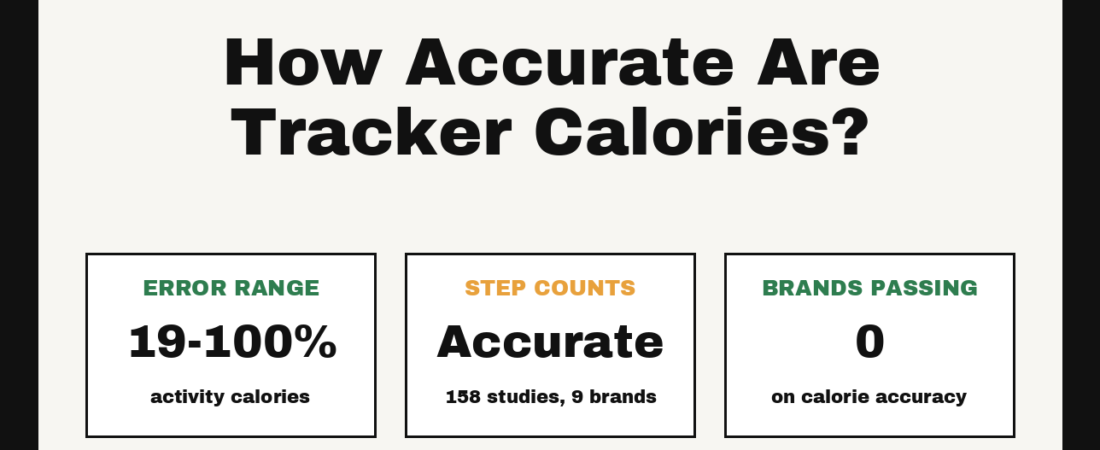
Short answer: the step count is reasonably accurate. The calorie count is not. A systematic review covering 158 studies and nine major brands concluded that no brand measured energy expenditure accurately, and validation work against metabolic chambers and doubly labelled water puts the error on the activity portion anywhere between 19 and 100 percent. Use the number as a consistency signal, never as a measurement.
Estimate your own burn from step count instead: steps to calories calculator.
What the validation studies found
Three lines of evidence converge, and they converge somewhere uncomfortable. Shcherbina and colleagues put seven wrist-worn devices on 60 adults and compared them against indirect calorimetry. Heart rate held up well, with a median error of about 2 percent for the best device. Energy expenditure did not: the median error ran from 27.4 percent for the best performer to 92.6 percent for the worst, and the authors noted plainly that no device achieved an error below 20 percent.
Murakami and colleagues went further and used two reference standards. In a metabolic chamber over a standardised day, with a true activity expenditure of 528.8 kcal, the 12 devices tested produced mean absolute errors of 26.5 to 93.7 percent, and none of them correlated with the criterion value. In 15 days of free living measured by doubly labelled water, against a true figure of 728.0 kcal per day, errors ran from 19.4 to 100.2 percent, and all but two devices significantly underestimated.
| Study | What was tested | Reference method | Error in energy expenditure |
|---|---|---|---|
| Shcherbina 2017 | 7 wrist devices, 60 adults | Indirect calorimetry | 27.4% to 92.6%; none below 20% |
| Murakami 2019 | 12 devices, standardised day | Metabolic chamber | 26.5% to 93.7%; no correlation |
| Murakami 2019 | 12 devices, 15 days | Doubly labelled water | 19.4% to 100.2%; mostly underestimates |
| Fuller 2020 | 9 brands, 158 studies | Various | Steps and heart rate reasonable; no brand accurate |
Note the direction is not consistent. The chamber studies found devices that overestimated; the free-living work found most of them underestimating. That inconsistency is itself the finding. If the error ran one way by a fixed amount you could simply correct for it.
Why steps are accurate and calories are not
A step is a discrete mechanical event. An accelerometer detects a characteristic spike, counts it, and is right most of the time. Fuller’s review found Fitbit, Apple Watch and Samsung all measured steps accurately under controlled conditions.
Energy expenditure is not an event. It is a continuous physiological quantity that no wearable sensor measures directly. The device infers it from accelerometry, heart rate, and the height, weight, age and sex you typed in when you set it up. Every one of those inputs carries error, and the model mapping them onto calories is a population average applied to an individual.
That model breaks down in predictable places. Heart rate tracks effort well during steady cardio and badly at rest, where caffeine, stress and sleep move it independently of energy cost. Accelerometry sees nothing useful during lifting, cycling or carrying load, because the wrist is not moving in proportion to the work. And two people of identical height and weight can differ substantially in lean mass, which is the tissue that actually sets resting expenditure. That is the same problem covered in why every TDEE calculator gives you a different number.
What the error costs you in practice
Take Murakami’s free-living figure of 728 kcal per day of genuine activity expenditure, and apply a middle-of-the-range 30 percent error. That is roughly 218 kcal per day of uncertainty, or about 1,530 kcal across a week. At the usual working figure of 7,700 kcal per kilogram of fat tissue, that is close to 0.2 kg a week, or 0.9 kg a month, of pure measurement noise.
Put the other way: if you set a 500 kcal deficit against a daily total your watch overstated by 218 kcal, your actual deficit is 282 kcal. You would be doing everything right and losing weight at little more than half the rate you planned for.
| If your tracker says | At 20% error | At 30% error | At 50% error |
|---|---|---|---|
| 300 kcal | 240 to 360 | 210 to 390 | 150 to 450 |
| 500 kcal | 400 to 600 | 350 to 650 | 250 to 750 |
| 800 kcal | 640 to 960 | 560 to 1,040 | 400 to 1,200 |
This compounds with the intake side, where the errors are larger still and run in one direction. See why calorie counting is inaccurate for that half of the problem. Overstated burn plus understated intake is the single most common reason a diet stalls while the numbers say it should not.
How to use the number anyway
- Do not eat it back. This is the single highest-value rule. The active calorie readout is the least reliable number your device produces, and treating it as a food allowance converts its error directly into stalled progress.
- Set your target from a formula, not the watch. Start from a TDEE estimate and adjust from measured weight change over two to three weeks.
- Use it for trend, not level. A device that is 30 percent wrong is usually wrong by a similar amount day to day. This week against last week is informative; the absolute figure is not.
- Trust the steps more than the calories. Step count is the one output validated as reasonably accurate, which is why a step-based estimate with a known formula is often more defensible than the device’s own number.
- Never chase a ring. Closing a move goal built on an unvalidated estimate is a motivational tool, not a measurement.
FAQ
How does Garmin calculate calories burned?
The same way every major brand does, in broad outline. A proprietary model combines accelerometer data, optical heart rate and your entered profile, usually layered on a resting rate estimated from a standard equation. The specific coefficients are not published, which is part of why independent validation is the only way to judge them and why the published errors are as wide as they are.
Why does my watch say I burned more calories than the treadmill?
Two different models, both estimates, neither measuring you. The treadmill uses speed, grade and your entered weight through a standard equation; the watch adds heart rate and its own algorithm. Where they disagree, the treadmill’s inputs are at least known quantities, but neither figure deserves to be called a measurement.
Should I eat back the calories my watch says I burned?
No. Given errors of 20 to 100 percent on the activity portion, eating back that figure will on many days erase the deficit entirely. If you want to account for activity, build it into your maintenance estimate up front and adjust from the scale.
Are step counts accurate?
Broadly yes, for mainstream wrist devices under normal walking conditions. Accuracy falls off at very slow speeds, when pushing a trolley or pram, and when the wrist is otherwise occupied, but the error is far smaller than on calories.
Which fitness tracker is most accurate for calories?
No honest answer names a winner. Individual studies find one device performing better than others in their particular sample, but rankings do not replicate across studies, and firmware updates invalidate older testing. Fuller’s review concluded that no brand was accurate for energy expenditure, and that is the safest position to hold.
Sources
- Shcherbina A, Mattsson CM, Waggott D, Salisbury H, Christle JW, Hastie T, Wheeler MT, Ashley EA. Accuracy in wrist-worn, sensor-based measurements of heart rate and energy expenditure in a diverse cohort. Journal of Personalized Medicine. 2017;7(2):3.
- Murakami H, Kawakami R, Nakae S, Yamada Y, Nakata Y, Ohkawara K, Sasai H, Ishikawa-Takata K, Tanaka S, Miyachi M. Accuracy of 12 wearable devices for estimating physical activity energy expenditure using a metabolic chamber and the doubly labeled water method: validation study. JMIR mHealth and uHealth. 2019;7(8):e13938.
- Murakami H, Kawakami R, Nakae S, Nakata Y, Ishikawa-Takata K, Tanaka S, Miyachi M. Accuracy of wearable devices for estimating total energy expenditure: comparison with metabolic chamber and doubly labeled water method. JAMA Internal Medicine. 2016;176(5):702-703.
- Fuller D, Colwell E, Low J, Orychock K, Tobin MA, Simango B, Buote R, Van Heerden D, Luan H, Cullen K, Slade L, Taylor NGA. Reliability and validity of commercially available wearable devices for measuring steps, energy expenditure, and heart rate: systematic review. JMIR mHealth and uHealth. 2020;8(9):e18694.
General information, not medical advice.
GramGoal Team. We build nutrition calculators and price-check the supplement market monthly. General information, not medical advice. See our methodology and affiliate disclosure.