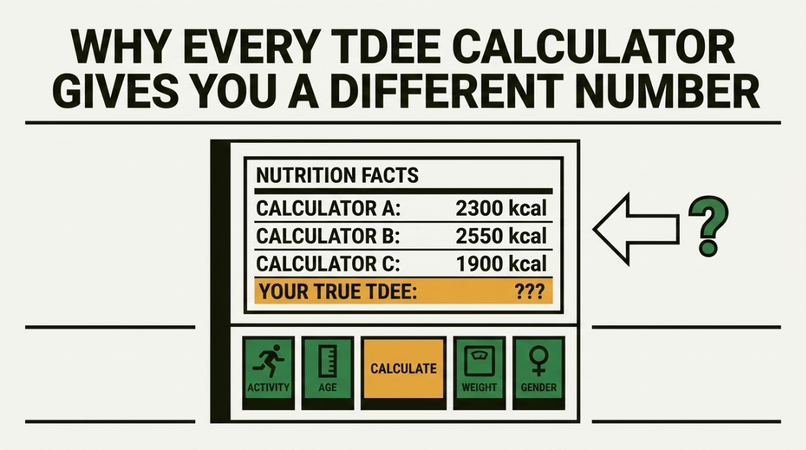
Run your stats through five TDEE calculators and you will get five different numbers, sometimes 300 kcal apart. None of them is broken. They disagree for three predictable reasons, and knowing them tells you how to actually use your number.
Reason 1: different BMR equations
Your basal metabolic rate can be estimated with several published formulas. Mifflin-St Jeor (which our calculator uses) is the one most dietetics bodies favor for the general population. Harris-Benedict is older and tends to run higher. Katch-McArdle uses lean body mass, so it needs a body-fat estimate, which adds its own error. Same person, three equations, three baselines.
Reason 2: activity multipliers are guesses
The multiplier (1.2 for sedentary up to about 1.725 for hard training) is where most of the spread comes from. People routinely overrate their activity level. Two calculators can use the same equation and still disagree because one labels 3 workouts a week as moderate and another calls it very active.
Reason 3: rounding and hidden assumptions
Some tools silently add a thermic effect of food, some round to the nearest 50, some cap or floor results. The output looks precise; the inputs are estimates.
What to do with your number
- Treat any TDEE as a starting estimate with roughly a 10 percent error band.
- Pick one calculator and stay with it, so changes you see are real trends, not tool differences.
- Track weight for two to three weeks. Stable weight means that number is your real maintenance, whatever the calculator said.
Then build on it: chain your TDEE into a calorie and protein plan here, and adjust from real results.
General information, not medical advice.
GramGoal Team. We build nutrition calculators and price-check the supplement market monthly. General information, not medical advice. See our methodology and affiliate disclosure.