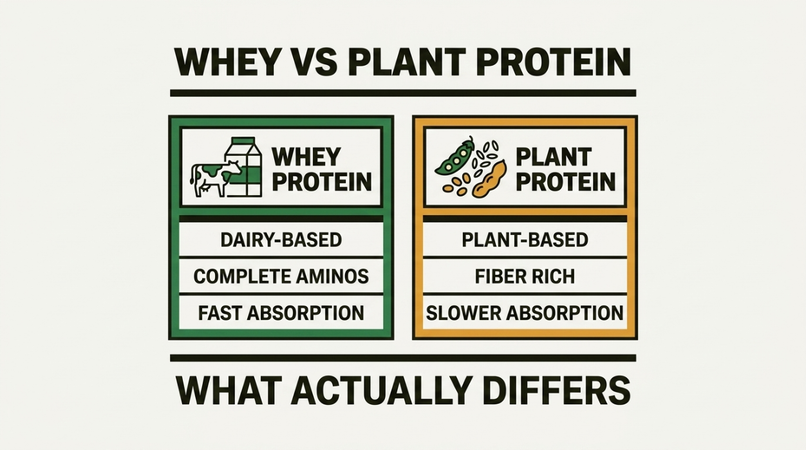
Short answer: whey builds muscle slightly more efficiently per gram because it is higher in leucine and digests quickly. Plant proteins work too, but you generally need a bit more of them, and blends beat single sources. If you eat plant-based, the practical fix is a soy or pea-rice blend and roughly 10 to 20 percent more total protein.
What actually differs
- Leucine content. Muscle protein synthesis is triggered by leucine, and you need roughly 2.5 to 3 g per serving to maximise the response. Whey contains around 10 to 11 percent leucine; most plant proteins sit lower, so the same 25 g scoop delivers less of the trigger.
- Completeness. Whey contains all essential amino acids in useful proportions. Pea protein is low in methionine; rice protein is low in lysine. Combining them covers both, which is why blends exist.
- Digestion speed. Whey absorbs quickly, casein slowly. Plant proteins vary. This matters far less than total daily intake.
- Digestive comfort. Whey concentrate contains lactose and bothers some people; isolate has much less. Pea protein is lactose-free but can cause bloating in others.
- Heavy metals. Plant proteins have generally tested higher, because plants absorb minerals from soil. More on what the testing shows.
Does the difference matter in practice?
Less than the internet suggests. Studies comparing whey and plant protein at matched total intakes generally find similar strength and lean mass outcomes over months, particularly when the plant protein is a complete blend and the dose is adequate. The advantage of whey is efficiency per gram, not exclusivity of results.
If you already eat plenty of protein, the source matters little. If you are eating close to the minimum, whey extracts more from each gram.
Choosing well
- Eating animal products, want cheapest per gram: whey concentrate.
- Lactose sensitive: whey isolate.
- Plant-based: a soy protein, or a pea and rice blend, at a slightly larger serving.
- Before bed: casein digests slowly, which some evidence supports for overnight synthesis.
- Any choice: prefer third-party tested products.
Whatever you choose, compare on cost per 20 g of actual protein rather than price per tub. Plant proteins are frequently more expensive per gram, which is a real consideration.
FAQ
Is plant protein as good as whey?
For building muscle at matched intakes, close. You typically need modestly more, and blends outperform single plant sources.
How much more plant protein do I need?
Roughly 10 to 20 percent more total protein is a common rule of thumb, driven by lower leucine content and digestibility.
Is soy protein safe for men?
Yes. Research does not support the claim that normal soy intake meaningfully affects testosterone or oestrogen in men.
Which plant protein is most complete?
Soy comes closest on its own. Pea and rice combined cover each other gaps well.
General information, not medical advice.
GramGoal Team. We build nutrition calculators and price-check the supplement market monthly. General information, not medical advice. See our methodology and affiliate disclosure.