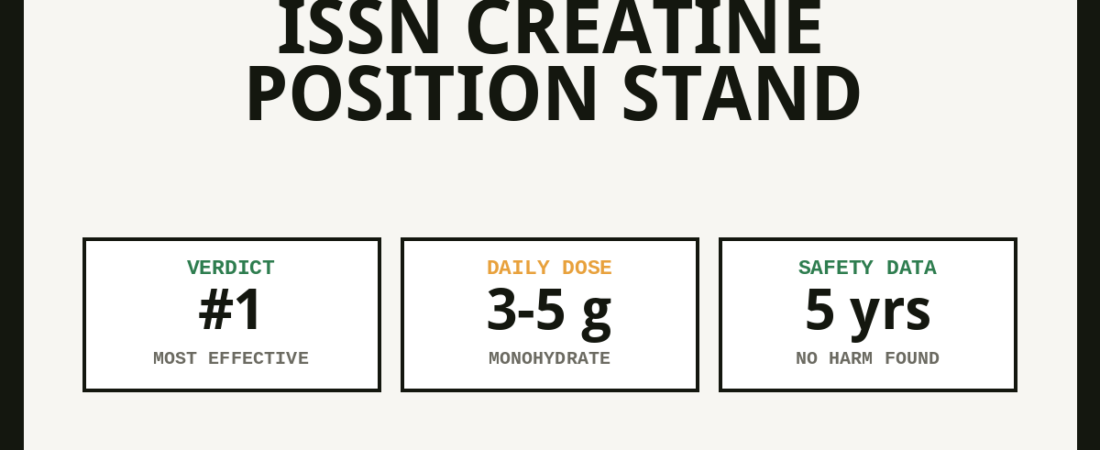
Short answer: the ISSN creatine position stand concludes that creatine monohydrate is the most effective ergogenic nutritional supplement available for increasing high-intensity exercise capacity and lean body mass during training, and that it is safe in healthy individuals at recommended doses. That is unusually strong language for a scientific position paper.
The core conclusions
- Efficacy: monohydrate is the most effective supplement available for high-intensity capacity and lean mass gain during training.
- Safety: no harmful effects in healthy individuals at recommended doses, across studies lasting up to five years.
- Loading: roughly 0.3 g per kg daily for five to seven days saturates stores. 3 to 5 g daily reaches the same point in three to four weeks.
- Form: monohydrate is the reference. Alternative forms have not demonstrated superiority.
- Myths addressed: the stand states creatine does not cause dehydration, cramping, or kidney damage in healthy people.
- Beyond sport: it identifies potential clinical applications including sarcopenia, neurological conditions and rehabilitation.
- Youth: it concludes creatine appears safe in younger athletes under appropriate supervision, which is more permissive than many assume.
The kidney section, specifically
The stand addresses this directly because it is the most persistent concern. Creatine raises serum creatinine, which is used to estimate kidney function, but studies measuring actual function including glomerular filtration rate have not found impairment in healthy individuals.
The practical implication is to tell your doctor you supplement creatine before blood work, so an elevated creatinine reading is interpreted correctly rather than triggering unnecessary investigation. Existing kidney disease remains a separate medical conversation. Full breakdown of the safety evidence.
Dosing, as the stand describes it
| Protocol | Dose | Duration | Result |
|---|---|---|---|
| Loading | 0.3 g/kg/day, split into 4 | 5-7 days | Saturation |
| Maintenance after loading | 3-5 g/day | Ongoing | Maintains saturation |
| No loading | 3-5 g/day | 3-4 weeks | Same saturation |
Loading versus steady dosing compared.
Why the language is so confident
Creatine has an unusually large evidence base for a supplement: hundreds of peer-reviewed studies over three decades, with consistent findings and a safety record spanning long durations. Most supplements have nothing comparable, which is why position stands about them are hedged and this one is not.
The standard caveat applies: the ISSN receives industry funding and some authors have commercial relationships, disclosed in the publication. The conclusions align with independent reviews, which is a reasonable check on that.
FAQ
What does the ISSN say about creatine?
That monohydrate is the most effective ergogenic nutritional supplement available for high-intensity exercise capacity and lean mass, and that it is safe at recommended doses in healthy people.
Does the ISSN recommend loading?
It describes loading as the fastest route to saturation, not a requirement. 3 to 5 g daily reaches the same endpoint more slowly.
What does it say about kidneys?
No evidence of harm in healthy individuals at recommended doses. Serum creatinine rises for metabolic reasons unrelated to kidney damage.
Is creatine safe for teenagers?
The stand concludes it appears safe in younger athletes under appropriate supervision, though individual decisions should involve a clinician.
Sources
- Kreider RB et al. International Society of Sports Nutrition position stand: safety and efficacy of creatine supplementation in exercise, sport, and medicine. JISSN, 2017.
- Antonio J et al. Common questions and misconceptions about creatine supplementation. JISSN, 2021.
- Hultman E et al. Muscle creatine loading in men. Journal of Applied Physiology, 1996.
- Dalbo VJ et al. Putting to rest the myth of creatine supplementation leading to muscle cramps and dehydration. British Journal of Sports Medicine, 2008.
General information, not medical advice. Discuss creatine with your doctor if you have kidney disease.
Part of The Research — studies and position stands explained plainly.
GramGoal Team. We build nutrition calculators and price-check the supplement market monthly. General information, not medical advice. See our methodology and affiliate disclosure.