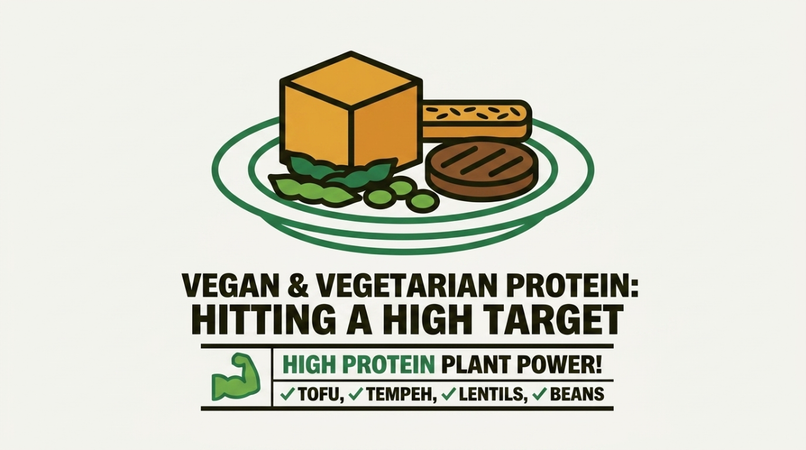
Short answer: hitting a high protein target on a plant-based diet is entirely achievable, and it takes more deliberate planning than most people expect. You need roughly 10 to 20 percent more total protein, a focus on the densest sources, and variety across the day to cover amino acids. Soy, seitan, legumes, tofu and a plant protein blend do most of the work.
Calculate your target, then add roughly 15 percent.
Why the adjustment exists
Two reasons, both modest individually and additive together.
- Lower leucine content. Muscle protein synthesis needs roughly 2.5 to 3 g of leucine per meal. Most plant proteins carry around 8 percent leucine against whey at 11 percent, so you need a larger serving to reach the same trigger.
- Lower digestibility. Plant proteins are generally somewhat less digestible than animal sources, partly due to fibre and antinutrients. Cooking, soaking and processing improve this.
Neither is a barrier. They are a reason to eat more of it, which is a solvable problem.
The densest plant sources
| Food | Serving | Protein | Calories | Notes |
|---|---|---|---|---|
| Seitan | 100 g | 25 g | 140 | Highest by far, low in lysine |
| Soy protein isolate | 30 g | 25 g | 115 | Complete protein |
| Tempeh | 100 g | 19 g | 190 | Fermented, complete |
| Pea and rice blend | 30 g | 24 g | 120 | Covers each other gaps |
| Tofu, firm | 150 g | 17 g | 115 | Complete, versatile |
| Edamame | 150 g | 17 g | 190 | Complete, high fibre |
| Lentils, cooked | 200 g | 18 g | 230 | Low in methionine |
| Black beans, cooked | 200 g | 16 g | 265 | High fibre |
| Chickpeas, cooked | 200 g | 18 g | 330 | Calorie dense |
Note the calorie column. Legumes are excellent food and carry substantial carbohydrate with the protein, which matters if you are in a deficit. Tofu, seitan and protein powder give protein at a lower calorie cost.
Complementary proteins, simplified
The old advice to combine proteins at every meal is outdated. The body maintains an amino acid pool, so variety across the day is sufficient. The practical version:
- Legumes are low in methionine. Grains, nuts and seeds supply it.
- Grains are low in lysine. Legumes supply it.
- Soy and quinoa are complete on their own.
- Eat both categories daily and the problem resolves itself.
Nutrients that need attention beyond protein
- Vitamin B12. Not reliably available from plants. Supplementation is necessary for vegans, not optional.
- Iron. Plant iron is less bioavailable. Vitamin C alongside meals improves absorption substantially.
- Omega-3 EPA and DHA. ALA converts poorly. Algae oil supplies both directly. Calculate your gap.
- Creatine. Dietary intake comes from meat and fish, so vegetarians start lower and tend to show the largest response to supplementation. Dosing.
- Zinc, iodine and calcium all warrant attention depending on the diet.
A worked day at 130 g
| Meal | Contents | Protein |
|---|---|---|
| Breakfast | Soy yogurt, 40 g oats, 25 g pea-rice protein | 36 g |
| Lunch | 200 g lentils, quinoa, vegetables | 28 g |
| Snack | 150 g edamame | 17 g |
| Dinner | 150 g tofu, 100 g seitan, stir fry | 42 g |
| Snack | Handful of almonds and seeds | 8 g |
| Total | 131 g |
FAQ
Can you build muscle on a vegan diet?
Yes. Studies comparing matched protein intakes find similar strength and lean mass outcomes.
How much more protein do vegans need?
Roughly 10 to 20 percent more total protein, driven by lower leucine and digestibility.
Is soy safe for men?
Yes. Research does not support the claim that normal soy intake meaningfully affects hormones in men.
Do I need to combine proteins at each meal?
No. Variety across the day is sufficient because the body maintains an amino acid pool.
Sources
- Hevia-Larrain V et al. High-Protein Plant-Based Diet Versus a Protein-Matched Omnivorous Diet to Support Resistance Training Adaptations. Sports Medicine, 2021.
- Academy of Nutrition and Dietetics. Position of the Academy: Vegetarian Diets. Journal of the Academy of Nutrition and Dietetics, 2016.
- van Vliet S, Burd NA, van Loon LJ. The Skeletal Muscle Anabolic Response to Plant- versus Animal-Based Protein Consumption. Journal of Nutrition, 2015.
- Kaviani S et al. Determining the Creatine Content of Plant-Based Diets. Nutrients.
- National Institutes of Health, Office of Dietary Supplements. Vitamin B12 fact sheet. ods.od.nih.gov
General information, not medical advice.
GramGoal Team. We build nutrition calculators and price-check the supplement market monthly. General information, not medical advice. See our methodology and affiliate disclosure.