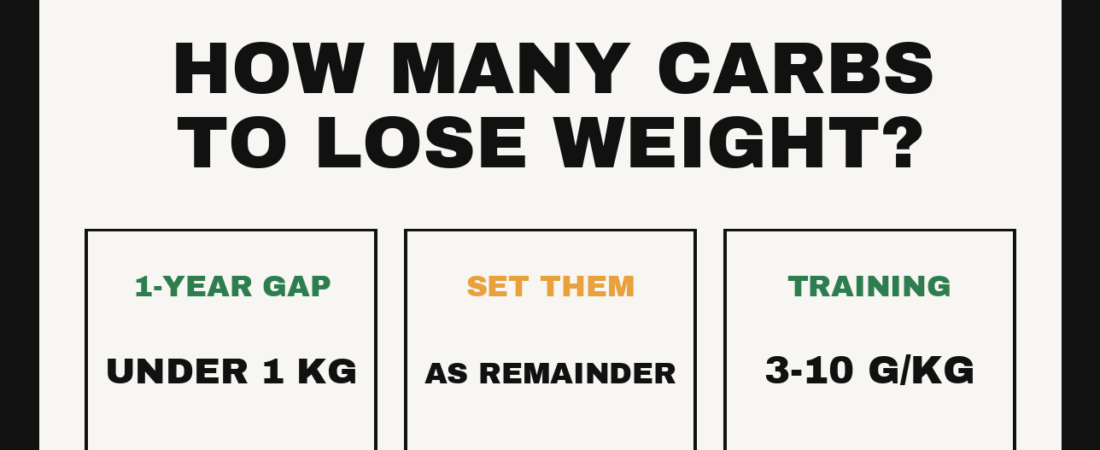
Short answer: there is no carbohydrate number that causes fat loss. When calories and protein are matched, low-carb and higher-carb diets produce the same weight loss, and the largest meta-analyses put the year-long difference at under one kilogram in either direction. So carbohydrate is not a target you set. It is the remainder after protein and fat, and how much room there is depends on how much you train.
Work out the remainder with the carbohydrate calculator, or set all three at once in the macro calculator.
The remainder method
Set the deficit first with the calorie deficit calculator. Then protein, because it is the macro that protects muscle in a deficit. Then fat to its floor of about 20 to 25 percent of calories. Whatever is left is carbohydrate. Worked through for an 80 kg person eating 1.8 g/kg of protein (144 g) with fat at 25 percent:
| Daily calories | Protein | Fat | Carbohydrate left |
|---|---|---|---|
| 1,800 | 144 g | 50 g | 194 g |
| 2,000 | 144 g | 56 g | 231 g |
| 2,200 | 144 g | 61 g | 269 g |
| 2,400 | 144 g | 67 g | 306 g |
| 2,600 | 144 g | 72 g | 344 g |
Grams are rounded, so the arithmetic is a few calories out in places. Change the protein or fat figure and the carbohydrate column moves; that is the whole mechanism. How much protein per day and how much fat per day cover the two inputs.
What the trials actually show
Three bodies of evidence, pointing the same way:
| Study | Size | Result |
|---|---|---|
| Naude et al. 2014, meta-analysis | 19 trials, 3,209 people | Low-carb vs balanced: 0.74 kg difference at 3–6 months, 0.48 kg at 1–2 years. Both confidence intervals cross zero. |
| Gardner et al. 2018 (DIETFITS) | 609 adults, 12 months | −5.3 kg on healthy low-fat, −6.0 kg on healthy low-carb. Between-group difference 0.7 kg (CI −0.2 to 1.6), not significant. |
| Bueno et al. 2013, meta-analysis | 13 trials, 1,569 people, 12 months+ | Ketogenic diets 0.91 kg ahead (CI −1.65 to −0.17). Statistically significant; the authors call it clinically small. |
Taken together: after a year, the gap between a very-low-carbohydrate diet and a higher-carbohydrate one is somewhere around a kilogram, and which one is ahead depends on which review you read. That is the entire effect of the variable people argue about most.
The only trial that removed adherence from the equation entirely found the opposite of the popular claim. Hall and colleagues (2015) fed 19 adults with obesity in a metabolic ward and cut 30 percent of calories from fat in one arm and from carbohydrate in the other. Cutting fat lost about 89 g of body fat per day; cutting carbohydrate lost about 53 g. Six days per arm, so it answers a mechanism question rather than a practical one, but it is not the direction most people expect.
Why cutting carbs looks so effective in week one
Glycogen is stored with water. The classic estimate is around 3 g of water per gram of glycogen, though the true ratio is debated and probably lower. Either way, a trained adult holds several hundred grams of glycogen, so sharply dropping carbohydrate can shed one to two kilograms in the first week that has nothing to do with fat. Reintroduce carbohydrate and it comes straight back. Weight fluctuations covers this in more detail.
This is the single biggest reason low-carb diets feel like they are working faster than they are, and the reason people abandon them when the scale stalls in week three.
How much you actually want, by training load
Fat loss does not need carbohydrate. Training does. The 2016 joint position stand from the Academy of Nutrition and Dietetics, Dietitians of Canada and the American College of Sports Medicine gives daily targets by training volume:
| Training load | Target | At 80 kg |
|---|---|---|
| Light, low intensity or skill-based | 3–5 g/kg/day | 240–400 g |
| Moderate, about 1 hour a day | 5–7 g/kg/day | 400–560 g |
| High, 1–3 hours moderate to high intensity | 6–10 g/kg/day | 480–800 g |
| Very high, 4–5 hours | 8–12 g/kg/day | 640–960 g |
The obvious tension: the upper rows are incompatible with an energy deficit. 800 g of carbohydrate is 3,200 kcal before you have eaten any protein or fat. These are performance targets for athletes eating at or above maintenance. In a fat-loss phase you sit at the light-to-moderate end and accept that the hardest sessions will feel worse, which is one of the real costs of dieting.
The one carbohydrate floor worth keeping
Fibre. The Dietary Reference Intakes put adequate intake between 21 and 38 g a day depending on age and sex, and almost all of it arrives inside carbohydrate foods. Cutting carbohydrate hard without deliberately protecting fibre is the most common self-inflicted problem on a low-carb diet. The fiber calculator gives your figure, and fibermaxxing covers what happens at the other extreme.
Where the evidence is thin
Almost every long trial in this area is undermined by the same problem: by 12 months, both groups have drifted toward each other. In DIETFITS the low-carb group was averaging around 130 g of carbohydrate a day by the end, not the 20 g they started with. So these trials compare intended diets that people partly abandoned, which is realistic but makes them weak tests of the underlying physiology.
The metabolic ward studies that avoid that problem are tiny and last days. There is no large, long, fully controlled feeding trial, and there probably never will be, because it would cost a fortune and nobody would volunteer.
FAQ
How many carbs a day to lose weight?
Whatever is left after your calorie target, protein and fat are set. For most people in a deficit that lands somewhere between 100 and 300 g. There is no threshold below which fat loss starts.
How many carbs a day to lose weight for a woman?
The method is identical. The number is usually lower only because calorie targets are lower. A 65 kg woman eating 1,700 kcal with 120 g of protein and 47 g of fat has about 200 g left.
Do carbs make you gain weight?
Not specifically. Excess calories do, whichever macro supplies them. Carbohydrate does cause visible short-term swings on the scale through glycogen and water, which is often mistaken for fat gain.
Is low carb better for fat loss?
Not by enough to matter. Across 19 trials and 3,209 people the difference at one to two years was under half a kilogram, with the confidence interval crossing zero. It is better for the people who find it easier to stick to, which is a real advantage but a personal one.
How many carbs should I eat on a cut while lifting?
As many as the deficit allows after protein and the fat floor. Lifting is glycolytic, and cutting carbohydrate to the bone while training hard tends to cost you session quality rather than fat.
Sources
- Naude CE, Schoonees A, Senekal M, Young T, Garner P, Volmink J. Low carbohydrate versus isoenergetic balanced diets for reducing weight and cardiovascular risk: a systematic review and meta-analysis. PLOS ONE, 2014;9(7):e100652.
- Gardner CD, Trepanowski JF, Del Gobbo LC, et al. Effect of low-fat vs low-carbohydrate diet on 12-month weight loss in overweight adults and the association with genotype pattern or insulin secretion: the DIETFITS randomized clinical trial. JAMA, 2018;319(7):667–679.
- Bueno NB, de Melo IS, de Oliveira SL, da Rocha Ataide T. Very-low-carbohydrate ketogenic diet v. low-fat diet for long-term weight loss: a meta-analysis of randomised controlled trials. British Journal of Nutrition, 2013;110(7):1178–1187.
- Hall KD, Bemis T, Brychta R, et al. Calorie for calorie, dietary fat restriction results in more body fat loss than carbohydrate restriction in people with obesity. Cell Metabolism, 2015;22(3):427–436.
- Thomas DT, Erdman KA, Burke LM. Position of the Academy of Nutrition and Dietetics, Dietitians of Canada, and the American College of Sports Medicine: Nutrition and Athletic Performance. Journal of the Academy of Nutrition and Dietetics, 2016;116(3):501–528.
- Institute of Medicine. Dietary Reference Intakes for Energy, Carbohydrate, Fiber, Fat, Fatty Acids, Cholesterol, Protein, and Amino Acids. National Academies Press, 2005. (Total fibre adequate intake 21–38 g/day.)
General information, not medical advice.
GramGoal Team. We build nutrition calculators and price-check the supplement market monthly. General information, not medical advice. See our methodology and affiliate disclosure.