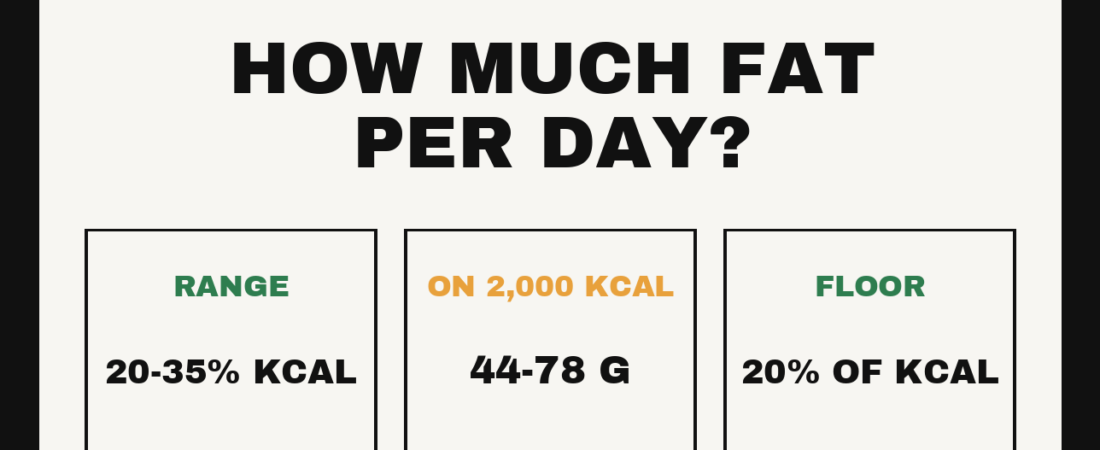
Short answer: 20 to 35 percent of your calories, which is the range the Institute of Medicine set for adults. On 2,000 kcal that is 44 to 78 g a day. The number that actually matters is the floor: going below about 20 percent of energy for long stretches is discouraged, because it squeezes out fat-soluble vitamins and essential fatty acids and, in men, produces a small drop in testosterone. Above the floor, the exact figure is a preference, not a health variable.
Get your own number from the fat intake calculator, or set all three macros together in the macro calculator.
Grams of fat per day, by calorie intake
Fat carries 9 kcal per gram, so the conversion from percentage to grams is a division. Find your intake, pick a column.
| Daily calories | 20% (floor) | 25% | 30% | 35% (ceiling) |
|---|---|---|---|---|
| 1,500 | 33 g | 42 g | 50 g | 58 g |
| 1,800 | 40 g | 50 g | 60 g | 70 g |
| 2,000 | 44 g | 56 g | 67 g | 78 g |
| 2,200 | 49 g | 61 g | 73 g | 86 g |
| 2,500 | 56 g | 69 g | 83 g | 97 g |
| 2,800 | 62 g | 78 g | 93 g | 109 g |
| 3,000 | 67 g | 83 g | 100 g | 117 g |
If you do not know your calorie intake yet, the TDEE calculator is the starting point.
The floor, and what happens below it
The 2016 joint position stand from the Academy of Nutrition and Dietetics, Dietitians of Canada and the American College of Sports Medicine is explicit: athletes should be discouraged from chronically eating below 20 percent of energy as fat, because the loss of dietary variety that usually comes with it reduces intake of fat-soluble vitamins and essential fatty acids.
There is also a hormonal signal, though a modest one. Whittaker and Wu’s 2021 meta-analysis pooled six intervention studies in 206 men comparing diets averaging 19.5 percent of energy from fat against 39.6 percent. Total testosterone was lower on the low-fat diets, with a standardised mean difference of −0.38 (95% CI −0.75 to −0.01). In the subgroup of European and North American men the effect was clearer (−0.52, CI −0.75 to −0.30). Six small short studies is a thin base, and the authors say so themselves. Read it as a reason not to drive fat very low for months, not as evidence that eating more fat raises testosterone.
As a rule of thumb, 20 percent of energy works out near 0.5 to 0.6 g per kg of bodyweight at typical intakes. That is a derived shortcut rather than a sourced recommendation, so where the two disagree, use the percentage.
| Bodyweight | Practical floor (0.6 g/kg) |
|---|---|
| 50 kg (110 lb) | 30 g |
| 60 kg (132 lb) | 36 g |
| 70 kg (154 lb) | 42 g |
| 80 kg (176 lb) | 48 g |
| 90 kg (198 lb) | 54 g |
| 100 kg (220 lb) | 60 g |
Does eating fat make you fat?
Under controlled conditions, no more than any other calorie. Sacks and colleagues (2009) randomised 811 adults to four diets varying in fat and protein and followed them for two years. Weight loss was 3.3 kg in both the high-fat and low-fat groups. Composition did not decide the outcome; calories did.
The one careful trial that found a difference found it pointing the other way. Hall and colleagues (2015) locked 19 adults with obesity in a metabolic ward and cut 30 percent of their calories, once from fat and once from carbohydrate, in each person. Cutting fat produced about 89 g of body fat lost per day; cutting carbohydrate produced about 53 g. It was six days per arm in 19 people, so it settles a mechanism question rather than a practical one, but it is the opposite of the popular claim.
The practical read: fat is the macro you set second, after protein, and its main job is to stay above the floor while leaving room for the carbohydrate that fuels training.
Type matters more than total
Two figures are worth keeping:
- Saturated fat under 10 percent of energy. On 2,000 kcal that is 22 g. This is the one fat sub-target with consistent public health backing.
- Essential fatty acids. The adequate intake for linoleic acid is 17 g a day for adult men and 12 g for women; for alpha-linolenic acid it is 1.6 g and 1.1 g. Note that these total under 20 g, well below any sensible fat floor, so essential fatty acids are almost never the binding constraint. Long-chain omega-3s are a separate question, covered in EPA and DHA and the omega-3 calculator.
Where the evidence is thin
The 20 to 35 percent range is a judgement built from a mixed base of intervention trials and observational data, not a number derived from a measured requirement the way protein’s is. Nobody has established a true minimum fat intake for healthy adults, and the 20 percent floor is a practical guard against nutrient gaps rather than a threshold where something breaks.
The testosterone finding rests on six studies of two to ten weeks in 206 men total, several using vegetarian low-fat diets that differed in more than fat. Whether the effect matters for training outcomes has not been tested at all.
FAQ
How much fat do I need a day?
20 to 35 percent of your calories. On 2,000 kcal that is 44 to 78 g; on 2,500 kcal it is 56 to 97 g.
What should my fat intake be to lose weight?
The same range, applied to your reduced calorie target. Fat percentage does not change fat loss once calories and protein are matched, so pick the end of the range you find easiest to stick to.
What is the minimum fat intake per day?
About 20 percent of calories, or roughly 0.5 to 0.6 g per kg of bodyweight. Below that, sustained for months, is where the concerns start.
Is 100 g of fat a day too much?
Not on its own. At 2,600 kcal or more, 100 g sits inside the 35 percent ceiling. At 1,800 kcal it is half your intake, which leaves too little room for protein and training fuel.
How much fat per day for a man vs a woman?
The percentage range is the same. The gram figure differs only because calorie intakes differ. The essential fatty acid intakes do differ: 17 g and 1.6 g for men, 12 g and 1.1 g for women.
On which fats those should be, the loudest current argument is about cooking oils: do seed oils cause inflammation?
Sources
- Institute of Medicine. Dietary Reference Intakes for Energy, Carbohydrate, Fiber, Fat, Fatty Acids, Cholesterol, Protein, and Amino Acids. National Academies Press, 2005. (Fat AMDR 20–35% of energy; linoleic acid AI 17 g/d men, 12 g/d women; alpha-linolenic acid AI 1.6 g/d and 1.1 g/d.)
- Thomas DT, Erdman KA, Burke LM. Position of the Academy of Nutrition and Dietetics, Dietitians of Canada, and the American College of Sports Medicine: Nutrition and Athletic Performance. Journal of the Academy of Nutrition and Dietetics, 2016;116(3):501–528.
- Whittaker J, Wu K. Low-fat diets and testosterone in men: systematic review and meta-analysis of intervention studies. Journal of Steroid Biochemistry and Molecular Biology, 2021;210:105878.
- Sacks FM, Bray GA, Carey VJ, et al. Comparison of weight-loss diets with different compositions of fat, protein, and carbohydrates. New England Journal of Medicine, 2009;360(9):859–873.
- Hall KD, Bemis T, Brychta R, et al. Calorie for calorie, dietary fat restriction results in more body fat loss than carbohydrate restriction in people with obesity. Cell Metabolism, 2015;22(3):427–436.
General information, not medical advice.
GramGoal Team. We build nutrition calculators and price-check the supplement market monthly. General information, not medical advice. See our methodology and affiliate disclosure.