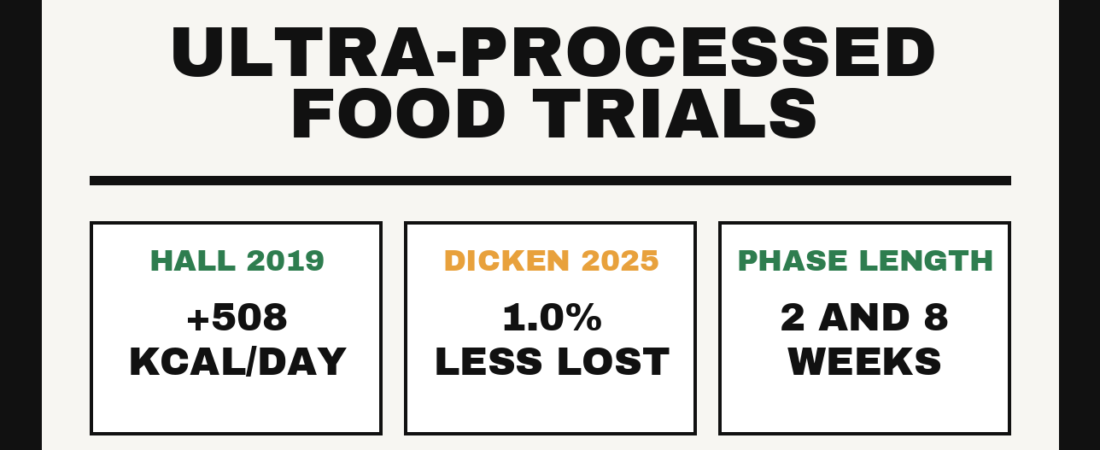
Short answer: two controlled feeding trials have tested food processing directly, and both found a real but modest effect. Hall 2019 locked 20 people in a metabolic ward and found they ate 508 more calories a day on an ultra-processed diet matched for calories presented, macronutrients, sugar, sodium and fibre. Dicken 2025 ran the same idea in real life for eight weeks and found about one percentage point more weight loss on minimally processed food. Processing appears to matter. It matters less than the headlines, and two senior nutrition researchers have publicly disputed how much.
If you want the practical lever rather than the debate, it is mostly calorie density and protein. Check any food against the protein per 100 g table.
What ultra-processed actually means
The term comes from the NOVA system, which sorts food by how much industrial processing it has had rather than by nutrients. Group 4, ultra-processed, covers formulations made largely from substances extracted from foods plus additives that are not used in home cooking: protein isolates, modified starches, emulsifiers, colourings, flavourings.
That definition is the source of most of the argument. It puts a supermarket sandwich, a fizzy drink, a mass-market wholemeal loaf and a protein bar in the same category, on the basis of manufacturing method rather than nutritional content. Whether that grouping predicts anything useful is exactly what the trials were built to test.
The two trials side by side
| Hall 2019 | Dicken 2025 | |
|---|---|---|
| Setting | Inpatient metabolic ward, all food supplied | Free-living, food delivered to the home |
| People analysed | 20 | 50 |
| Design | Randomised crossover | Randomised crossover, 4-week washout |
| Length of each phase | 2 weeks | 8 weeks |
| What was matched | Calories presented, energy density, macros, sugar, sodium, fibre | Both diets met national healthy eating guidance |
| Main result | 508 ± 106 kcal/day more eaten on ultra-processed | −2.06% vs −1.05% body weight |
| Weight | +0.9 kg on ultra-processed, −0.9 kg on unprocessed | About 1 kg more lost on minimally processed |
The Hall design is the stronger one for causation. Participants were free to eat as much as they wanted from meals matched on every nutrient the researchers could match, and they still took in roughly 500 extra calories a day on the ultra-processed menu. That is not a self-reporting artefact; every item was weighed.
The Dicken design is the more realistic one. People shopped, cooked and lived normally for eight weeks per phase, with both diets built to meet healthy eating guidance. The gap shrank to about one percentage point of bodyweight, roughly a kilogram.
Where the evidence is thin
This is an unusually contested area, and pretending otherwise would be dishonest.
- Published disagreement. Ludwig, Willett and Putt wrote to Nature Medicine arguing the roughly one kilogram difference in Dicken 2025 has limited public health relevance, and that it does not support adding food processing to dietary guidance.
- Small and short. Twenty people for two weeks, and fifty for eight. Neither tells you what happens over years.
- The mechanism is unidentified. Candidates include eating rate, texture and softness, energy density, hyperpalatability and lower protein per calorie. The trials show an effect without isolating its cause.
- The category is broad. If the effect is really about softness and calorie density, then a dense, soft, low-protein ultra-processed food and a high-protein one should behave very differently, and lumping them together hides that.
- Most other evidence is observational, where people eating more ultra-processed food differ from those who eat less in income, cooking time and much else.
What to do with this
The useful reading is not “avoid all packaged food”. It is that heavily processed food makes it easier to overeat without noticing, which is a problem of defaults rather than morality.
- Lower the calorie density of your base meals. This is the lever with the clearest mechanism behind it. Rolls on calorie density covers the underlying work.
- Anchor meals on protein. Most of what makes the ultra-processed category easy to overeat is low protein per calorie. The protein calculator sets the target.
- Keep the processed foods that earn their place. Plain yoghurt, tinned fish, frozen vegetables, bread and protein powder are not the problem this research identified.
- Cook more of your own food if you can. That is the intervention both trials effectively tested, and planning ahead is what makes it stick.
FAQ
What are ultra-processed foods?
NOVA group 4: industrial formulations made mostly from extracted substances plus additives not used in home kitchens. Soft drinks, packaged snacks, mass-produced bread, reconstituted meats, most ready meals.
Ultra-processed foods vs processed foods: what is the difference?
Processed foods, NOVA group 3, are ordinary foods with salt, sugar or oil added: tinned beans, cheese, cured meat, bread made from flour, water, yeast and salt. Ultra-processed goes further, using ingredients and additives that only exist industrially.
Are all ultra-processed foods bad?
The classification is about manufacturing, not nutrition, so it necessarily includes items that are fine. The trials measured the category as a whole, which means they cannot tell you which members drove the result.
Do ultra-processed foods make you gain weight?
In the inpatient trial, yes: 0.9 kg gained in two weeks on the ultra-processed diet against 0.9 kg lost on the unprocessed one, with intake left to the participant. Outside a ward the effect was smaller.
Is protein powder ultra-processed?
By the NOVA definition, yes, since it is an extracted protein isolate. It is also high in protein per calorie and low in calorie density, which is the opposite of the profile the trials suggest is doing the damage. A good illustration of why the category is a blunt instrument.
Sources
- Hall KD et al. Ultra-processed diets cause excess calorie intake and weight gain: an inpatient randomized controlled trial of ad libitum food intake. Cell Metabolism, 2019;30(1):67–77.e3.
- Dicken SJ, Jassil FC, Brown A et al. Ultraprocessed or minimally processed diets following healthy dietary guidelines on weight and cardiometabolic health: a randomized, crossover trial. Nature Medicine, 2025;31(10):3297–3308.
- Ludwig DS, Willett WC, Putt ME. Concerns over conclusions in an ultra-processed food trial. Nature Medicine, 2026. doi:10.1038/s41591-025-04087-7
- Monteiro CA et al. Ultra-processed foods: what they are and how to identify them. Public Health Nutrition, 2019;22(5):936–941.
General information, not medical advice.
Part of The Research — studies and position stands explained plainly.
GramGoal Team. We build nutrition calculators and price-check the supplement market monthly. General information, not medical advice. See our methodology and affiliate disclosure.