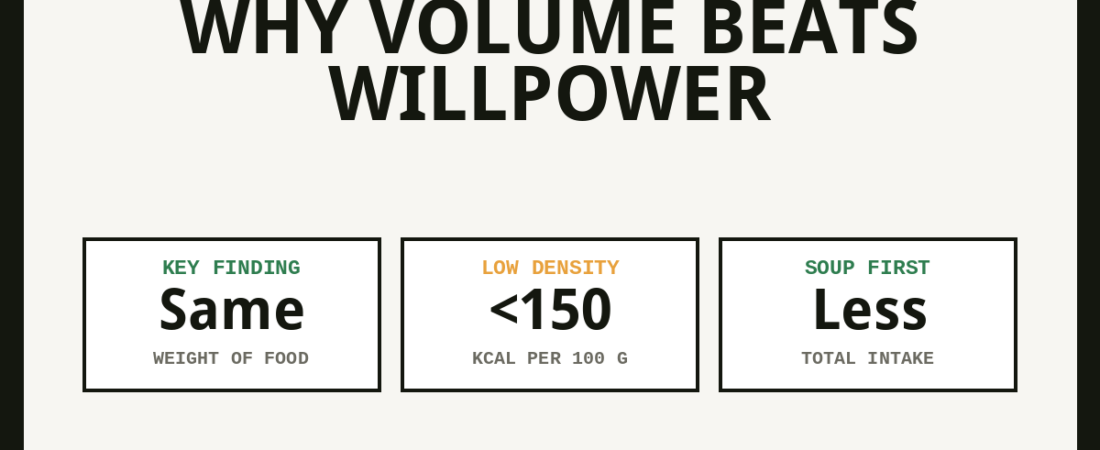
Short answer: Barbara Rolls and colleagues established that people tend to eat a fairly consistent weight of food each day, largely independent of its calorie content. That single finding explains why low calorie density eating works for fat loss without hunger, and why it does not require willpower in the way restriction does.
Calculate the density of any food. The same mechanism shows up in the ultra-processed food feeding trials.
The core experiments
Rolls team ran a series of controlled feeding studies in which the energy density of meals was manipulated while keeping them similar in appearance, palatability and macronutrient composition. Participants were free to eat as much as they wanted.
The consistent result: people ate a similar weight of food across conditions. When density was lowered, they consumed fewer calories without reporting greater hunger or lower satisfaction. When density was raised, intake rose.
The soup experiment
One of the clearest demonstrations involved serving the same ingredients in different forms. A first course of broth-based soup, which is mostly water, reduced total meal intake meaningfully compared with the same ingredients served as a solid dish with a drink alongside.
The water incorporated into the food affected satiety; the same water drunk separately did not. That distinction is why a glass of water before a meal is a weaker intervention than soup, despite the intuition being similar.
Density bands and what they mean
| Calories per 100 g | Category | Examples |
|---|---|---|
| Under 60 | Very low | Most vegetables, broth soups, fruit |
| 60-150 | Low | Potatoes, legumes, lean fish, yoghurt |
| 150-250 | Medium | Lean meat, eggs, cooked grains |
| 250-400 | High | Bread, cheese, fattier meats |
| Above 400 | Very high | Nuts, oils, chocolate, crisps |
Why this beats willpower
Most diet advice asks you to eat less of what you want. This finding suggests a structural alternative: change what fills the plate and the calorie reduction follows without a corresponding increase in hunger.
It also explains why two meals of identical calories can feel completely different. A 500 calorie salad with chicken occupies far more stomach volume than 500 calories of crisps, and the research says volume is what your satiety signalling responds to.
The limitation worth naming
These were mostly short-term controlled studies, and the consistent-weight finding is a population tendency rather than a law. Individuals vary, and long-term adherence data is weaker than the mechanistic evidence.
It also does not mean dense foods are bad. Nuts and olive oil are nutritious and dense. The practical application is building meals around low density foods so the dense ones fit, not eliminating them.
FAQ
What is calorie density?
Calories per unit weight of food, usually per 100 g. Lower density means more food for the same calories.
Do people really eat a consistent weight of food?
Rolls research found people ate similar weights across conditions of differing density, consuming fewer calories when density was lower.
Why does soup reduce intake?
Water incorporated into food increases satiety in a way that the same water drunk alongside does not.
Should I avoid high density foods?
No. Build meals around low density foods so dense, nutritious ones fit within your target.
Sources
- Rolls BJ. The relationship between dietary energy density and energy intake. Physiology and Behavior, 2009.
- Bell EA, Rolls BJ. Energy density of foods affects energy intake across multiple levels of fat content in lean and obese women. American Journal of Clinical Nutrition, 2001.
- Rolls BJ, Roe LS, Meengs JS. Salad and satiety: energy density and portion size of a first-course salad affect energy intake at lunch. Journal of the American Dietetic Association, 2004.
- Flood JE, Rolls BJ. Soup preloads in a variety of forms reduce meal energy intake. Appetite, 2007.
General information, not medical advice.
Part of The Research — studies and position stands explained plainly.
GramGoal Team. We build nutrition calculators and price-check the supplement market monthly. General information, not medical advice. See our methodology and affiliate disclosure.