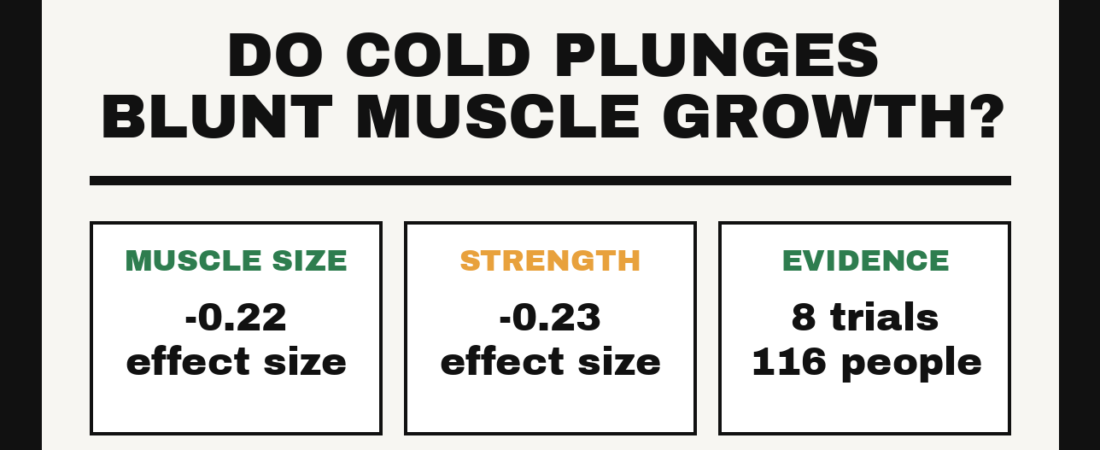
Short answer: yes, modestly. The best pooled estimate we have, from eight training studies in 116 people, is that sitting in cold water straight after lifting produces slightly less muscle growth than lifting alone. The effect is small and the confidence interval still touches zero, so this is a trade rather than a disaster. The fix is simple: move the cold away from the lifting, not out of your life.
What the hypertrophy evidence shows
Pinero and colleagues pooled every controlled trial that ran resistance training with and without post-session cold water immersion for at least four weeks. Eight studies, 116 participants, programmes of 4 to 12 weeks, all using water at 10 to 15 degrees Celsius for 10 to 20 minutes.
Training alone produced a standardised gain of 0.36 (95 percent credible interval 0.10 to 0.61). Training plus cold water produced 0.14 (-0.08 to 0.36). The comparative effect was -0.22 (-0.47 to 0.04), with an 83 percent probability that the true difference is at least small in magnitude. Both groups grew. One grew less.
Strength runs the same direction. Grgic meta-analysed 10 studies in 170 participants and found cold water immersion attenuated strength gains with an effect size of -0.23. Notably, when the immersion covered the whole body rather than a single limb, the difference was no longer significant, which is a hint that the effect may be smaller in the way people actually use a plunge tub than in the tightly controlled single-leg designs.
| Outcome | Evidence base | Effect of adding cold | Read as |
|---|---|---|---|
| Muscle size | 8 trials, 116 people | -0.22 (-0.47 to 0.04) | Small reduction, likely real |
| Strength | 10 trials, 170 people | -0.23 | Small reduction |
| Strength, whole-body immersion | Subgroup | No significant difference | Uncertain |
| Endurance adaptation | 6 weeks of interval training | No effect | Not the same problem |
Why cold interferes
The mechanism study most people are quoting second-hand is Roberts and colleagues in the Journal of Physiology. Twenty-one active men trained twice weekly for 12 weeks, half using 10 minutes of cold water immersion afterwards and half using active recovery. The active recovery group gained significantly more strength and muscle mass, with 17 percent greater type II fibre cross-sectional area and a 26 percent rise in myonuclei that the cold group did not show at all.
A second arm took muscle biopsies after single-leg work and found satellite cell activation and p70S6 kinase phosphorylation both higher after active recovery than after cold. In plain terms, the inflammatory and signalling response that cold water is so good at suppressing is part of what tells the muscle to rebuild bigger. Blunting the soreness and blunting the signal are the same action.
This is the same trade covered in more detail in the piece on what actually helps muscle soreness, where cold water is one of the few interventions with a reliable, if modest, effect.
When cold is still worth it
The interference is specific, not general. Broatch, Petersen and Bishop put 16 men through six weeks of sprint interval training with cold water immersion or a room-temperature control and found no effect on markers of mitochondrial biogenesis or on training adaptations. Cold after a hard aerobic session is not the same problem as cold after a hard lifting session.
And cold does what it is famous for. Higgins, Greene and Baker’s review of team-sport recovery found cold water immersion useful for restoring performance between closely spaced efforts. If you have a match tomorrow, feeling better tomorrow is the goal and growth is not on the table anyway.
So the honest framing is a scheduling problem:
- In-season, or two hard sessions in 24 hours: cold is a reasonable tool.
- Building muscle as the main goal: keep cold away from your lifting days, or put hours between the two.
- Cold on cardio days or rest days: no evidence of a cost.
- Cold because you like it: fine, and worth knowing what it costs.
The timing point is not a guess. The meta-analysis authors were explicit that their results apply only to immersion within 15 minutes of finishing. Nobody has run the trial that separates them by four hours, so the widely repeated advice to “wait a few hours” is reasonable extrapolation rather than a finding.
Where the evidence is thin
Thinner than the confidence of the internet suggests. The whole hypertrophy case rests on 116 people. Only one of the eight studies included women at all. On the SMART-LD quality tool the studies averaged 9.8 out of 20, with five rated poor and three fair. The credible interval crosses zero, so a true effect of nothing is not excluded. Meta-regression found no moderation by training status, programme length or training frequency, which sounds reassuring but mostly reflects how little data there is to detect moderation with.
What we can say is that the direction has been consistent across independent groups, outcomes and methods, and that no trial has found cold water immersion to improve hypertrophy. That is enough to act on for anyone whose main goal is building muscle. It is not enough to tell a recreational lifter who enjoys a plunge that they are undoing their work.
FAQ
Does cold plunge affect muscle growth?
When done within 15 minutes of resistance training, yes, by a small amount. Pooled across eight trials the reduction was -0.22 in standardised units, roughly the difference between a decent result and a slightly better one, not between growing and not growing.
Should you ice bath after lifting?
Not if muscle and strength are the point of the session. If recovering fast for a competition or a second session matters more than that week’s adaptation, the trade favours the cold.
How cold is a cold plunge, and how long?
Every study in the hypertrophy meta-analysis used 10 to 15 degrees Celsius for 10 to 20 minutes, which is the protocol the research describes. Colder and longer has not been shown to buy more, and the soreness literature found the longest immersion times performed worst for delayed effects.
Is cold plunge good for recovery?
For short-term recovery of performance and perceived soreness, the evidence is reasonably good. For long-term adaptation to lifting, it works against you. Those two answers are not in conflict, they are the same mechanism seen from either end.
Does cold water immersion hurt endurance training?
No evidence that it does. Six weeks of sprint interval training with cold water immersion showed no effect on mitochondrial signalling or training adaptations, so aerobic sessions appear to be safe ground for it.
Sources
- Pinero A, Burke R, Augustin F, Mohan A, DeJesus K, Sapuppo M, Weisenthal M, Coleman M, Androulakis-Korakakis P, Grgic J, Swinton PA, Schoenfeld BJ. Throwing cold water on muscle growth: a systematic review with meta-analysis of the effects of post-exercise cold water immersion on resistance training-induced hypertrophy. European Journal of Sport Science. 2024;24(2):177-189.
- Grgic J. Effects of post-exercise cold-water immersion on resistance training-induced gains in muscular strength: a meta-analysis. European Journal of Sport Science. 2023;23(3):372-380.
- Roberts LA, Raastad T, Markworth JF, Figueiredo VC, Egner IM, Shield A, Cameron-Smith D, Coombes JS, Peake JM. Post-exercise cold water immersion attenuates acute anabolic signalling and long-term adaptations in muscle to strength training. The Journal of Physiology. 2015;593(18):4285-4301.
- Broatch JR, Petersen A, Bishop DJ. Cold-water immersion following sprint interval training does not alter endurance signaling pathways or training adaptations in human skeletal muscle. American Journal of Physiology: Regulatory, Integrative and Comparative Physiology. 2017;313(4):R372-R384.
- Higgins TR, Greene DA, Baker MK. Effects of cold water immersion and contrast water therapy for recovery from team sport: a systematic review and meta-analysis. Journal of Strength and Conditioning Research. 2017;31(5):1443-1460.
GramGoal Team. We build nutrition calculators and price-check the supplement market monthly. General information, not medical advice. See our methodology and affiliate disclosure.