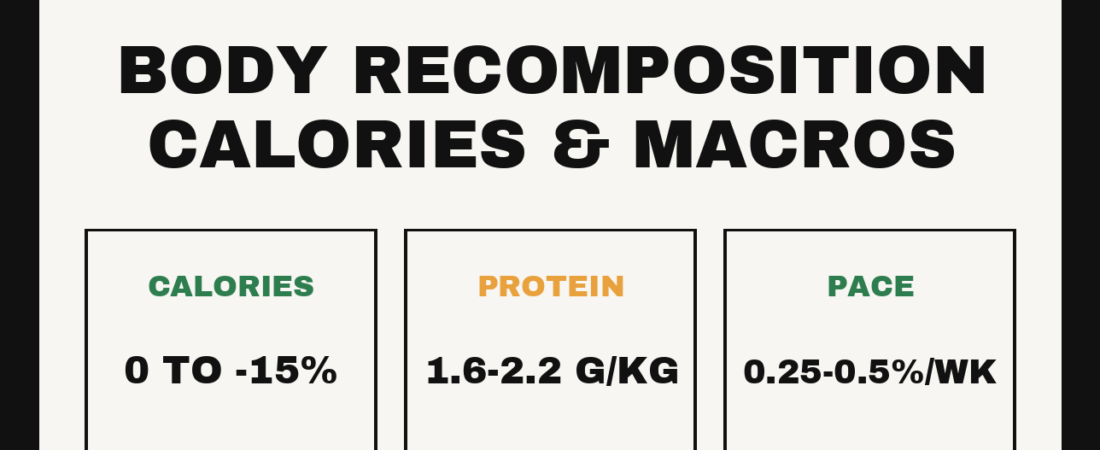
Short answer: body recomposition is not a special diet. It is a small energy deficit, roughly 0 to 15 percent below maintenance, held for months, with protein at 1.6 to 2.2 g per kg of bodyweight, hard progressive resistance training, and a rate of weight change slow enough that the scale looks almost flat. Beginners, returners and people carrying more fat recomp fastest. Trained lean lifters can still do it, but slowly enough that a tape measure is a better judge than a scale.
Run your own numbers with the body recomposition calculator, or start from maintenance calories and split them in the macro calculator.
What a recomp looks like as numbers
Energy balance sits near zero while tissue balance does not: fat mass falls and lean mass rises at the same time. That is possible because stored body fat can fund muscle growth, so the deficit driving fat loss does not have to be large. The practical consequence is that the calorie number for a recomp is closer to maintenance than most people expect, and the protein number is higher.
| Starting point | Calories vs maintenance | Protein | What to expect |
|---|---|---|---|
| New to lifting, higher body fat | −10 to −20% | 1.6–2.0 g/kg | Fastest. Scale falls and measurements improve together |
| Returning after a layoff | −5 to −10% | 1.6–2.0 g/kg | Fast. Regaining previous muscle does most of the work |
| Trained, average body fat | −5 to −10% | 1.8–2.2 g/kg | Slow. Judge it over 12 weeks or more |
| Trained and already lean | 0 to −5% | 2.0–2.4 g/kg | Slowest. Often better served by a dedicated cut or bulk |
If you are unsure which row applies, cut, bulk or recomp walks through the decision first.
Protein does most of the work
The clearest demonstration is Longland and colleagues (2016). Forty young men trained hard six days a week for four weeks on a 40 percent energy deficit. The group eating 2.4 g/kg of protein gained 1.2 kg of lean mass and lost 4.8 kg of fat. The group eating 1.2 g/kg gained 0.1 kg of lean mass and lost 3.5 kg of fat. Same deficit, same training, different protein.
Treat the size of that effect as an upper bound rather than a forecast. It was four weeks, in young untrained-to-recreationally-trained men, with every meal supplied and supervised. What generalises is the direction and the mechanism, not the exact kilograms.
Helms and colleagues (2014) reviewed protein needs for lean, resistance-trained people in a deficit and landed on 2.3 to 3.1 g per kg of fat-free mass. For most people between 15 and 25 percent body fat that works out at roughly 1.8 to 2.4 g per kg of total bodyweight. The protein calculator does that conversion, and how much protein per day covers where the ranges come from.
The deficit itself is not free. Murphy and Koehler’s 2022 meta-analysis found that energy deficiency blunts lean mass gains from resistance training, though strength gains survive largely intact. That is why recomp calls for a small deficit rather than no deficit or a big one: it is a size question, not a yes-or-no question.
How slow is slow enough
Garthe and colleagues (2011) took 24 elite athletes to the same total weight loss of about 5.6 percent by two routes: 0.7 percent of bodyweight per week, or 1.4 percent. The slow group gained 2.1 percent lean mass and lost 31 percent of their fat mass. The fast group lost 0.2 percent lean mass and 21 percent of their fat mass. Same endpoint on the scale, very different body composition.
| Bodyweight | 0.7% per week | Typical recomp pace (0.25–0.5%) |
|---|---|---|
| 60 kg (132 lb) | 0.42 kg (0.9 lb) | 0.15–0.30 kg |
| 70 kg (154 lb) | 0.49 kg (1.1 lb) | 0.18–0.35 kg |
| 80 kg (176 lb) | 0.56 kg (1.2 lb) | 0.20–0.40 kg |
| 90 kg (198 lb) | 0.63 kg (1.4 lb) | 0.23–0.45 kg |
| 100 kg (220 lb) | 0.70 kg (1.5 lb) | 0.25–0.50 kg |
For a recomp, 0.7 percent per week is the ceiling, not the target. Most recomps run at a quarter to a half of a percent, which on an 80 kg lifter is 200 to 400 g a week. That is smaller than ordinary day-to-day weight fluctuations, which is exactly why the scale is a poor instrument here.
Setting fat and carbohydrate
Protein is fixed first. Fat comes second and should not fall below about 20 percent of calories. Carbohydrate takes whatever is left, because it fuels the training that drives the whole process. A worked example for an 80 kg lifter whose maintenance is 2,700 kcal, eating 2,450 kcal (roughly 9 percent below):
| Macro | Rule | Grams | Calories |
|---|---|---|---|
| Protein | 2.0 g/kg | 160 g | 640 |
| Fat | 25% of intake | 68 g | 612 |
| Carbohydrate | Remainder | 300 g | 1,198 |
| Total | 2,450 |
How to tell it is working
Three signals, none of which is scale weight on any given morning:
- Waist circumference measured at the same spot, same time of day, once a week. A falling waist at stable weight is a recomp.
- Working weights in the main lifts. If they are climbing while your weight is flat, you are adding tissue.
- Photos monthly, same light, same time of day. Over 12 weeks these show what a scale cannot.
If nothing has moved after 12 weeks, the problem is usually that the deficit was not real. Calorie counting accuracy covers why logged intake and actual intake drift apart.
Where the evidence is thin
Most recomposition data comes from studies four to twelve weeks long, mostly in young men, measuring changes with DXA or air displacement whose error bars are wide relative to the effects being measured. Barakat and colleagues’ 2020 review establishes that recomposition happens in trained people, but it is a narrative review, not a meta-analysis, so it cannot tell you how fast or for whom.
The bigger gap: nobody has run a long trial comparing a deliberate year-long recomp against alternating cut and bulk blocks over the same year. Anyone who tells you which wins is reasoning from theory, not from data.
FAQ
How many calories for body recomposition?
Between maintenance and 15 percent below it. Beginners and people with more fat to lose sit at the deeper end; lean trained lifters sit at or just under maintenance.
What macros for body recomp?
Protein 1.6 to 2.2 g per kg, fat at 20 to 30 percent of calories, carbohydrate as the remainder. Protein is the only one of the three worth being strict about.
Can you build muscle in a calorie deficit?
Yes, and it has been shown repeatedly. It happens most readily in beginners, returners and people with higher body fat, and gets slower as you get leaner and better trained.
How long does body recomposition take?
Months, not weeks. Twelve weeks is the shortest block worth judging, and visible change in a trained lifter often takes six months or more.
Do you need a calorie deficit to recomp?
Not strictly. Recomposition has been observed at maintenance, particularly in beginners. A small deficit tends to make the fat-loss half visible sooner.
Sources
- Longland TM, Oikawa SY, Mitchell CJ, Devries MC, Phillips SM. Higher compared with lower dietary protein during an energy deficit combined with intense exercise promotes greater lean mass gain and fat mass loss: a randomized trial. American Journal of Clinical Nutrition, 2016;103(3):738–746.
- Garthe I, Raastad T, Refsnes PE, Koivisto A, Sundgot-Borgen J. Effect of two different weight-loss rates on body composition and strength and power-related performance in elite athletes. International Journal of Sport Nutrition and Exercise Metabolism, 2011;21(2):97–104.
- Helms ER, Zinn C, Rowlands DS, Brown SR. A systematic review of dietary protein during caloric restriction in resistance trained lean athletes: a case for higher intakes. International Journal of Sport Nutrition and Exercise Metabolism, 2014;24(2):127–138.
- Murphy C, Koehler K. Energy deficiency impairs resistance training gains in lean mass but not strength: a meta-analysis and meta-regression. Scandinavian Journal of Medicine & Science in Sports, 2022;32(1):125–137.
- Barakat C, Pearson J, Escalante G, Campbell B, De Souza EO. Body Recomposition: Can Trained Individuals Build Muscle and Lose Fat at the Same Time? Strength and Conditioning Journal, 2020;42(5):7–21.
General information, not medical advice.
GramGoal Team. We build nutrition calculators and price-check the supplement market monthly. General information, not medical advice. See our methodology and affiliate disclosure.