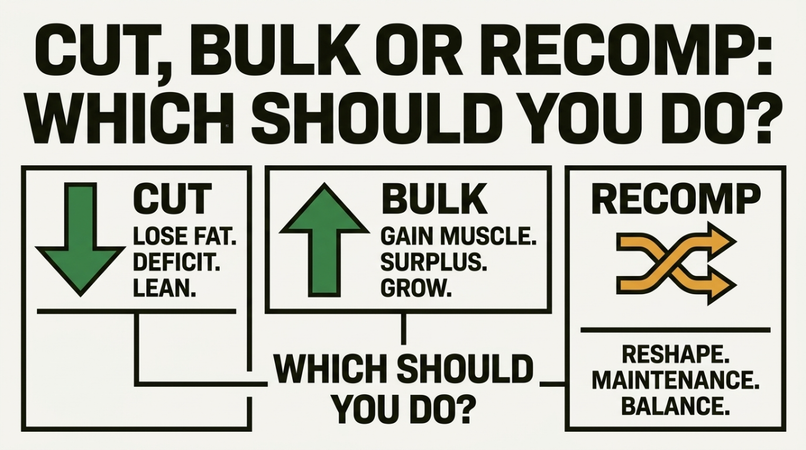
Short answer: if you are above roughly 20 percent body fat as a man or 30 percent as a woman, cut first. If you are lean and want to build, bulk. If you are new to training, returning after a break, or somewhere in the middle with fat to lose, recomposition often beats both. The wrong choice is switching every three weeks.
Estimate your body fat first, because that is what the decision rests on.
The decision, simplified
| Situation | Do this | Why |
|---|---|---|
| New to lifting, any body fat | Recomp | Beginners gain muscle and lose fat simultaneously |
| Returning after a long break | Recomp | Muscle memory makes this efficient |
| Man above 20%, woman above 30% | Cut | Plenty of stored energy; bulking adds fat you will remove later |
| Man 12-18%, woman 20-27%, trained | Either, or recomp | Depends on priority and patience |
| Man below 12%, woman below 20%, trained | Lean bulk | Further cutting costs muscle and performance |
Cutting
A calorie deficit of 15 to 25 percent, high protein, resistance training maintained. Expect to lose 0.5 to 1 percent of bodyweight weekly, with slower rates protecting muscle better as you get leaner.
- Protein 1.6 to 2.2 g per kg, higher end the leaner you are.
- Keep training loads up. Reducing weights during a cut accelerates muscle loss. Volume can drop; intensity should not.
- Plan diet breaks beyond about twelve weeks. Check if you need one.
- Expect strength to plateau rather than climb. Maintaining is a good outcome in a deficit.
Bulking
The most common error here is the surplus being far too large. Muscle can only be built so fast, and calories beyond that rate become fat.
- Surplus of 10 to 15 percent, roughly 250 to 400 calories above maintenance.
- Rate of gain: 0.25 to 0.5 percent of bodyweight monthly for trained lifters. Faster means more fat.
- Protein 1.6 to 2.0 g per kg. More is not better in a surplus.
- Progressive overload is the actual driver. A surplus without progression just adds fat. Training variables.
Realistic expectation: an experienced lifter might add one to two kilograms of muscle in a year of dedicated work. Bulking harder does not accelerate that; it changes the fat-to-muscle ratio of what you gain.
Recomposition
Eating around maintenance while training hard and keeping protein high, so fat falls and muscle rises simultaneously. It works best for beginners, returners and people with higher body fat, and becomes slower and harder as you get leaner and more trained.
The main cost is patience. Scale weight barely moves for months, which is why people abandon it. Recomp calculator with training and rest day targets.
How long to spend in each phase
- Cuts: 8 to 16 weeks, with breaks. Longer cuts erode adherence and lean mass.
- Bulks: 4 to 6 months minimum. Short bulks accomplish little because muscle gain is slow.
- Recomp: months, judged by measurements rather than the scale.
- Maintenance: underrated. Spending time at maintenance between phases improves long-term adherence and lets expenditure normalise. Post-diet maintenance.
The most common mistake
Cycling too fast. Someone cuts for three weeks, decides they look flat, bulks for three weeks, decides they look soft, and repeats. Neither phase runs long enough to produce a result, and the net effect over a year is nothing.
Pick a phase based on your current body fat, commit for a defined block, and judge it at the end rather than in the middle.
FAQ
Should I cut or bulk first?
Cut if you are above roughly 20 percent body fat as a man or 30 percent as a woman. Bulk if lean. Recomp if new to training.
Can you build muscle in a deficit?
Yes, particularly as a beginner, returner, or with higher body fat. It becomes harder as you get leaner and more trained.
How big should a bulking surplus be?
10 to 15 percent above maintenance. Larger surpluses add fat without accelerating muscle gain.
How long should a cut last?
Eight to sixteen weeks, with maintenance breaks if it runs long.
Sources
- Barakat C et al. Body Recomposition: Can Trained Individuals Build Muscle and Lose Fat at the Same Time? Strength and Conditioning Journal, 2020.
- Garthe I et al. Effect of two different weight-loss rates on body composition and strength in elite athletes. IJSNEM, 2011.
- Helms ER, Aragon AA, Fitschen PJ. Evidence-based recommendations for natural bodybuilding contest preparation. JISSN, 2014.
- Slater GJ et al. Is an Energy Surplus Required to Maximize Skeletal Muscle Hypertrophy Associated With Resistance Training? Frontiers in Nutrition, 2019.
General information, not medical advice.
Size a lean bulk surplus properly.
GramGoal Team. We build nutrition calculators and price-check the supplement market monthly. General information, not medical advice. See our methodology and affiliate disclosure.