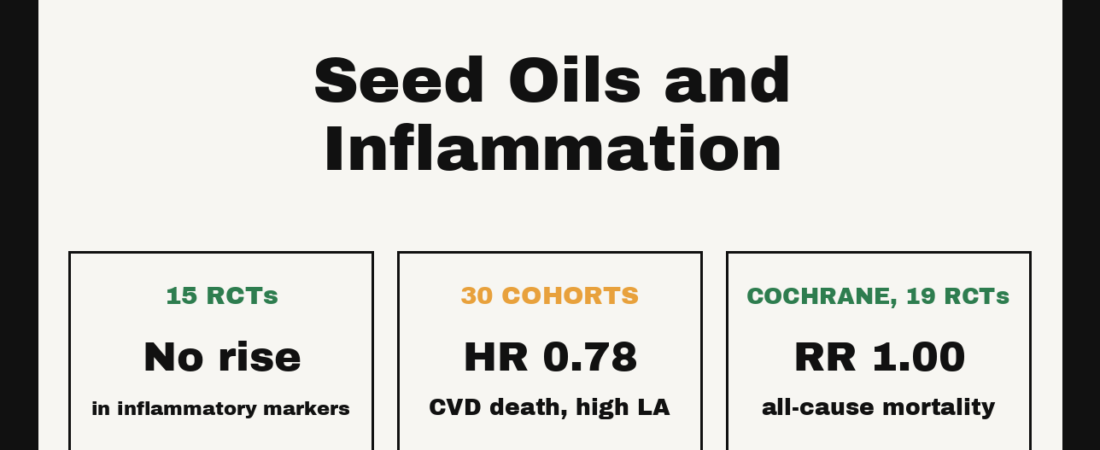
Short answer: the claim that seed oils drive inflammation has been tested directly, and the trials do not support it. A systematic review of 15 randomised controlled trials found essentially no evidence that adding linoleic acid to the diet raises inflammatory markers in healthy people. Blood-level data from 30 cohorts and 68,659 people link higher linoleic acid to lower cardiovascular risk, not higher. The honest caveat: the randomised evidence on hard outcomes is low certainty, and one recovered 1960s trial found the opposite in men who had already had a heart attack.
For the practical question of how much total fat to eat, see how much fat per day and the fat intake calculator.
What is actually being argued about
"Seed oil" is not a scientific category. In practice it means the high-linoleic cooking oils: soybean, sunflower, corn, cottonseed, safflower, grapeseed and canola. What they share is a high proportion of linoleic acid, the main omega-6 fat in the food supply.
The argument runs like this: linoleic acid is a precursor to arachidonic acid, which is a precursor to pro-inflammatory signalling molecules, so eating more of it should raise inflammation. Every step is real biochemistry. Whether the chain produces that outcome in humans eating food is a separate question, and it has been tested.
The inflammation claim, tested head-on
Johnson and Fritsche gathered every randomised controlled trial in which healthy, non-infant humans were fed differing amounts of linoleic acid and had inflammatory markers measured. Fifteen qualified: eight parallel-group, seven crossover.
None of the fifteen produced a significant increase in C-reactive protein, fibrinogen, plasminogen activator inhibitor type 1, cytokines, soluble vascular adhesion molecules or tumour necrosis factor alpha. Two reported small shifts in prostaglandin and thromboxane metabolites, which the authors did not read as increased inflammation. Their conclusion: virtually no randomised evidence shows that adding linoleic acid to the diet increases inflammatory markers.
That is the single most direct test of the specific claim, and it is negative.
What happens to the outcomes that matter
Inflammatory markers are a proxy. Deaths and heart attacks are not. Two large bodies of evidence look at those directly, and they disagree in an instructive way.
| Study | Type and size | Main finding |
|---|---|---|
| Johnson & Fritsche 2012 | Systematic review, 15 RCTs | No increase in CRP, TNF-α, fibrinogen or cytokines |
| Hooper 2018 (Cochrane) | 19 RCTs, 6,461 people, 1–8 years | All-cause mortality RR 1.00 (0.88–1.12); CVD events RR 0.97 (0.81–1.15); MI RR 0.88 (0.76–1.02). All low certainty |
| Marklund 2019 | 30 cohorts, 68,659 people, 15,198 CVD events | Higher blood linoleic acid: total CVD HR 0.93, CVD death HR 0.78, ischaemic stroke HR 0.88 |
| Ramsden 2013 (Sydney Diet Heart) | RCT 1966–73, 458 men after a coronary event | Linoleic acid group died more: 17.6% v 11.8%, HR 1.62 (1.00–2.64) |
The Cochrane review is the cautious middle. Across 19 trials, increasing omega-6 fats made little or no difference to death or cardiovascular events and may have slightly reduced heart attacks — but every one of those conclusions was graded low-certainty, downgraded for risk of bias and indirectness. The correct reading is not "proven safe", it is "the randomised evidence is weak and shows no signal of harm".
The Marklund analysis is the largest dataset, and it sidesteps the weakness of diet questionnaires by measuring linoleic acid in blood and tissue rather than asking people what they ate. Across 68,659 participants, those with more linoleic acid in circulation had less cardiovascular disease, not more. Arachidonic acid, the supposedly inflammatory downstream product, showed no increased risk either.
The trial that points the other way
The Sydney Diet Heart Study is the strongest card in the seed-oil sceptic’s hand, and it deserves to be described accurately rather than waved away.
It ran from 1966 to 1973 in 458 Australian men aged 30 to 59 who had recently had a coronary event. The intervention group replaced animal fats and common margarines with safflower oil and safflower-oil margarine, pushing linoleic acid from about 6% of energy to about 15%. Ramsden and colleagues recovered the original data from magnetic tape decades later and found the intervention group died more often: 17.6% versus 11.8% all-cause, 17.2% versus 11.0% cardiovascular, 16.3% versus 10.1% coronary. Adding the missing data to a meta-analysis of linoleic-acid-selective trials produced non-significant trends toward harm: coronary death HR 1.33 (0.99–1.79), cardiovascular death HR 1.27 (0.98–1.65).
The limitations are the authors’ own, stated in the paper. The dose was extreme, and they note the findings may not generalise to lower linoleic acid intakes, to women, to men outside 30–59, or to people without established heart disease. The oil was safflower, chosen because it raises omega-6 without any omega-3 — cleaner science, but less like anything a normal person eats. And in the authors’ own pooled analysis, the four trials that raised omega-3 alongside omega-6 showed reduced cardiovascular mortality, HR 0.79 (0.63–0.99).
Where this leaves things
- The direct inflammation claim is not supported. Fifteen randomised trials looked for it and did not find it.
- The large observational signal runs the other way: more linoleic acid in the blood, less cardiovascular disease.
- The randomised evidence on death and heart attacks is genuinely low certainty in both directions. Anyone claiming it is settled, either way, is overstating.
- Most seed oil in a typical diet arrives inside fried and packaged food, which differs from the oil itself in many other ways. No study here resolves that confound, and it is closer to what the ultra-processed food trials were measuring.
- Omega-3 intake is the variable with the clearer evidence base. See how much EPA and DHA you need and the omega-3 calculator.
FAQ
Are seed oils inflammatory?
Not by the measure researchers actually use. Across 15 randomised trials feeding people extra linoleic acid, none showed a significant rise in CRP, TNF-alpha, fibrinogen or cytokines.
Should I eat seed oils every day?
Nothing in the evidence base says ordinary daily amounts are harmful, and the largest biomarker dataset associates higher linoleic acid with lower cardiovascular risk. The one trial showing harm used roughly 15% of total energy from a single isolated oil in men with existing heart disease, which is not ordinary daily use.
Is it safe to eat seed oils everyday?
The randomised evidence on hard outcomes is low certainty, so "proven safe" overstates it. What can be said is that 19 trials in 6,461 people found no signal of increased death or cardiovascular events, with a risk ratio for all-cause mortality of exactly 1.00.
What are industrial seed oils?
The term usually means solvent-extracted, refined, bleached and deodorised cooking oils, as opposed to cold-pressed ones. The distinction is about processing method, not about linoleic acid content, and the trials above tested the fatty acid rather than the refining process.
Sources
- Johnson GH, Fritsche K. Effect of dietary linoleic acid on markers of inflammation in healthy persons: a systematic review of randomized controlled trials. Journal of the Academy of Nutrition and Dietetics, 2012;112(7):1029–1041.e15.
- Hooper L, Al-Khudairy L, Abdelhamid AS et al. Omega-6 fats for the primary and secondary prevention of cardiovascular disease. Cochrane Database of Systematic Reviews, 2018; CD011094.
- Marklund M, Wu JHY, Imamura F et al. Biomarkers of dietary omega-6 fatty acids and incident cardiovascular disease and mortality: an individual-level pooled analysis of 30 cohort studies. Circulation, 2019;139(21):2422–2436.
- Ramsden CE, Zamora D, Leelarthaepin B et al. Use of dietary linoleic acid for secondary prevention of coronary heart disease and death: evaluation of recovered data from the Sydney Diet Heart Study and updated meta-analysis. BMJ, 2013;346:e8707.
General information, not medical advice.
Part of The Research — studies and position stands explained plainly.
GramGoal Team. We build nutrition calculators and price-check the supplement market monthly. General information, not medical advice. See our methodology and affiliate disclosure.