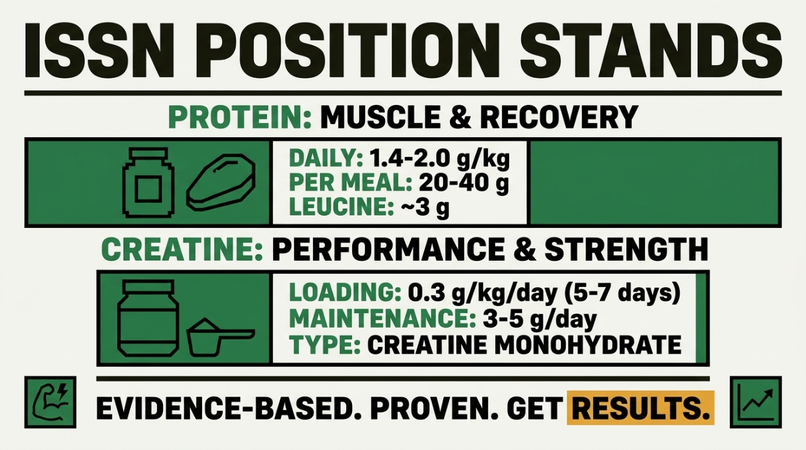
Short answer: the International Society of Sports Nutrition position stand on protein concludes that 1.4 to 2.0 g per kg of bodyweight per day is sufficient for most exercising individuals to build and maintain muscle, that higher intakes may benefit those in a calorie deficit, and that total daily intake matters more than precise timing. This article summarises what the position stands actually say, because they are the documents most fitness advice is loosely paraphrasing.
Apply the ISSN range to your bodyweight with the protein calculatorFree calculator →Apply these ranges to your own bodyweight.
What a position stand is
A position stand is a formal review in which a scientific society assembles researchers to evaluate the literature on a topic and publish agreed conclusions, with the evidence graded. It is not one study, and it is not an opinion piece. The ISSN publishes its stands in the peer-reviewed Journal of the International Society of Sports Nutrition.
They matter because they filter noise. A single trial can find almost anything; a position stand describes where the weight of evidence sits, and states plainly where it is thin.
Protein: the core conclusions
- Total intake. 1.4 to 2.0 g per kg of bodyweight daily is sufficient for most exercising people to build and maintain muscle mass.
- Higher intakes. Amounts above this may be appropriate for people in a calorie deficit trying to preserve lean mass, or for those with high training volumes. Intakes in the region of 2.3 to 3.1 g per kg of fat-free mass have been examined for resistance-trained individuals in a deficit.
- Per meal. Roughly 0.25 g per kg of bodyweight per meal, or about 20 to 40 g of a complete protein, maximally stimulates muscle protein synthesis in most people.
- Leucine. Approximately 2 to 3 g of leucine per serving appears necessary to maximally trigger the response, which is what drives the emphasis on complete proteins.
- Distribution. Spreading intake across meals every three to four hours is recommended over a skewed pattern.
- Safety. Higher protein intakes have not been shown to harm kidney function in healthy individuals. Existing kidney disease changes this, and is a medical question.
Nutrient timing: the window is wider than folklore
The ISSN nutrient timing position stand concluded that the anabolic window is considerably wider than the thirty-minute figure that circulated for years, with the post-exercise period remaining nutrient-sensitive for at least several hours. It also noted that pre-sleep protein of 30 to 40 g can increase overnight muscle protein synthesis.
Schoenfeld and colleagues meta-analysis of protein timing found that when total daily protein intake was controlled for, the apparent advantage of immediate post-workout protein largely disappeared. Full breakdown of the timing evidence.
Creatine: what the stand concludes
- Creatine monohydrate is described as the most effective ergogenic nutritional supplement available for increasing high-intensity exercise capacity and lean mass during training.
- It is not harmful in healthy individuals at recommended doses, with the safety literature spanning decades.
- Loading of roughly 0.3 g per kg daily for five to seven days saturates stores quickly; 3 to 5 g daily reaches the same point more slowly.
- Monohydrate is the reference form. Alternative forms have not demonstrated superiority.
Loading versus steady dosing compared.
How the ISSN ranges compare with government guidance
This is where confusion usually starts. The two sets of numbers answer different questions.
- The old RDA of 0.8 g per kg was set to prevent deficiency across a general population, not to optimise muscle mass or performance.
- The 2025-2030 Dietary Guidelines for Americans raised the general-population figure to 1.2 to 1.6 g per kg. What changed and why.
- The ISSN range of 1.4 to 2.0 g per kg addresses exercising individuals specifically, which is why it sits higher.
Neither is wrong. They describe different populations and different goals, and quoting one at someone in the other situation is the source of most arguments about protein on the internet.
What the stands are careful about
Worth noting for balance: position stands are written by researchers who often receive industry funding, and the ISSN has industry sponsorship. That is disclosed in the publications rather than hidden, and the conclusions are broadly consistent with independent reviews such as Morton and colleagues meta-analysis in the British Journal of Sports Medicine, which found protein supplementation augments resistance-training gains with benefits plateauing around 1.6 g per kg. Convergence between independently funded and society reviews is a reasonable signal.
Practical translation
- Set total daily protein at 1.6 to 2.2 g per kg if you train, higher end in a deficit.
- Split it across three to five meals of 25 to 40 g.
- Do not obsess over timing until the total and split are consistent.
- Add creatine monohydrate at 3 to 5 g daily if you train and want the best-supported supplement available.
- Everything else is a rounding error by comparison.
FAQ
What does ISSN recommend for protein?
1.4 to 2.0 g per kg of bodyweight daily for most exercising individuals, with higher intakes appropriate during calorie restriction.
Is 2 g per kg of protein too much?
It sits within the recommended range for exercising people and has not been shown to harm kidney function in healthy individuals.
Why does the ISSN number differ from the RDA?
The RDA prevents deficiency in a general population. The ISSN range targets muscle building and retention in people who train.
How much protein per meal does research support?
Roughly 0.25 g per kg per meal, or about 20 to 40 g of complete protein, supplying 2 to 3 g of leucine.
Sources
- Jäger R et al. International Society of Sports Nutrition Position Stand: protein and exercise. Journal of the International Society of Sports Nutrition, 2017.
- Kerksick CM et al. International Society of Sports Nutrition Position Stand: nutrient timing. Journal of the International Society of Sports Nutrition, 2017.
- Kreider RB et al. International Society of Sports Nutrition position stand: safety and efficacy of creatine supplementation. JISSN, 2017.
- Morton RW et al. A systematic review, meta-analysis and meta-regression of the effect of protein supplementation on resistance training-induced gains in muscle mass and strength. British Journal of Sports Medicine, 2018.
- Schoenfeld BJ, Aragon AA, Krieger JW. The effect of protein timing on muscle strength and hypertrophy: a meta-analysis. JISSN, 2013.
- US Departments of Agriculture and Health and Human Services. Dietary Guidelines for Americans, 2025-2030. dietaryguidelines.gov
General information, not medical advice. Protein recommendations differ for people with kidney disease.
Part of The Research — studies and position stands explained plainly.
GramGoal Team. We build nutrition calculators and price-check the supplement market monthly. General information, not medical advice. See our methodology and affiliate disclosure.