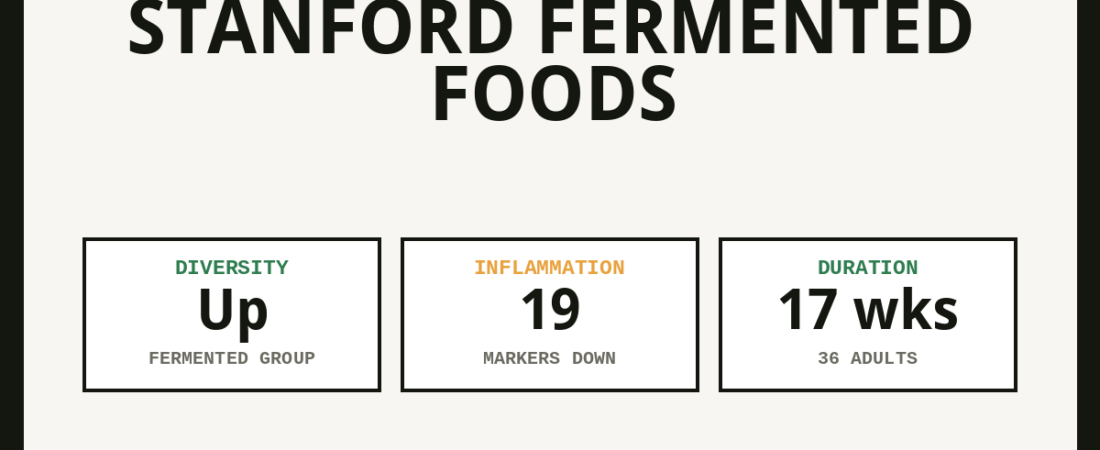
Short answer: Wastyk and colleagues 2021, published in Cell by a Stanford team, compared a high-fibre diet against a high-fermented-food diet over 17 weeks. The fermented food group showed increased microbiome diversity and decreased markers of inflammation. The high-fibre group did not, which surprised the researchers.
The design
Thirty-six healthy adults were randomised to one of two diets for 17 weeks, with a ramp-up period and then a maintenance phase. Both groups increased their intake substantially from baseline.
- Fermented food group: up to six servings daily of yoghurt, kefir, fermented cottage cheese, kimchi, other fermented vegetables, vegetable brine drinks and kombucha.
- High-fibre group: up to 45 g of fibre daily from legumes, seeds, wholegrains, nuts, fruit and vegetables.
Blood and stool samples were collected throughout, with 19 inflammatory proteins measured.
The results
| Outcome | Fermented foods | High fibre |
|---|---|---|
| Microbiome diversity | Increased | No overall change |
| Inflammatory markers | 19 proteins decreased | No overall decrease |
| Response consistency | Consistent across participants | Varied by baseline microbiome |
The fibre result was the unexpected one. The researchers proposed that participants starting with low microbiome diversity may lack the bacteria needed to process a sudden large fibre increase, and that a longer intervention might show different results.
How to read this without over-reading it
This is a genuinely well-designed controlled dietary intervention, which is rare in microbiome research. It is also 36 people over 17 weeks, and it does not show that fibre is unimportant.
Fibre has a large evidence base for cardiovascular and metabolic outcomes, including the Reynolds 2019 Lancet series. What this study suggests is more specific: for increasing microbiome diversity in the short term, fermented foods appear to work more reliably than adding fibre quickly does.
The practical takeaway is not fibre or fermented foods. It is both, with fibre increased gradually so your existing bacteria can adapt. The food-first approach.
One thing to check when shopping
Shelf-stable sauerkraut and pickles are usually pasteurised and contain no live cultures. The study used products with live organisms. Look for refrigerated items stating live or active cultures.
FAQ
What did the Stanford fermented food study find?
Fermented foods increased microbiome diversity and decreased 19 inflammatory markers over 17 weeks. High fibre did not produce the same effects in that period.
Does this mean fibre does not matter?
No. Fibre has strong evidence for cardiovascular and metabolic outcomes. This study was about short-term microbiome diversity specifically.
How much fermented food did they eat?
Up to six servings daily, ramped up over several weeks.
Does supermarket sauerkraut count?
Only if refrigerated with live cultures. Shelf-stable versions are typically pasteurised.
Sources
- Wastyk HC et al. Gut-microbiota-targeted diets modulate human immune status. Cell, 2021.
- Reynolds A et al. Carbohydrate quality and human health: a series of systematic reviews and meta-analyses. The Lancet, 2019.
- McDonald D et al. American Gut: an open platform for citizen science microbiome research. mSystems, 2018.
General information, not medical advice.
Part of The Research — studies and position stands explained plainly.
GramGoal Team. We build nutrition calculators and price-check the supplement market monthly. General information, not medical advice. See our methodology and affiliate disclosure.