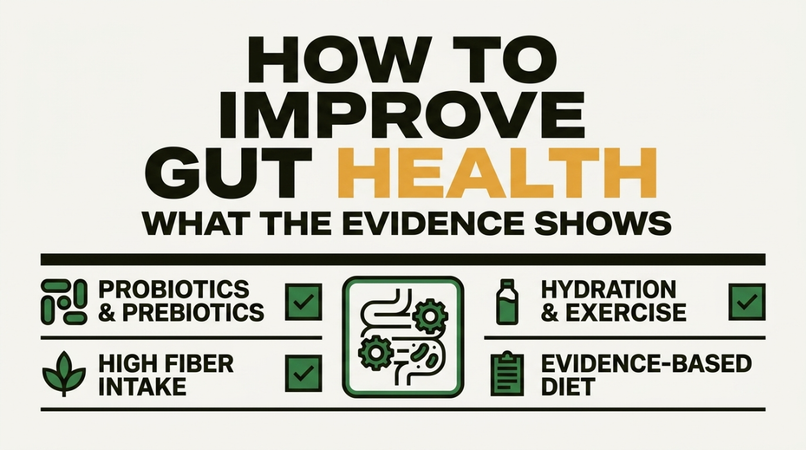
Short answer: the evidence points overwhelmingly at food rather than supplements. Eating more plant diversity and more fiber does more for your gut microbiome than any probiotic capsule, and the single most repeated finding in the research is that people who eat a wider range of plants have more diverse gut bacteria. Most adults eat roughly half the fiber recommended, which is the gap worth closing first.
What the gut microbiome actually is
Your large intestine hosts trillions of bacteria, along with fungi and viruses, collectively called the gut microbiome. These organisms ferment the parts of food you cannot digest, principally fiber, and produce short-chain fatty acids such as butyrate that feed the cells lining your colon.
Higher microbial diversity is generally associated with better health outcomes in population research, though the direction of causation is not always clear and there is no single definition of a healthy microbiome. Be sceptical of any product claiming to optimise yours, because science has not established what optimal looks like.
The interventions with the strongest evidence
1. Plant diversity
The American Gut Project, a large citizen-science study, found that people eating more than thirty different plant types per week had noticeably more diverse gut microbiomes than those eating ten or fewer. Thirty sounds daunting until you count properly: herbs, spices, nuts, seeds, whole grains and legumes all count, and a mixed handful of nuts is several.
Practical version: aim for variety rather than volume. Six different vegetables across a week beats the same one six times.
2. Fiber, and specifically fermentable fiber
Fiber is the primary food source for gut bacteria. Recommendations sit around 25 g daily for women and 38 g for men, and average intake in most Western countries is closer to 15 g. Closing that gap is the highest-value change most people can make.
- Soluble, fermentable fiber from oats, legumes, apples and psyllium feeds bacteria directly.
- Insoluble fiber from wholegrains and vegetable skins adds bulk and speeds transit.
- Resistant starch from cooked and cooled potatoes, rice and pasta, plus green bananas, reaches the colon intact and ferments there.
Increase gradually, roughly 5 g per week, and raise fluid intake alongside. Going from 15 g to 35 g overnight causes the bloating that makes people quit. More on hitting a fiber target.
3. Fermented foods
A Stanford trial published in Cell in 2021 compared a high-fiber diet with a high-fermented-food diet over ten weeks. The fermented food group, eating yoghurt, kefir, kimchi, sauerkraut and kombucha, showed increased microbial diversity and decreased markers of inflammation. This is one of the more compelling pieces of evidence in the field because it was a controlled dietary intervention rather than an observational study.
Worth noting: shelf-stable supermarket sauerkraut is usually pasteurised and contains no live cultures. Look for refrigerated products stating live or active cultures.
4. Things that harm it
- Antibiotics. Necessary when prescribed, but they reduce diversity, sometimes for months. Take them when needed and support recovery with fiber and fermented foods afterwards.
- Very low fiber diets, including poorly constructed low-carb approaches, starve fermenting bacteria.
- Chronic sleep disruption and stress, both associated with microbiome changes through the gut-brain axis.
- Excess alcohol, associated with reduced diversity and increased gut permeability.
Where supplements fit
Probiotic supplements have genuine evidence for specific, narrow uses, principally antibiotic-associated diarrhoea and some irritable bowel symptoms, with effects that are strain-specific rather than general. Buying a generic probiotic to improve gut health broadly is not well supported. Fiber supplements such as psyllium do work for regularity and satiety, but they do not replicate the nutrient package of fiber-rich whole foods.
The order of operations is food first, supplements to fill a specific gap.
A practical week
- Count your plant types for one week. Most people find they are at ten to fifteen.
- Add legumes to two meals. Lentils and beans are the highest-value single change for both fiber and diversity.
- Swap one refined grain for a wholegrain daily.
- Add one fermented food daily, refrigerated with live cultures.
- Keep nuts, seeds and herbs in rotation; they count toward diversity cheaply.
- Increase fiber by about 5 g per week, not all at once, with more water.
When symptoms need a doctor rather than a diet change
Persistent changes in bowel habit, blood in stool, unexplained weight loss, ongoing severe pain or symptoms that wake you at night warrant medical assessment rather than self-management. Coeliac disease, inflammatory bowel disease and other conditions are diagnosable and treatable, and no amount of fermented food substitutes for that.
FAQ
How long does it take to improve gut health?
Microbiome composition responds to dietary change within days, though stable shifts take weeks. The Stanford fermented food trial ran ten weeks.
Do I need a probiotic supplement?
For general gut health, probably not. Specific strains have evidence for specific conditions, which is a different question from broad improvement.
What is the 30 plants a week rule?
A guideline from American Gut Project findings that people eating over thirty plant types weekly had more diverse microbiomes. Herbs, spices, nuts, seeds and grains all count.
Does yoghurt count as a fermented food?
Yes, if it contains live active cultures. Heat-treated products do not.
Sources
- Wastyk HC et al. Gut-microbiota-targeted diets modulate human immune status. Cell, 2021. The Stanford fermented food versus fiber trial.
- McDonald D et al. American Gut: an open platform for citizen science microbiome research. mSystems, 2018.
- National Institutes of Health. Human Microbiome Project overview. nih.gov
- NHS. How to get more fibre into your diet, and digestive health guidance. nhs.uk
- Slavin J. Fiber and prebiotics: mechanisms and health benefits. Nutrients, 2013.
- Sonnenburg ED, Sonnenburg JL. Starving our microbial self: the deleterious consequences of a diet deficient in microbiota-accessible carbohydrates. Cell Metabolism, 2014.
General information, not medical advice. Persistent digestive symptoms deserve medical assessment.
Calculate your fiber target and current gap.
GramGoal Team. We build nutrition calculators and price-check the supplement market monthly. General information, not medical advice. See our methodology and affiliate disclosure.