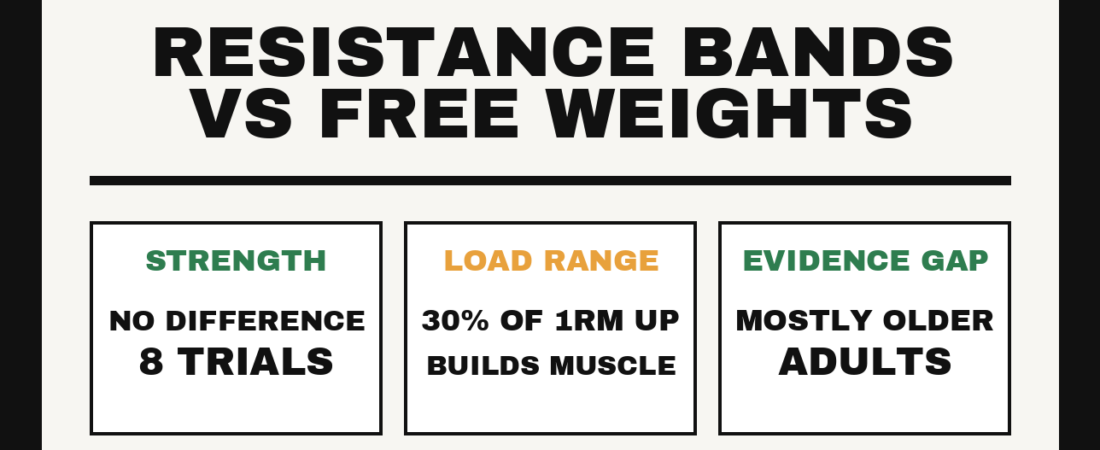
Short answer: for building strength, bands and weights come out roughly even in the trials that have compared them head to head. A 2019 meta-analysis of eight studies found no meaningful difference in either upper or lower body strength gains. The catch is that almost all of this research sits in older adults, rehabilitation settings and untrained people. There is very little evidence on whether bands can drive muscle growth in a trained lifter, and the honest answer there is that nobody has properly tested it.
What the direct comparisons found
The central piece of evidence is a 2019 systematic review and meta-analysis in SAGE Open Medicine covering eight studies that pitted elastic resistance against conventional resistance. For lower limb strength the standardised mean difference was -0.11 (95 percent CI -0.40 to 0.19, p = 0.48). For upper limb strength it was 0.09 (95 percent CI -0.18 to 0.35, p = 0.52). Both confidence intervals straddle zero comfortably. The authors concluded that elastic resistance training produces similar strength gains to conventional resistance training across different populations and protocols.
| Study | Design | Population | Finding |
|---|---|---|---|
| Lopes et al. 2019 | Meta-analysis, 8 studies | Mixed, largely untrained and older | No significant strength difference vs conventional |
| Folkins et al. 2021 | 4-week randomised trial | Adults | Similar concentric and eccentric force change |
| Hernandez-Martinez et al. 2024 | Meta-analysis, 9 trials, 477 people | Healthy older adults | Function improved; certainty of evidence very low |
That last row deserves a flag. The 2024 review in Experimental Gerontology found improvements in the 30-second chair stand, sit-and-reach and timed up-and-go, but heterogeneity ran at 98 to 100 percent and the authors explicitly rated the certainty of the evidence as very low, saying no definitive recommendations could be made. Good news reported honestly is still soft news.
Why the mechanism supports bands working
Muscle does not know what is generating the tension. A 2021 review in Sports re-examining the repetition continuum concluded that similar whole-muscle growth is achievable across a wide spectrum of loads from roughly 30 percent of one-rep max upward, provided sets are taken close to failure. The authors were emphatic that in low-load training a high level of effort is what makes the difference, and that studies showing poor results from light loads had participants stopping well short of fatigue.
That is the whole case for bands in one sentence. A band that makes the last two reps genuinely difficult is doing the same job as a dumbbell that does. A band you can pull thirty times without discomfort is not.
The hypertrophy guide covers tension, volume and proximity to failure in more detail.
Where bands are genuinely different
- The resistance curve is backwards. A band gets harder the further it stretches, so tension peaks at lockout and is lowest in the stretched position. Many free-weight movements are the opposite. This matters most where the hard part of the lift is the bottom, such as a squat or a bench press.
- You cannot measure the load. There is no reliable way to say a band is providing 40 kg at a given point, which makes progressive overload a matter of judgement rather than arithmetic. You progress by moving to a thicker band, shortening the working length, or adding reps.
- There is a ceiling. A reasonably strong lifter runs out of band before running out of capacity, particularly for lower-body movements. Upper-body pulling and pressing hold up much better.
Where the research is thin
This is the part usually left out. Almost every controlled comparison of bands against weights has been run in older adults, clinical populations or complete beginners, over four to twelve weeks, using strength and function as outcomes. Muscle thickness and cross-sectional area barely appear. There is no good trial of band-only training in resistance-trained younger adults with hypertrophy as the endpoint.
So the defensible claim is narrow: bands are proven adequate for building strength in beginners and older adults, and mechanistically plausible but untested for hypertrophy in someone already trained. Anyone telling you bands match a barbell for an experienced lifter is extrapolating past the data, and so is anyone telling you they are useless.
How to use bands so they actually work
- Take sets close to failure. Two reps in reserve or fewer. With light loads this is not optional, it is the entire mechanism.
- Add tension by shortening the band. Standing further onto the band is the most controllable way to progress without buying a new one.
- Match the exercise to the curve. Rows, pull-aparts, presses and lateral raises suit bands well. Deep squats and hip hinges suit them badly.
- Keep your volume where it would be with weights. Roughly ten or more hard sets per muscle per week. Bands do not change the dose.
- Combine rather than replace. Using bands for accessory work around compound lifts sidesteps the ceiling problem entirely.
If you train with weights alongside them, estimating your one-rep max gives you a reference point for what a band feels like relative to a real load, and the training only pays off if the nutrition supports it, so check your daily protein target.
FAQ
Can you build muscle with resistance bands only?
Almost certainly yes if you are new to training and take sets close to failure, since growth happens across a wide load range. Whether bands alone keep driving growth in an already-trained lifter has not been tested properly.
Are resistance bands as good as weights?
For strength gains in the populations studied, the meta-analytic answer is that they perform similarly. For a trained lifter chasing size, the comparison has not been made.
Do resistance bands build strength?
Yes. Eight studies pooled in 2019 found no significant difference in upper or lower body strength gains between elastic and conventional resistance training.
How do you progressive overload with resistance bands?
Shorten the band’s working length, step up to a thicker band, add reps, add sets, or slow the eccentric. You lose the precision of adding 2.5 kg, so track reps and effort instead.
Are bands better than weights for older adults?
Not better, but well supported and practical. A 2024 meta-analysis of nine trials in 477 healthy older adults found improvements in chair stand, flexibility and mobility, while cautioning that the certainty of that evidence is very low.
Sources
- Lopes JSS, Machado AF, Micheletti JK, de Almeida AC, Cavina AP, Pastre CM. Effects of training with elastic resistance versus conventional resistance on muscular strength: a systematic review and meta-analysis. SAGE Open Medicine, 2019;7:2050312119831116.
- Schoenfeld BJ, Grgic J, Van Every DW, Plotkin DL. Loading recommendations for muscle strength, hypertrophy, and local endurance: a re-examination of the repetition continuum. Sports, 2021;9(2):32.
- Hernandez-Martinez J, et al. Effects of elastic band training on body composition and physical performance in older people: a systematic review with meta-analysis. Experimental Gerontology, 2024;196:112553.
- Folkins E, Sahni S, Ryan J, Wooden S, Bushby G, Radzinski C. Concentric and eccentric force changes with elastic band and isotonic heavy resistance training: a randomized controlled trial. International Journal of Sports Physical Therapy, 2021;16(3).
General information, not medical advice. Stop and seek advice for joint pain that persists beyond normal training soreness.
GramGoal Team. We build nutrition calculators and price-check the supplement market monthly. General information, not medical advice. See our methodology and affiliate disclosure.