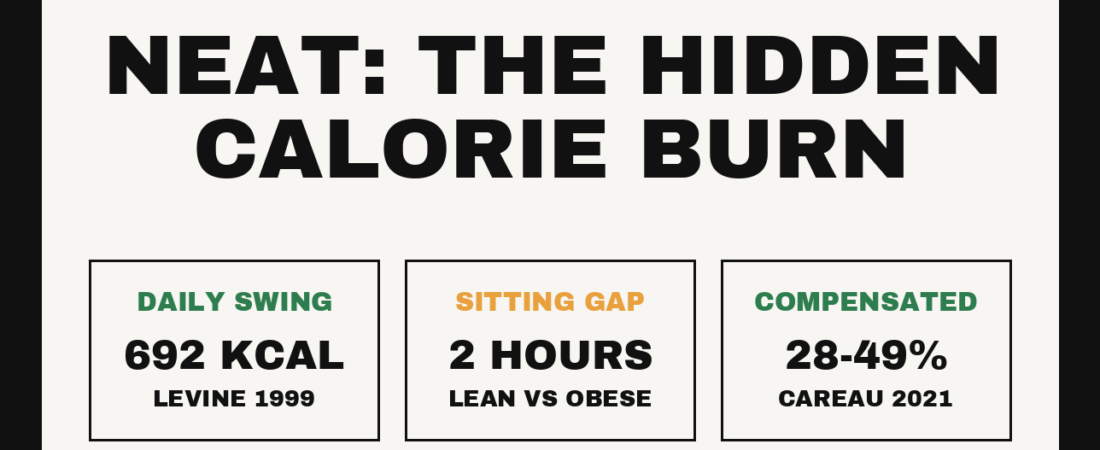
Short answer: non-exercise activity thermogenesis is everything you burn that is not sleeping, digesting or deliberate exercise — walking to the kettle, standing, fidgeting, holding posture. In Levine’s 1999 overfeeding trial, 16 adults eating 1,000 surplus calories a day for eight weeks changed their NEAT by as much as 692 kcal per day, and that one variable tracked a tenfold spread in how much fat they stored (r = 0.77). It is the largest and least controllable term in your daily burn, and no activity multiplier captures it.
Estimate your own daily burn with the TDEE calculator, or convert a step count with the steps to calories calculator.
What NEAT is
Daily energy expenditure splits four ways: resting metabolic rate, the cost of digesting food, deliberate exercise, and everything else. That last bucket is NEAT, and for most people it dwarfs their training, because training is an hour and the rest of the day is sixteen.
It is also the only one of the four that varies wildly between people of the same size. Two colleagues with identical desk jobs and identical gym routines can differ by several hundred calories a day on this term alone.
Levine 1999: the overfeeding trial
Sixteen non-obese volunteers at the Mayo Clinic spent two weeks establishing their maintenance intake, then eight weeks eating 1,000 kcal a day above it. That is a 56,000 kcal surplus in total, identical for everyone.
| Measure | Result |
|---|---|
| Surplus | 1,000 kcal/day for 8 weeks |
| Mean weight gain | About 4.5 kg (10 lb) |
| Range of weight gain | About 0.9 to 7.3 kg (2 to 16 lb) |
| Surplus stored as fat | 39% |
| Share of extra burn from NEAT | About two thirds |
| Largest NEAT increase | 692 kcal/day |
| NEAT vs fat gain | r = 0.77, p < 0.001 |
Everyone ate the same surplus. Some gained two pounds and some gained sixteen. The thing that separated them was not metabolism in the mystical sense — it was how much their bodies spontaneously moved more in response to being overfed. The people who resisted fat gain were not trying harder. They were fidgeting.
Levine 2005: lean people sit less
Six years later the same group strapped posture sensors to 10 lean and 10 mildly obese sedentary volunteers and recorded their position every half-second for 10 days. The obese participants sat roughly two hours more per day. The authors estimated that adopting the lean group’s movement pattern would be worth about 350 kcal a day.
The more interesting result was what did not happen. Posture allocation did not change when the obese participants lost weight, and did not change when the lean participants gained it. Whatever sets it appears to sit upstream of bodyweight rather than following from it.
Taken naively, 350 kcal a day is around 128,000 kcal a year, or roughly 17 kg of fat. Nobody observes that in practice, which brings us to the part most write-ups of this research leave out.
Where the evidence is thin: compensation
Extra movement does not add to your daily total one-for-one. Careau and colleagues pooled doubly labelled water data from 1,754 adults and found that part of any increase in activity energy expenditure is quietly offset by a fall in basal expenditure.
| BMI percentile | Activity calories compensated | Net gain |
|---|---|---|
| 10th | About 28% | About 72% |
| 90th | About 49% | About 51% |
So for someone at the heavier end, roughly half of what a walking pad adds gets subtracted somewhere you cannot see. Compensation rises with fat mass, which is exactly the wrong direction for the people most often told to move more.
It also runs the other way. NEAT falls during a calorie deficit, which is part of why maintenance drops as you diet. Levine’s trial was overfeeding, and there is no guarantee the response is symmetrical.
Does a walking pad actually do anything?
The best available test is Koepp and colleagues, who replaced the desks of 36 sedentary employees with treadmill desks and followed them for a year.
| Measure | Baseline | 6 months | 12 months |
|---|---|---|---|
| Sedentary time | 1,020 min/day | 929 min/day | 978 min/day |
| Change vs baseline | — | 91 min less | 42 min less |
Across the whole group, weight fell by 1.4 ± 3.3 kg. The obese subgroup lost 2.3 ± 3.5 kg. Fat mass did not change significantly across all 36 participants, though among the 22 who did lose weight it fell by 3.4 ± 5.4 kg.
Read the standard deviations. Every one of them is larger than the mean it sits beside, which means the average result is small and the spread between individuals is enormous. Note also that the effect halved between month six and month twelve — people used the treadmill less as the novelty wore off.
What to do with this
You cannot train NEAT the way you train a squat, and much of it is not under conscious control. What you can change is the environment that produces it: where you park, whether calls happen sitting down, whether there is a reason to stand up every hour.
Treat a walking pad as a way of raising the floor of a sedentary day, not as a training session. And stop expecting a calculator to account for any of this — the activity multiplier is a guess, which is one of the reasons every TDEE calculator gives you a different number. Create the deficit with food and use your weight trend over weeks as the real measurement.
FAQ
What does NEAT stand for?
Non-exercise activity thermogenesis. It covers all the energy you spend on movement that is not deliberate exercise: walking around, standing, fidgeting, maintaining posture, household and occupational activity.
How many calories does NEAT burn per day?
There is no single figure, which is the point. Levine’s overfed subjects changed their NEAT by up to 692 kcal a day in response to the same surplus, and the lean and obese groups in the 2005 study differed by an estimated 350 kcal a day in posture alone. The between-person range is in the hundreds of calories.
Is a walking pad worth it for weight loss?
As a weight loss tool on its own, the evidence is weak: about 1.4 kg over a year in the one long trial, with a spread wider than the effect. As a way of cutting 40 to 90 minutes of sitting out of a desk day, it works. Buy it for the second reason.
Why do two people with the same TDEE estimate lose weight differently?
Largely this. Resting rate is reasonably predictable from height, weight, age and sex. NEAT is not predictable from anything, and it is the term that moves most. Any calculator is giving you a starting point, not a measurement.
Can you increase your NEAT deliberately?
Partly. Deliberate added movement becomes something closer to exercise, and the compensation data say some of it gets offset. Changing your environment so that movement is the default is more durable than deciding to fidget more.
Sources
- Levine JA, Eberhardt NL, Jensen MD. Role of nonexercise activity thermogenesis in resistance to fat gain in humans. Science, 1999;283(5399):212–214.
- Levine JA, Lanningham-Foster LM, McCrady SK, Krizan AC, Olson LR, Kane PH, Jensen MD, Clark MM. Interindividual variation in posture allocation: possible role in human obesity. Science, 2005;307(5709):584–586.
- Koepp GA, Manohar CU, McCrady-Spitzer SK, Ben-Ner A, Hamann DJ, Runge CF, Levine JA. Treadmill desks: A 1-year prospective trial. Obesity, 2013;21(4):705–711.
- Careau V, Halsey LG, Pontzer H, et al. Energy compensation and adiposity in humans. Current Biology, 2021;31(20):4659–4666.
General information, not medical advice.
Part of The Research — studies and position stands explained plainly.
GramGoal Team. We build nutrition calculators and price-check the supplement market monthly. General information, not medical advice. See our methodology and affiliate disclosure.