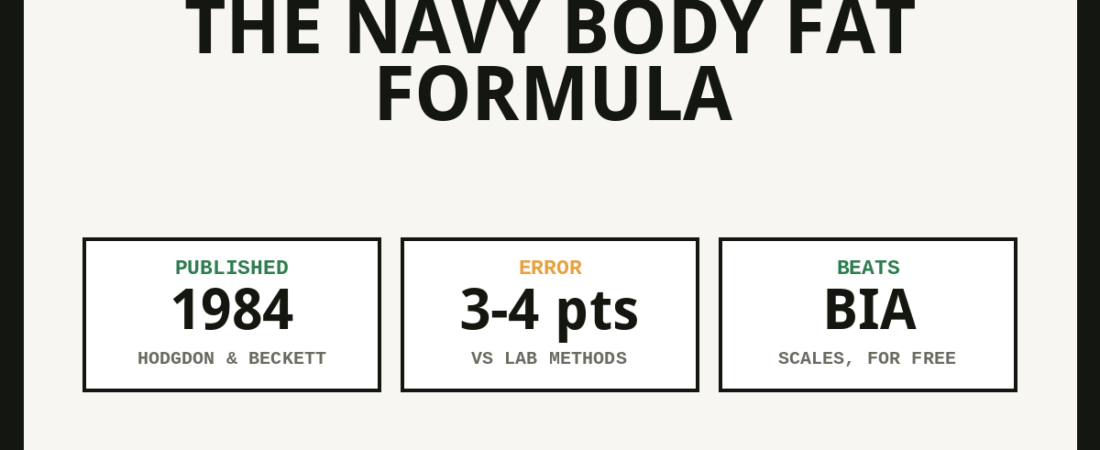
Short answer: the US Navy body fat formula comes from Hodgdon and Beckett 1984, developed at the Naval Health Research Center. It estimates body fat from neck, waist and, for women, hip circumference plus height. Typical error against laboratory methods is 3 to 4 percentage points, which is respectable for a tape measure.
Why it exists
The US Navy needed a body composition standard that could be applied at scale, by non-specialists, without equipment. Hydrostatic weighing was the reference method at the time and was entirely impractical for routine screening across a large service.
Hodgdon and Beckett developed regression equations predicting hydrostatically measured body density from circumference measurements, validated against several hundred naval personnel. The equations remain in use in the US military today. The Army uses a related standard.
What it measures and why it works
The logic is that abdominal circumference tracks visceral and subcutaneous fat, while neck circumference provides a correction related to frame and lean tissue. Height normalises for body size.
That same pairing of waist and height is the whole of a simpler screen: the waist-to-height ratio, where the target is keeping your waist under half your height.
It works because central adiposity correlates reasonably well with total body fat across populations. It fails in individuals where that relationship breaks down, which is the key limitation.
Accuracy compared with other methods
| Method | Typical error | Practicality |
|---|---|---|
| DEXA | 1-2 points | Clinic, costly |
| Hydrostatic weighing | 2-3 points | Laboratory only |
| Navy tape method | 3-4 points | Free, repeatable at home |
| Skinfold calipers | 3-4 points | Cheap, needs skill |
| Bioimpedance scale | 4-8 points | Convenient, hydration sensitive |
Worth noting where it sits: the tape method matches skinfold calipers and beats consumer bioimpedance scales, at no cost and with better repeatability than either.
Where it goes wrong
- Very muscular individuals. A thick neck from trained muscle reduces the estimate, sometimes substantially.
- Unusual fat distribution. Someone carrying fat on hips and thighs rather than the abdomen will read lower than reality.
- Measurement technique. A centimetre of tape error moves the result by a percentage point or more. Same position, same tension, same time of day.
- Population fit. Derived largely from young military personnel, so it generalises less well to older or very sedentary populations.
How to use it well
Treat the absolute number as approximate and the trend as meaningful. If you measure the same way every fortnight, a fall from 24 to 21 percent is real information even if both figures carry three points of error, because the error is largely consistent for you.
That consistency is why a free tape measure used carefully often beats an expensive scale used casually.
FAQ
How accurate is the Navy body fat formula?
Roughly 3 to 4 percentage points against laboratory methods, comparable to skinfold calipers.
Why does it measure the neck?
Neck circumference acts as a correction for frame size and lean tissue against the abdominal measurement.
Is it accurate for muscular people?
Less so. A muscular neck can pull the estimate lower than reality.
How do I measure properly?
Same landmarks every time, tape level and snug without compressing, relaxed, at the same time of day.
Sources
- Hodgdon JA, Beckett MB. Prediction of percent body fat for US Navy men and women from body circumferences and height. Naval Health Research Center, 1984.
- Peterson CM et al. Tri-ponderal mass index and body composition measures. American Journal of Clinical Nutrition.
- US Department of the Army. Army Regulation 600-9, The Army Body Composition Program.
- Gallagher D et al. Healthy percentage body fat ranges. American Journal of Clinical Nutrition, 2000.
General information, not medical advice.
Part of The Research — studies and position stands explained plainly.
GramGoal Team. We build nutrition calculators and price-check the supplement market monthly. General information, not medical advice. See our methodology and affiliate disclosure.