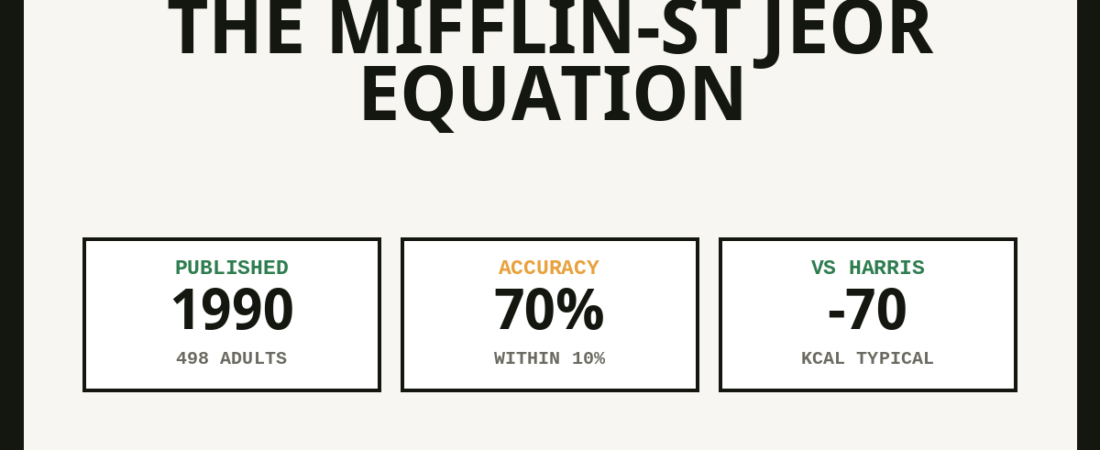
Short answer: the Mifflin-St Jeor equation was published in 1990 in the American Journal of Clinical Nutrition, derived from 498 healthy adults measured by indirect calorimetry. It replaced Harris-Benedict as the default resting metabolic rate equation because the Frankenfield 2005 systematic review found it more accurate in both non-obese and obese adults.
The equation
Men: RMR = (10 x weight in kg) + (6.25 x height in cm) – (5 x age) + 5
Women: RMR = (10 x weight in kg) + (6.25 x height in cm) – (5 x age) – 161
The only difference between sexes is the constant, which is unusual among predictive equations and part of what makes it simple to apply.
How it was derived
Mifflin, St Jeor and colleagues measured resting metabolic rate by indirect calorimetry in 498 healthy adults, roughly half of them with obesity, spanning a wide age range. They then fitted a regression against weight, height, age and sex.
The reason this mattered is that Harris-Benedict, the standard at the time, was derived in 1919 from a much smaller and less representative sample, and had been observed to overestimate in contemporary populations.
Why it became the default
The decisive evidence came from Frankenfield, Roth-Yousey and Compher in 2005, a systematic review published in the Journal of the American Dietetic Association. It compared predictive equations against measured resting metabolic rate and concluded Mifflin-St Jeor was the most reliable for both non-obese and obese adults.
That review is why dietetics practice guidance in many countries names it specifically, and why most calculators use it silently as their default.
How accurate is it?
The honest figure: Mifflin-St Jeor predicts within 10 percent of measured RMR in roughly 70 percent of individuals. That leaves about 30 percent where the estimate is off by more than a tenth, in either direction.
| Equation | Derived | Sample | Notes |
|---|---|---|---|
| Mifflin-St Jeor | 1990 | 498 adults | Current default |
| Harris-Benedict revised | 1984 | Re-analysis | Reads 50-100 kcal higher |
| Katch-McArdle | – | Lean mass based | Better if body fat known |
| Cunningham | 1980 | Lean mass based | Similar to Katch-McArdle |
The three equations compared with worked examples.
What it cannot see
The equation uses weight, height, age and sex. It has no input for body composition, which is its main structural limitation. Two people of identical weight, height, age and sex receive the same figure regardless of whether one carries substantially more muscle.
For lean, trained individuals this tends to underestimate, and for people with high body fat it tends to overestimate. Where a reliable body fat measurement exists, Katch-McArdle handles that better because it works from lean mass. Katch-McArdle calculator.
The bigger source of error
Worth stating plainly: the equation is rarely the reason a calorie target is wrong. Multiplying RMR by an activity factor introduces far more uncertainty, because one step on that scale changes the result by roughly 300 kcal while the difference between equations is under 100.
Most people also overestimate their activity level. Three gym sessions a week alongside a desk job is light to moderate, not active.
FAQ
What is the Mifflin-St Jeor equation?
10W + 6.25H – 5A + 5 for men, and the same with -161 for women, using kilograms, centimetres and years.
Is Mifflin-St Jeor the most accurate?
For the general population, the Frankenfield 2005 review found it the most reliable of the common equations. Katch-McArdle can be better with a reliable body fat figure.
How accurate is it?
Within 10 percent of measured RMR in roughly 70 percent of people.
Why do calculators disagree?
Usually the activity multiplier rather than the equation, which affects the result several times more.
Sources
- Mifflin MD, St Jeor ST, Hill LA, Scott BJ, Daugherty SA, Koh YO. A new predictive equation for resting energy expenditure in healthy individuals. American Journal of Clinical Nutrition, 1990.
- Frankenfield D, Roth-Yousey L, Compher C. Comparison of predictive equations for resting metabolic rate in healthy nonobese and obese adults: a systematic review. Journal of the American Dietetic Association, 2005.
- Roza AM, Shizgal HM. The Harris Benedict equation reevaluated. American Journal of Clinical Nutrition, 1984.
- Cunningham JJ. A reanalysis of the factors influencing basal metabolic rate in normal adults. American Journal of Clinical Nutrition, 1980.
General information, not medical advice.
Part of The Research — studies and position stands explained plainly.
GramGoal Team. We build nutrition calculators and price-check the supplement market monthly. General information, not medical advice. See our methodology and affiliate disclosure.