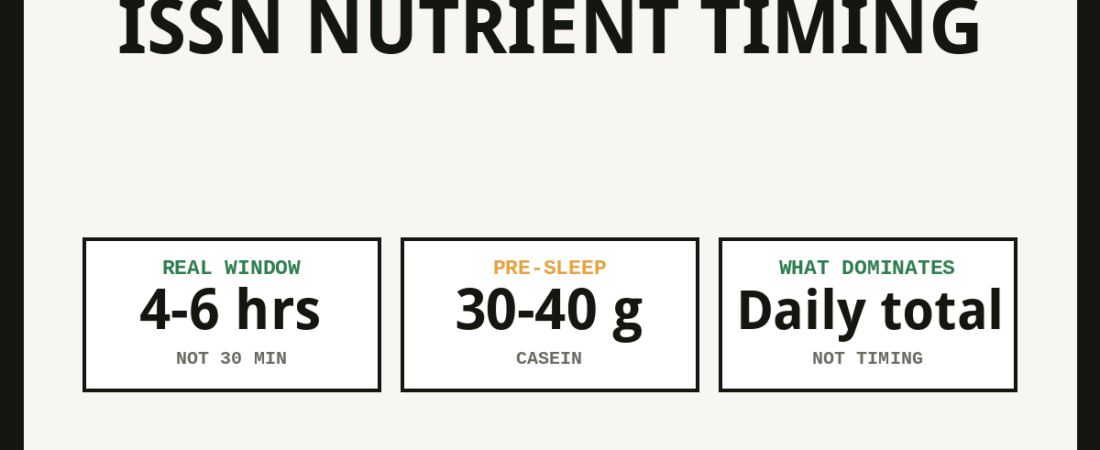
Short answer: the ISSN nutrient timing position stand concludes that the post-exercise anabolic window is considerably wider than the 30 minutes folklore suggests, remaining open for at least several hours. It also supports 30 to 40 g of pre-sleep protein, and states that total daily intake matters more than timing for most outcomes.
What the stand concludes
- The window is hours, not minutes. Muscle remains sensitive to protein for at least four to six hours post-exercise, and considerably longer in untrained individuals.
- Total daily protein dominates. Timing effects are small once total intake is adequate and well distributed.
- Pre-sleep protein works. 30 to 40 g of casein before sleep increases overnight muscle protein synthesis.
- Carbohydrate timing matters for glycogen, particularly when training twice daily or with under eight hours between sessions. For most people training once a day, it is not urgent.
- Pre-exercise protein produces similar responses to post-exercise protein, which is part of why the window is wide.
- Fasted training does not impair adaptations when total intake is adequate.
Where the 30 minute myth came from
Acute studies in the late 1990s showed that amino acids delivered around exercise raised muscle protein synthesis sharply. That finding was real. The extrapolation to a narrow window was not, and it was commercially convenient for a supplement industry selling fast-absorbing post-workout products.
The correction came largely from Schoenfeld and colleagues, whose meta-analysis found the apparent timing effect largely disappeared once total daily protein was controlled for. Full breakdown of the timing evidence.
What actually matters, ranked
| Factor | Importance |
|---|---|
| Total daily protein | Dominant |
| Distribution across meals | Meaningful |
| Per-meal dose clearing the leucine threshold | Meaningful |
| Pre-sleep feeding | Small but real |
| Minutes after training | Minor |
FAQ
How long is the anabolic window?
At least four to six hours according to the position stand, not 30 minutes.
Do I need protein immediately after training?
No. Getting your total daily protein with reasonable distribution matters far more.
Does the ISSN support pre-sleep protein?
Yes, 30 to 40 g before sleep to support overnight muscle protein synthesis.
Is fasted training bad for muscle?
Not when total daily intake is adequate.
Sources
- Kerksick CM et al. International Society of Sports Nutrition Position Stand: nutrient timing. JISSN, 2017.
- Schoenfeld BJ, Aragon AA, Krieger JW. The effect of protein timing on muscle strength and hypertrophy: a meta-analysis. JISSN, 2013.
- Res PT et al. Protein ingestion before sleep improves postexercise overnight recovery. MSSE, 2012.
- Jager R et al. ISSN Position Stand: protein and exercise. JISSN, 2017.
General information, not medical advice.
Part of The Research — studies and position stands explained plainly.
GramGoal Team. We build nutrition calculators and price-check the supplement market monthly. General information, not medical advice. See our methodology and affiliate disclosure.