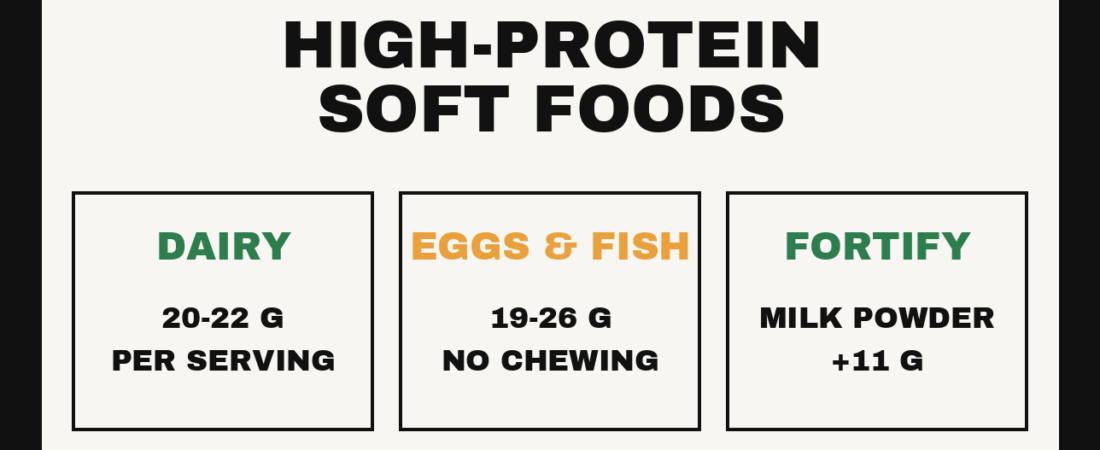
Short answer: you can hit a full protein target without chewing anything. Greek yogurt, cottage cheese, scrambled eggs, ricotta, blended legume soups, soft-cooked fish, tofu and milk-based shakes each deliver 15 to 30 g per serving. The two habits that do most of the work are anchoring every soft meal on dairy or eggs, and fortifying blended foods with skimmed milk powder or a scoop of protein powder rather than thinning them with water.
Set a daily target or split it into per-meal doses.
Why protein matters more when eating is hard
Periods of low intake are exactly when muscle is lost fastest, and they tend to be the periods when eating is least appealing: after dental surgery, during jaw pain, with nausea, or with the appetite suppression that comes with GLP-1 medication. Two expert groups have put numbers on this. The PROT-AGE group recommends 1.0 to 1.2 g per kg of bodyweight daily for healthy older adults and 1.2 to 1.5 g per kg during acute or chronic illness. The ESPEN expert group landed on the same ranges independently.
For a 70 kg adult that is 70 to 105 g a day, which is achievable entirely on soft food. It just needs to be planned, because the default soft foods people reach for, soup, mashed potato, ice cream, toast soaked in tea, are close to protein-free.
Soft high-protein foods, with gram counts
| Food | Serving | Protein | Texture note |
|---|---|---|---|
| Whey or soy isolate in milk | 1 scoop + 250 ml | 34 g | Fully liquid |
| Cod or other white fish, poached | 120 g | 26 g | Flakes with a fork |
| Firm tofu, blended | 150 g | 26 g | Smooth when blended |
| Canned salmon or tuna, mashed | 100 g | 25 g | Mash with yogurt to loosen |
| Slow-cooked chicken, shredded in sauce | 100 g | 25 g | Soft but still fibrous |
| Cottage cheese | 200 g | 22 g | Blend for a smooth texture |
| Greek yogurt, plain | 200 g | 20 g | Fully smooth |
| Skyr | 170 g | 19 g | Fully smooth |
| Scrambled eggs | 3 large | 19 g | Keep soft-set and moist |
| Ricotta | 150 g | 17 g | Fully smooth |
| Blended lentil soup | 350 g | 16 g | Fully smooth |
| Refried beans | 200 g | 13 g | Thin with stock if needed |
| Hummus | 150 g | 12 g | Fully smooth |
| Porridge made with milk | 250 g | 11 g | Cook longer for softer oats |
| Kefir | 250 ml | 9 g | Fully liquid |
| Silken tofu | 200 g | 10 g | Fully smooth, low protein |
| Milk | 250 ml | 8 g | Fully liquid |
| Custard made with milk | 200 g | 8 g | Fully smooth |
Values are rounded from USDA FoodData Central. The full per-100 g reference is in protein per 100 g.
Fortifying instead of diluting
The single highest-yield habit is to build soft food on a protein-containing liquid. Blending soup with stock adds volume and nothing else; blending it with milk or stirring in milk powder changes the meal.
| Add-in | Amount | Protein added |
|---|---|---|
| Whey or soy isolate powder | 1 scoop (30 g) | 25 g |
| Skimmed milk powder | 4 tbsp (30 g) | 11 g |
| Greek yogurt stirred in | 100 g | 10 g |
| Grated cheese melted in | 30 g | 8 g |
| Milk instead of water or stock | 250 ml | 8 g |
| Egg beaten into hot porridge | 1 large | 6 g |
| Silken tofu blended into a smoothie | 100 g | 5 g |
Unflavoured isolate disappears into savoury food better than most people expect, and skimmed milk powder is the cheapest fortifier per gram. Nausea tends to favour cold, mild, low-odour options, so yogurt and cold milk shakes often go down when a hot meal will not. If you are on GLP-1 medication, protecting muscle when appetite is gone covers the same problem from the appetite side.
A soft day that reaches 110 g
| Meal | What | Protein |
|---|---|---|
| Breakfast | 200 g Greek yogurt blended with banana and 4 tbsp milk powder | 31 g |
| Lunch | 3 soft-scrambled eggs with 30 g melted cheese | 27 g |
| Afternoon | 250 ml milk with 20 g isolate | 25 g |
| Dinner | 120 g poached cod with mashed potato made with milk | 30 g |
| Total | 113 g |
Nothing on that list needs chewing, and it clears the 1.2 g per kg mark for an 85 kg adult.
Two things to be careful about
Soft is not the same as safe to swallow. If a clinician has put you on a texture-modified diet for a swallowing problem, that diet is specified to a defined level on the IDDSI framework, and foods that merely feel soft can still be the wrong consistency. Follow the level you were given rather than a general list.
After dental surgery the constraint is usually different, often about heat, suction and particle size rather than swallowing, so follow the specific instructions you were given about straws, temperature and seeds.
Where the evidence is thin
- The protein gap is smaller than the calorie gap. A 2020 meta-analysis of texture-modified diets found people ate about 238 kcal per day less than on regular diets, but the protein difference, 6.3 g per day, was not statistically significant. The bigger risk on soft food is undereating overall, not protein specifically.
- Fortification outcomes are under-studied. Adding milk powder or protein powder reliably raises the protein content of a meal. Whether that translates into preserved muscle or better recovery has been tested in few controlled trials, mostly in older hospital populations.
- Presentation appears to matter. The same meta-analysis found shaped and moulded texture-modified meals outperformed traditional purees on both energy and protein intake, which suggests appetite and appearance are doing real work here, not just nutrient density.
- Almost none of this was studied in healthy adults recovering from dental work. The evidence base sits in geriatric and dysphagia care, and is being extrapolated.
FAQ
What soft foods are high in protein?
Greek yogurt, cottage cheese, ricotta, skyr, scrambled eggs, blended firm tofu, poached white fish, mashed canned fish, blended lentil soup and milk-based protein shakes. Each delivers 15 to 30 g per serving.
What can I eat for protein after dental surgery?
Yogurt, cottage cheese, soft scrambled eggs, milk shakes with protein powder and blended soups fortified with milk powder. Follow whatever your dentist said about straws and temperature.
How do I add protein to soup or mashed potato?
Use milk instead of stock or water, add 4 tbsp of skimmed milk powder for 11 g, stir in grated cheese for 8 g per 30 g, or blend in a scoop of unflavoured isolate for 25 g.
Is a protein shake enough on its own?
For a day or two it can carry the protein, but shakes are low in fibre and often low in calories. If soft eating goes past a few days, build meals around dairy, eggs and fish and use shakes to top up.
How much protein do I need while recovering?
Expert groups suggest 1.0 to 1.2 g per kg daily for healthy older adults, rising to 1.2 to 1.5 g per kg during illness. For a 70 kg adult that is roughly 70 to 105 g.
Sources
- Bauer J et al. Evidence-based recommendations for optimal dietary protein intake in older people: a position paper from the PROT-AGE Study Group. Journal of the American Medical Directors Association, 2013.
- Deutz NEP et al. Protein intake and exercise for optimal muscle function with aging: recommendations from the ESPEN Expert Group. Clinical Nutrition, 2014.
- Wu XS, Miles A, Braakhuis A. Nutritional intake and meal composition of patients consuming texture modified diets and thickened fluids: a systematic review and meta-analysis. Healthcare, 2020.
- Cichero JAY et al. Development of international terminology and definitions for texture-modified foods and thickened fluids used in dysphagia management: the IDDSI framework. Dysphagia, 2017.
- USDA FoodData Central. Agricultural Research Service, US Department of Agriculture.
- Jager R et al. International Society of Sports Nutrition position stand: protein and exercise. JISSN, 2017.
General information, not medical advice. If you have been given a texture-modified diet or post-surgical instructions, follow those.
GramGoal Team. We build nutrition calculators and price-check the supplement market monthly. General information, not medical advice. See our methodology and affiliate disclosure.