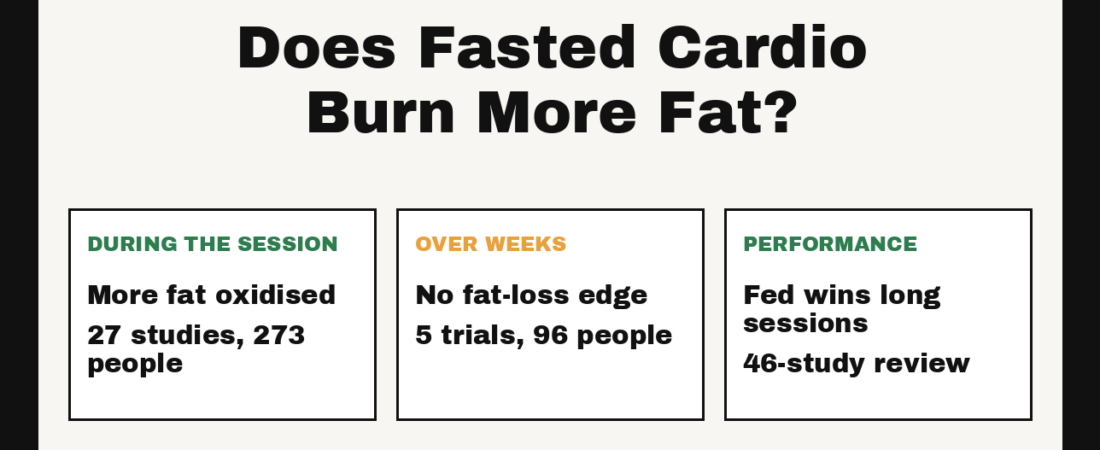
Short answer: yes, you oxidise more fat during a fasted session, and a meta-analysis of 27 studies confirms it. The amount is about three grams of fat across the whole workout, roughly 28 calories worth. Over weeks, the trials that actually measured body composition found no fat-loss advantage at all. Fasted cardio is a fine option if you like it. It is not a lever.
What happens during the session
The mechanism is real and not in dispute. Train without breakfast and insulin is low, so fat is easier to mobilise and your body leans on it more heavily for fuel. A 2016 systematic review and meta-analysis in the British Journal of Nutrition pooled 27 studies covering 273 participants and found a significant increase in fat oxidation during exercise performed fasted compared with fed. The pooled difference was about 3 g of fat across the session, with a 95 percent confidence interval running from roughly 0.8 to 5.4 g.
Three grams of fat is about 28 calories. That is the entire prize, and it is worth sitting with that number before reading on.
A more recent meta-analysis, published in Clinical Nutrition ESPEN in 2025, pooled 28 randomised trials in 302 healthy adults and complicated the picture. Free fatty acid concentrations were lower after fasted exercise than after fed exercise, and glucose and insulin rose more. But the respiratory exchange ratio, which is the direct measurement of which fuel you are actually burning, showed no significant difference between fasted and fed conditions. Two careful reviews, two different-looking answers, because they pooled different outcomes.
What happens over weeks
This is the part that matters, and the answer has been consistent since 2014.
Schoenfeld and colleagues randomised 20 young women to fasted or fed aerobic exercise, one hour three times a week for four weeks, with both groups held in a calorie deficit. Both groups lost weight and both lost fat mass. No significant between-group differences were found in any outcome measure. The authors concluded that body composition changes were similar regardless of whether training was fasted.
Hackett and Hagstrom later pooled the body-composition literature in the Journal of Functional Morphology and Kinesiology. They found five eligible studies covering 96 participants aged 21 to 27. Within-group effects on body mass were trivial to small in both conditions, and the between-group comparisons were smaller still and not statistically significant. The authors themselves flagged that the small number of studies means the finding should be read with caution.
| Study | Design | What it measured | Result |
|---|---|---|---|
| Vieira et al. 2016 | Meta-analysis, 27 studies, 273 people | Fat oxidation during exercise | About 3 g more fat oxidised fasted |
| Kazeminasab et al. 2025 | Meta-analysis, 28 RCTs, 302 people | Glucose, insulin, FFA, RER | Lower FFA fasted; no RER difference |
| Schoenfeld et al. 2014 | 4-week RCT, 20 women | Weight and fat mass | Both fell; no group difference |
| Hackett & Hagstrom 2017 | Meta-analysis, 5 studies, 96 people | Body mass, body fat percentage | Trivial effects; no group difference |
| Aird et al. 2018 | Meta-analysis, 46 studies | Performance and metabolism | Eating first helps long sessions |
The cost nobody mentions
Aird and colleagues reviewed 46 studies in the Scandinavian Journal of Medicine and Science in Sports and split the question by session length. Eating before exercise significantly improved prolonged aerobic performance (p = 0.012). For shorter sessions it made no difference (p = 0.687). Fasted exercise did raise post-exercise free fatty acids, and the authors noted signalling changes in muscle and fat tissue that may matter for adaptation, but they were explicit that the chronic picture is not settled.
So for a 30-minute walk or an easy zone 2 session, fasting costs you nothing. For a long ride or a hard hour, it probably costs you output, and output is what drives the training effect.
Where the evidence is thin
Worth being blunt about this. The body-composition meta-analysis rests on five studies and 96 people, all aged 21 to 27, none of them long. There is no trial running past a few months. Women are badly under-represented: Schoenfeld’s 20 participants are a meaningful share of the entire female dataset, which is awkward given how often the question is asked specifically about women. And the two fuel-use meta-analyses disagree on their headline marker. Nobody has run the study that would actually settle this.
What decides the outcome instead
Fat loss over a month is set by the size of your energy deficit and how well you hold it, not by the clock position of your last meal. Work out your numbers with the TDEE calculator and the calorie deficit calculator, then pick the training time you will actually keep. If protecting muscle is the worry, how to lose fat without losing muscle covers the levers that do move the needle, and walking for weight loss covers the least glamorous one.
FAQ
Does fasted cardio burn more fat?
During the session, yes, by about three grams of fat. Across weeks, no. The controlled trials that measured fat mass found no difference between fasted and fed groups.
Does fasted cardio burn muscle?
The trials that measured body composition did not find fasted groups faring worse on any outcome, but they were short and small, so this is weak reassurance rather than proof. Total protein intake and whether you lift are far larger factors than meal timing.
Is fasted cardio better than fed cardio?
Not for fat loss. For long or hard sessions, fed is better, because eating first improves prolonged aerobic performance. For short easy sessions, they are equivalent and you should pick whichever you prefer.
Is fasted cardio good for women?
The only dedicated body-composition trial in women found no advantage over fed training, and it had 20 participants over four weeks. That is the honest state of the evidence: no signal of benefit, and not enough data to say much more.
What does fasted cardio mean?
Aerobic exercise performed after an overnight fast, before eating anything. In the research it usually means 8 to 12 hours without food, which for most people is simply training before breakfast.
Sources
- Vieira AF, Costa RR, Macedo RC, Coconcelli L, Kruel LF. Effects of aerobic exercise performed in fasted v. fed state on fat and carbohydrate metabolism in adults: a systematic review and meta-analysis. British Journal of Nutrition. 2016;116(7):1153-1164.
- Kazeminasab F, Rafiee P, Miraghajani M, Santos HO, Symonds ME, Rosenkranz SK. The effects of acute bouts of exercise in fasted vs. fed states on glucose and lipid metabolism in healthy adults: a systematic review and meta-analysis of randomized clinical trials. Clinical Nutrition ESPEN. 2025;66:320-331.
- Schoenfeld BJ, Aragon AA, Wilborn CD, Krieger JW, Sonmez GT. Body composition changes associated with fasted versus non-fasted aerobic exercise. Journal of the International Society of Sports Nutrition. 2014;11:54.
- Hackett D, Hagstrom AD. Effect of overnight fasted exercise on weight loss and body composition: a systematic review and meta-analysis. Journal of Functional Morphology and Kinesiology. 2017;2(4):43.
- Aird TP, Davies RW, Carson BP. Effects of fasted vs fed-state exercise on performance and post-exercise metabolism: a systematic review and meta-analysis. Scandinavian Journal of Medicine and Science in Sports. 2018;28(5):1476-1493.
GramGoal Team. We build nutrition calculators and price-check the supplement market monthly. General information, not medical advice. See our methodology and affiliate disclosure.