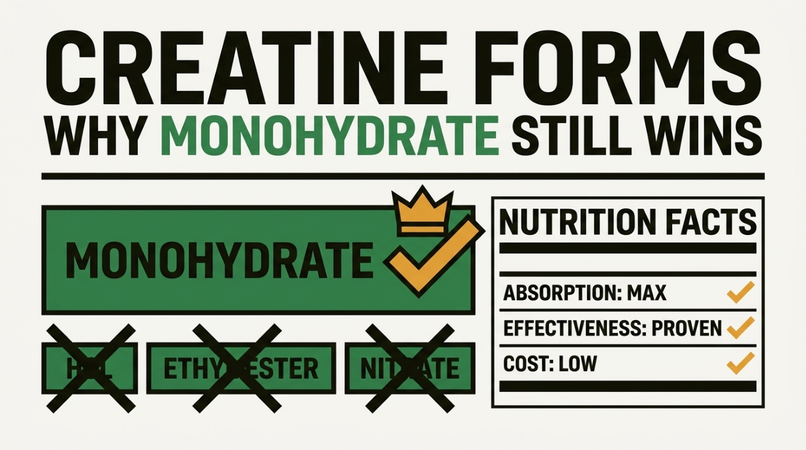
Short answer: creatine monohydrate is the form with the overwhelming majority of the research and the lowest cost per gram. Hydrochloride, ethyl ester, buffered forms and liquid versions cost more and have not demonstrated meaningful advantages. If a product is not monohydrate, you are usually paying extra for marketing.
The forms and what they claim
- Monohydrate. The reference standard. Hundreds of trials, decades of safety data, roughly 88 percent creatine by weight, and the cheapest per gram. Micronised monohydrate is the same compound ground finer so it mixes better.
- Hydrochloride (HCl). Marketed on better solubility and smaller doses. Solubility is genuinely higher, but that does not establish better results, and head-to-head evidence against monohydrate is limited.
- Ethyl ester. Claimed better absorption. Research has generally found it degrades to creatinine more readily and performs no better, in some studies worse, than monohydrate.
- Buffered (Kre-Alkalyn). Marketed on the claim that monohydrate converts to creatinine in the stomach. Comparative trials have not shown an advantage.
- Liquid creatine. Creatine is unstable in solution and degrades to creatinine over time. Generally the weakest option.
- Gummies. Convenient, but stability is a real issue and dose per gummy is often small. Full comparison here.
Why the myths persist
Monohydrate is cheap and unpatentable, which gives nobody a commercial reason to promote it. Every alternative form exists because a company can differentiate and charge more. That is not automatically dishonest, but it does explain why the best-supported option is the least marketed.
The stomach-conversion claim behind buffered creatine is a good example: it sounds mechanistically plausible, and the comparative trials simply did not find the predicted advantage.
What to look for on a label
- Creatine monohydrate as the sole active ingredient.
- Third-party testing if you compete in a tested sport.
- Price per gram, not price per tub. A 500 g tub at 19 USD is roughly 0.19 USD per 5 g dose.
- No proprietary blends hiding how much creatine you actually get.
- Nothing else you did not ask for. Pre-workout blends bundle creatine with stimulants at doses you cannot control.
FAQ
Is creatine HCl better than monohydrate?
It dissolves better. There is no good evidence it produces better results, and it costs more per gram of creatine.
Is micronised creatine worth it?
It is the same compound with a finer particle size, which mixes more easily. A small convenience benefit, usually at little extra cost.
Does creatine expire?
Dry powder is stable for years if kept sealed and dry. Creatine in liquid degrades much faster.
Do I need a loading phase?
No. It only shortens time to saturation from three or four weeks to about one. Full comparison.
General information, not medical advice. Discuss creatine with your doctor if you have kidney disease.
GramGoal Team. We build nutrition calculators and price-check the supplement market monthly. General information, not medical advice. See our methodology and affiliate disclosure.