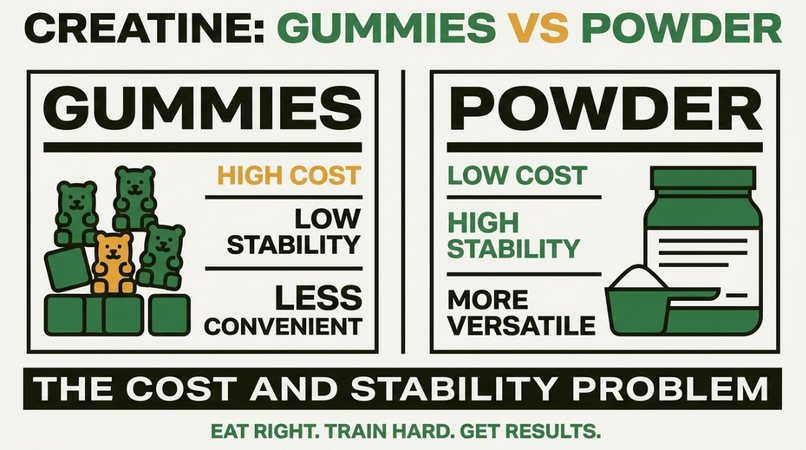
Short answer: gummies work, but you need to check the label arithmetic. Most creatine gummies deliver 1.5 to 3 g per serving, so hitting a standard 5 g daily dose often means four to six gummies, at several times the cost of powder. The bigger issue is stability: creatine degrades into creatinine in moisture, and independent testing has found some gummy products containing far less creatine than claimed.
Work out your daily dose first, then decide whether the format premium is worth it.
Why gummies became popular
Creatine searches have climbed steadily as the supplement moved beyond the gym into mainstream wellness, helped by newer research on cognition and healthy ageing. Gummy formats grew alongside that: they remove the two friction points people cite most, mixing powder into liquid and the gritty texture some monohydrate products have.
Convenience is a legitimate benefit. The supplement you actually take daily beats the theoretically superior one sitting unopened in a cupboard.
The stability problem
Creatine monohydrate is stable as a dry powder and unstable in solution. Over time in the presence of moisture it converts to creatinine, a waste product with no performance benefit. Gummies contain water and are stored at room temperature for months, which is exactly the condition that drives that conversion.
This is not a theoretical concern. Independent testing of creatine gummies has repeatedly found products containing substantially less active creatine than the label states, in some cases a small fraction of it. Reputable manufacturers can formulate around this, but it requires real stability data rather than a claim on the packet.
The cost arithmetic
This is where most people are surprised. Compare on cost per 5 g of creatine, not per container:
- Powder: a 500 g tub at around 19 USD gives 100 doses of 5 g, roughly 0.19 USD per dose.
- Gummies: a typical tub might hold 60 gummies at 1.5 g each, which is 90 g of creatine in total, at around 25 USD. That is 18 doses of 5 g, roughly 1.39 USD per dose.
That is seven times the cost for the same amount of the same compound. For a supplement you take daily for years, the difference is substantial.
How to evaluate a gummy product
- Check grams per gummy, not per serving. A serving may be four gummies. Multiply to find your real daily count.
- Look for third-party testing of the finished product. Given the stability issue, testing matters more here than for powder.
- Check the form. It should be creatine monohydrate. Alternative forms cost more without demonstrated advantages.
- Watch added sugar. Four to six gummies daily adds calories that count toward your total.
- Do the cost per 5 g calculation before buying. It takes thirty seconds and often ends the debate.
Who should choose which
Powder makes sense for almost everyone: cheapest per gram, stable, and easily mixed into anything you already drink. Gummies make sense if you have genuinely tried powder and stopped taking it, because adherence beats optimisation. If the format is what gets the supplement into you consistently, the premium may be worth paying, provided the product is tested.
FAQ
Do creatine gummies actually work?
If the product contains the creatine it claims and you take enough gummies to reach 3 to 5 g daily, yes. Both conditions need checking.
How many creatine gummies equal a scoop?
Depends on the product. At 1.5 g per gummy you need three to four for a 5 g dose; at 3 g per gummy, two.
Why are creatine gummies more expensive?
Manufacturing complexity, packaging, and the fact that convenience formats carry a price premium across the whole supplement category.
Do creatine gummies expire faster?
The concern is degradation to creatinine rather than spoilage. Buy from brands publishing stability data and avoid storing them somewhere warm.
General information, not medical advice. Discuss supplements with your doctor if you have a kidney condition or take medication.
GramGoal Team. We build nutrition calculators and price-check the supplement market monthly. General information, not medical advice. See our methodology and affiliate disclosure.