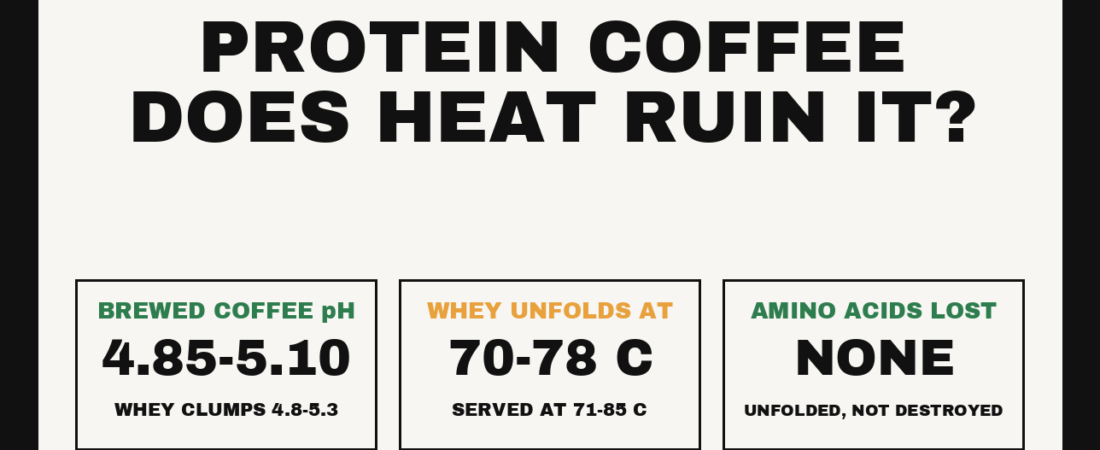
Short answer: no. Heat unfolds protein, it does not destroy the amino acids, and unfolded whey is actually broken down faster in the stomach than the native form. The clumping people notice is a pH problem, not a damage signal. The one genuine nutritional cost, glycation blocking lysine, needs far more heat and far more time than a mug of coffee provides. The honest caveat is a different one: coffee’s roast compounds inhibit a digestive enzyme in the test tube, and nobody has tested that in people.
Work out your daily protein target.
Denaturation is not destruction
The two words get used interchangeably and mean different things. Denaturing a protein unfolds its shape; the peptide bonds and amino acids are untouched. Since digestion works by unfolding proteins anyway, heat does part of the job for you.
The clearest demonstration comes from simulated gastric digestion of beta-lactoglobulin, the main whey protein and a famously pepsin-resistant one. After two hours of digestion, 65 percent of the native protein was still intact. Heating it at 90 degrees Celsius for five minutes first dropped that to 33 percent, and longer heating dropped it further.
| Treatment | Undigested |
|---|---|
| Native, unheated | 65% |
| 90 °C for 5 min | 33% |
| 90 °C for 60 min | 15% |
| 90 °C for 120 min | 7% |
A systematic review of 102 studies on milk protein processing reached the same conclusion in general terms: denaturation maintains overall digestibility while speeding up gastric breakdown. It named a different process, glycation, as the one that genuinely impairs digestibility and lysine availability. More on that below.
Faster gastric breakdown is not the same as more muscle built, so this is not an argument that hot coffee improves your shake. It is an argument that it does not harm it.
How hot is your coffee, actually?
This matters because whey’s major fractions need roughly 70 to 78 degrees before they unfold much, and coffee cools fast.
| Stage | Temperature |
|---|---|
| Brewing standard (SCA and NCA) | 90.6 to 96.1 °C |
| Typically served | 71 to 85 °C |
| Temperature people actually prefer to drink | 58 to 71 °C |
In one study of milk proteins, holding them at 55 to 65 degrees for 30 seconds left over 95 percent still native, and substantial denaturation of the main whey fractions required 95 degrees. Stirring cold powder into a mug already below 80 degrees is nowhere near that.
Why it clumps, and how to stop it
The clumping has a specific and slightly unlucky explanation. Proteins are least soluble at their isoelectric point, the pH where their net charge is zero. For the main whey fractions that window is pH 4.8 to 5.3. Hot brewed coffee measures pH 4.85 to 5.10.
So coffee sits almost exactly in whey’s worst-case pH range. Add heat above about 70 degrees and the unfolded molecules stick to each other through exposed hydrophobic regions, and you get the curdled look. That is a texture problem, not a nutrition problem.
- Slurry it first. Mix the powder into a small amount of cold water or milk until smooth, then pour the coffee in slowly.
- Let the coffee cool for a couple of minutes before adding anything.
- Use an isolate or hydrolysate rather than a concentrate. The difference between them.
- Use collagen or a clear whey. Both are formulated to stay dissolved. Clear whey explained.
- Try iced coffee. The whole problem largely disappears below the denaturation threshold.
The one real cost, in proportion
Glycation, the early Maillard reaction, is what actually damages protein quality: a reducing sugar reacts with the amino group on lysine and blocks it. This needs sugar, and black coffee supplies essentially none. The lactose comes from the powder itself, which is why a concentrate behaves differently from an isolate.
The best human evidence gave 15 men 40 gram doses of milk protein at either 3 percent or 50 percent glycation. Over six hours, the low-glycation protein released 49 percent of its lysine into the bloodstream and the high-glycation protein released 18 percent, an absolute drop of 31 percentage points. Crucially, leucine and phenylalanine bioavailability were unaffected, and leucine is the amino acid that triggers muscle protein synthesis.
Fifty percent glycation is an extreme. Across real infant formulas spanning 6.5 to 44.5 percent blocked lysine, only the 44.5 percent sample digested measurably worse.
For scale, here is what genuinely produces that kind of damage. Skim milk powder stored for 30 days lost available lysine as follows.
| Conditions | 43% humidity | 52% humidity |
|---|---|---|
| 30 °C | 5.9% | 13.7% |
| 32.5 °C | 11.9% | 22.2% |
| 35 °C | 15.8% | 29.0% |
Weeks, not minutes; in dry powder, driving measurable early Maillard reaction took up to 450 minutes at 60 degrees. Nobody has directly measured lysine loss from stirring powder into a hot drink, so this is inference from kinetics rather than a measured result. On those kinetics, your tub loses more sitting in a warm cupboard for a month than five minutes in a mug could cost it.
Does the coffee itself interfere?
Here the honest answer is more open than most articles admit. Caffeine has never been shown to impair protein or amino acid absorption, and no human trial has actually tested the question, so “caffeine blocks protein” and “coffee has no effect” are both unsupported.
What does exist points mildly the other way. Coffee melanoidins, the brown compounds formed during roasting, severely inhibited trypsin in a 2024 laboratory study and reduced the digestibility of casein at concentrations the authors called reachable through regular coffee drinking. That was in vitro. An older rat study found coffee reduced protein digestibility at a high dose, attributed to tannins.
None of this is strong enough to change what anyone does. It is strong enough that the confident “coffee makes no difference” claim is not what the literature says.
What about collagen?
Collagen peptides are marketed hard for coffee, and the heat-stability claim is fair: they are already hydrolysed, so there is little structure left to unfold, and they stay dissolved.
The catch is the amino acid profile. Collagen contains no tryptophan, which makes it technically an incomplete protein, scores 0.28 on the sulphur amino acids and is low in leucine. That makes it a poor sole protein source and a poor driver of muscle growth, not a worthless one: up to about 36 percent of daily protein can come from collagen while a mixed diet still scores a full PDCAAS of 1.0. What collagen is and is not good for.
FAQ
Can you put protein powder in hot coffee?
Yes. The protein still counts. Expect texture problems rather than nutritional ones, and mix it into a cold slurry first if you want it smooth. Work out what you need per meal.
Does heat destroy protein powder?
No. Heat unfolds the protein, which is what your stomach does anyway. Denatured whey is digested at least as well and faster in the stomach.
Why does my protein powder clump in coffee?
Coffee’s pH of roughly 4.85 to 5.10 sits inside whey’s isoelectric window of 4.8 to 5.3, where the protein is least soluble. Heat above about 70 degrees then makes the unfolded molecules stick together.
How do you make protein coffee?
Whisk the powder into 50 to 80 ml of cold liquid until smooth, then add the coffee slowly while stirring. A blender or milk frother works better than a spoon. Over ice, it is far easier.
Is collagen better than whey in coffee?
Better for texture, worse for protein quality. Collagen dissolves cleanly in hot liquid but has no tryptophan and little leucine, so it should not be the protein you count on for muscle.
Sources
- Peram MR, Loveday SM, Ye A, Singh H. In vitro gastric digestion of heat-induced aggregates of beta-lactoglobulin. Journal of Dairy Science, 2013;96(1):63-74.
- van Lieshout GAA, Lambers TT, Bragt MCE, Hettinga KA. How processing may affect milk protein digestion and overall physiological outcomes: a systematic review. Critical Reviews in Food Science and Nutrition, 2020;60(14):2422-2445.
- van Lieshout GAA, Trommelen J, Nyakayiru J, et al. Protein glycation compromises the bioavailability of milk protein-derived lysine in vivo in healthy adult males. American Journal of Clinical Nutrition, 2025;121(4):804-815.
- Zenker HE, van Lieshout GAA, van Gool MP, Bragt MCE, Hettinga KA. Lysine blockage of milk proteins in infant formula impairs overall protein digestibility and peptide release. Food and Function, 2020;11(1):358-369.
- Aalaei K, Rayner M, Sjoholm I. Kinetics of available lysine in stored commercial skim milk powder at moderate temperatures. International Journal of Food Science and Technology, 2018;53(9):2159-2165.
- Morgan F, Appolonia Nouzille C, Baechler R, Vuataz G, Raemy A. Lactose crystallisation and early Maillard reaction in skim milk powder and whey protein concentrates. Lait, 2005;85(3):315-323.
- Li H, Zhao T, Li H, Yu J. Effect of heat treatment on the property, structure, and aggregation of skim milk proteins. Frontiers in Nutrition, 2021;8:714869.
- Freire P, Zambrano A, Zamora A, Castillo M. Thermal denaturation of milk whey proteins: a comprehensive review. Dairy, 2022;3(3):500-512.
- Rao NZ, Fuller M. Acidity and antioxidant activity of cold brew coffee. Scientific Reports, 2018;8:16030.
- Cornacchia L, Forquenot de la Fortelle C, Venema P. Heat-induced aggregation of whey proteins in aqueous solutions below their isoelectric point. Journal of Agricultural and Food Chemistry, 2014;62(3):733-741.
- Abraham J, Diller K. A review of hot beverage temperatures: satisfying consumer preference and safety. Journal of Food Science, 2019;84(8):2011-2014.
- Brown F, Diller KR. Calculating the optimum temperature for serving hot beverages. Burns, 2008;34(5):648-654.
- Raupbach J, Troise AD, Fogliano V. Water-soluble coffee melanoidins inhibit digestive proteases. Journal of Agricultural and Food Chemistry, 2024;72(11):5777-5783.
- Eggum BO, Pedersen B, Jacobsen I. The influence of dietary tea, coffee and cocoa on protein and energy utilization of soya-bean meal and barley in rats. British Journal of Nutrition, 1983;50(2):197-205.
- Paul C, Leser S, Oesser S. Significant amounts of functional collagen peptides can be incorporated in the diet while maintaining indispensable amino acid balance. Nutrients, 2019;11(5):1079.
General information, not medical or dietary advice.
GramGoal Team. We build nutrition calculators and price-check the supplement market monthly. General information, not medical advice. See our methodology and affiliate disclosure.