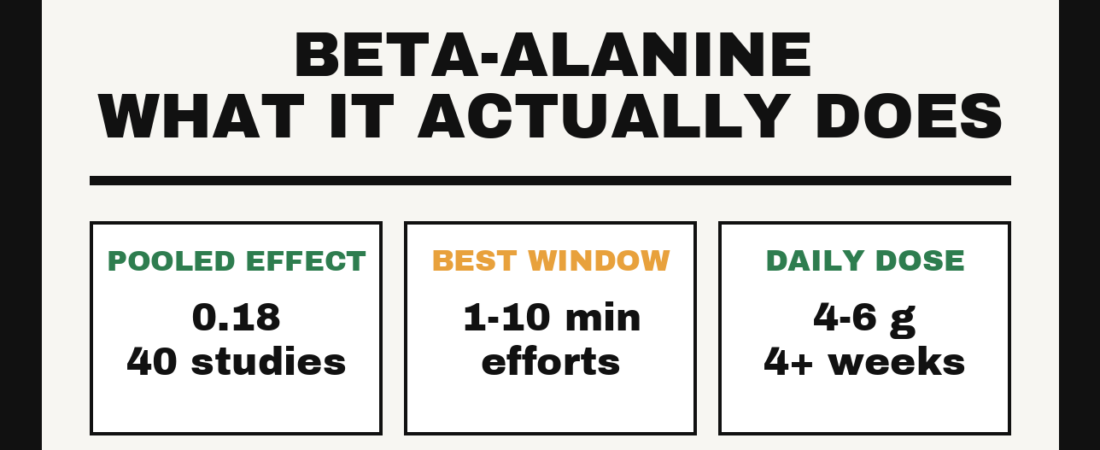
Short answer: beta-alanine works, in a narrow window. Across 40 studies in 1,461 people the overall effect size was 0.18, which is small, but it concentrates almost entirely in efforts lasting one to ten minutes. It does close to nothing for a heavy single, and close to nothing for a long ride. The tingle is harmless and the dose that matters is 4 to 6 grams a day for at least four weeks, which is more than most pre-workouts contain.
What it does
Beta-alanine is an amino acid that is not built into muscle protein. Its job is to be the rate-limiting ingredient for carnosine, a dipeptide stored in skeletal muscle that buffers hydrogen ions. Hard glycolytic work floods the muscle with those ions, pH falls and force production degrades. More carnosine means a bigger buffer and slightly later onset of that failure.
The International Society of Sports Nutrition position stand on beta-alanine puts it plainly: four weeks of supplementation at 4 to 6 grams daily significantly raises muscle carnosine, and that translates into improved exercise performance, most clearly for tasks lasting one to four minutes. The loading is the whole mechanism. A single dose before training does nothing useful, because you are filling a store, not taking a stimulant.
What the pooled data actually says
Saunders and colleagues ran the largest analysis, restricted to double-blind, placebo-controlled trials: 40 studies, 65 exercise protocols, 70 measures, 1,461 participants. The overall effect size was 0.18 (95 percent CI 0.08 to 0.28). Significant, and small.
The interesting part is where that average comes from. Exercise capacity protocols, meaning time to exhaustion at a fixed intensity, produced an effect size of 0.50. Time-trial performance, meaning covering a set distance as fast as possible, produced 0.11. Duration mattered too: the greatest benefits appeared in efforts of roughly one to ten minutes.
| Scenario | Effect size | Practical read |
|---|---|---|
| Overall, all protocols | 0.18 | Small but real |
| Time to exhaustion | 0.50 | Where the effect lives |
| Time trial | 0.11 | Close to nothing |
| Efforts of 1 to 10 minutes | Greatest benefit | The target zone |
| Efforts under 60 seconds | Not where benefits appear | Wrong energy system |
That gap between capacity and time-trial results is the honest caveat. Time to exhaustion tests are easier to move than real performance is, so the number that flatters beta-alanine most is also the one that resembles competition least.
Who it is not for
If your training is heavy sets of five with long rests, the buffering mechanism barely engages, and the ISSN stand notes that evidence for strength outcomes remains limited. If your event lasts an hour, you are not failing from acidosis. Rowers, 800 metre runners, combat athletes, high-rep circuit work and repeated-sprint sports sit squarely in the useful window. Powerlifters and marathoners largely do not.
The evidence in women is also much weaker than the headline suggests. A 2026 meta-analysis by Gu and colleagues found only 11 randomised trials in women, totalling 312 participants. Time to exhaustion improved (SMD 0.49, 95 percent CI 0.20 to 0.79), but peak power, anaerobic performance, VO2 max and body fat all returned imprecise estimates, and the authors graded certainty as very low across every outcome. The same conclusion applies here as with most supplements: most of the research was done on young men.
The tingle, and safety
Paraesthesia, the pins-and-needles flush across the face, neck and hands, is the one reliably reported side effect. Dolan and colleagues ran a formal risk assessment across 101 human and 50 animal studies. Paraesthesia had an odds ratio of 8.9 (95 percent credible interval 2.2 to 32.6) against placebo, so it is unambiguously the supplement doing it. Dropout rates matched placebo. There was a small rise in circulating alanine aminotransferase, but mean values stayed well inside clinical reference ranges, and there was no measurable depletion of muscle taurine or histidine in humans.
The tingle is dose-dependent rather than harmful, and it fades over 60 to 120 minutes. Splitting the daily total into doses of about 800 mg to 1.6 g, taken with food, largely avoids it, as do sustained-release formulations. It is not a sign the product is working, and its absence is not a sign it is not.
Reading the label
Pre-workouts typically include beta-alanine at 1.6 to 3.2 grams per scoop, sometimes buried in a proprietary blend where the actual amount is unknowable. That is often enough to make you tingle and not enough to load carnosine on a once-daily schedule, which is a fair description of why the ingredient has a reputation for being pointless. If you want the effect, you are looking for a total of 4 to 6 grams a day, every day, for at least four weeks, whether or not you train that day. If you are checking a label for that, the guide to reading a supplement label covers where the real numbers hide.
For comparison, the two supplements with stronger evidence than this one are caffeine and creatine, both of which do more across a wider range of training than beta-alanine does.
FAQ
What is beta-alanine?
An amino acid taken to raise muscle carnosine, which buffers the acidity that builds during hard, sustained efforts. It is not a stimulant and has no acute effect.
What does beta-alanine do?
It delays the point where rising acidity degrades force production, which shows up as slightly more work before failure in efforts lasting roughly one to ten minutes. The pooled effect across all trials is small (0.18) and larger in capacity tests (0.50) than in time trials (0.11).
Why does beta-alanine make you tingle?
Doses above roughly 800 mg at once trigger paraesthesia, a harmless nerve response producing pins and needles and skin flushing for an hour or two. Splitting the dose or using a sustained-release form avoids it.
What is the right beta-alanine dose?
The ISSN position stand supports 4 to 6 grams daily for at least two to four weeks, usually split into smaller doses through the day. Timing relative to training does not matter, consistency does.
Does beta-alanine have side effects?
Across 101 human studies, paraesthesia was the only side effect that showed up. Dropouts matched placebo and no clinically meaningful changes in health markers were found at the doses studied. Long-term use beyond about six months has not been well studied.
Should I use a pre-workout without beta-alanine?
If you dislike the tingle or your training sits outside the one-to-ten-minute window, you lose very little. Beta-alanine also does not need to be in a pre-workout at all, since it works by daily accumulation rather than acute dosing.
Sources
- Trexler ET, Smith-Ryan AE, Stout JR, Hoffman JR, Wilborn CD, Sale C, Kreider RB, Jager R, Earnest CP, Bannock L, Campbell B, Kalman D, Ziegenfuss TN, Antonio J. International Society of Sports Nutrition position stand: beta-alanine. Journal of the International Society of Sports Nutrition. 2015;12:30.
- Saunders B, Elliott-Sale K, Artioli GG, Swinton PA, Dolan E, Roschel H, Sale C, Gualano B. Beta-alanine supplementation to improve exercise capacity and performance: a systematic review and meta-analysis. British Journal of Sports Medicine. 2017;51(8):658-669.
- Dolan E, Swinton PA, Painelli VS, Stephens Hemingway B, Mazzolani B, Infante Smaira F, Saunders B, Artioli GG, Gualano B. A systematic risk assessment and meta-analysis on the use of oral beta-alanine supplementation. Advances in Nutrition. 2019;10(3):452-463.
- Gu J, Wei Y, Huang J, Bu Y, Xie S. Effects of beta-alanine supplementation on exercise performance and related physiological outcomes in women: a systematic review and meta-analysis. Frontiers in Nutrition. 2026;13:1857513.
GramGoal Team. We build nutrition calculators and price-check the supplement market monthly. General information, not medical advice. See our methodology and affiliate disclosure.