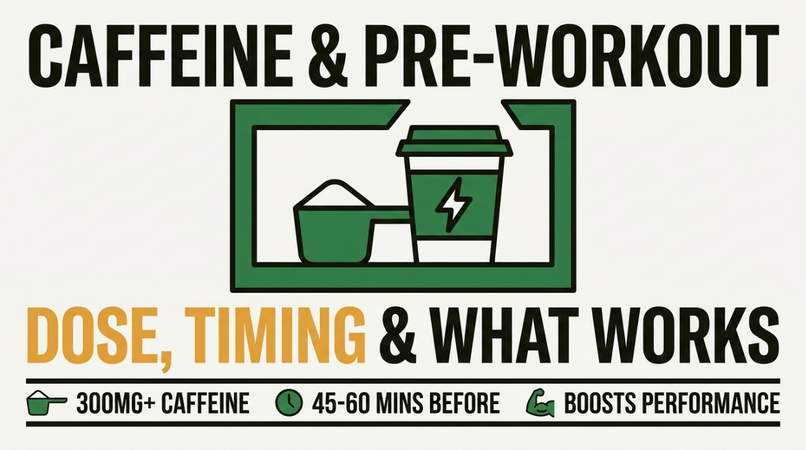
Short answer: caffeine is one of the few supplements with genuinely strong performance evidence. The International Society of Sports Nutrition position stand supports 3 to 6 mg per kg of bodyweight taken about 60 minutes before exercise for improvements in endurance, strength endurance and alertness. Most commercial pre-workouts either overshoot that or bury it in a proprietary blend alongside ingredients with far weaker support.
What caffeine actually does
Caffeine blocks adenosine receptors. Adenosine accumulates through the day and promotes drowsiness; blocking it reduces perceived effort and delays the sensation of fatigue. It does not create energy, which is why the crash arrives when adenosine binds after the caffeine clears.
For exercise specifically, the effect is well replicated: improved endurance performance, improved muscular endurance, reduced perceived exertion, and better reaction time and vigilance. Effects on pure maximal strength are smaller and less consistent.
Dosing by bodyweight
- 60 kg: 180 to 360 mg
- 70 kg: 210 to 420 mg
- 80 kg: 240 to 480 mg
- 90 kg: 270 to 540 mg
For reference, a typical brewed coffee contains roughly 80 to 120 mg, an espresso shot about 65 mg, and a strong pre-workout scoop 200 to 350 mg. Health authorities generally consider up to 400 mg daily safe for most healthy adults, which means the upper end of the performance range approaches or exceeds the daily guidance for larger individuals. Higher is not better, and above roughly 9 mg per kg side effects rise sharply without added benefit.
Timing and tolerance
Peak blood levels arrive roughly 45 to 60 minutes after ingestion, which is where the standard pre-workout timing comes from. The half-life is around five to six hours in most adults, though genetics create wide variation through the CYP1A2 enzyme. Fast metabolisers clear it quickly; slow metabolisers may still have half a dose circulating at bedtime.
Practical rule: stop caffeine at least eight hours before sleep. An afternoon coffee is a common and unrecognised cause of poor sleep, and poor sleep undermines training far more than caffeine assists it. What actually improves sleep.
Tolerance to the alertness effect develops within days to weeks. Tolerance to the performance effect appears to develop more slowly and incompletely, so habitual coffee drinkers still benefit, though a short reduction period before an important event may increase the effect.
The rest of a typical pre-workout, ranked by evidence
- Caffeine. Strong evidence. Usually the only reason the product works.
- Creatine monohydrate. Strong evidence, but pre-workouts often include an under-dose, and creatine works through daily saturation rather than acute timing, so taking it pre-workout specifically is pointless. Dose it properly and separately.
- Beta-alanine. Reasonable evidence for high-intensity efforts lasting one to four minutes, at 3 to 6 g daily accumulated over weeks. The tingling sensation is harmless paraesthesia and is not an indicator of effectiveness.
- Citrulline malate. Modest evidence for muscular endurance, generally at 6 to 8 g. Many products contain far less.
- Beetroot or nitrate. Reasonable endurance evidence, but effective doses are large and usually absent from blends.
- BCAAs. Weak. Complete protein outperforms isolated branched-chain amino acids for muscle purposes.
- Exotic proprietary compounds. Generally marketing.
The proprietary blend problem
Many pre-workouts list a blend total rather than individual doses, which makes it impossible to know whether the beta-alanine is at an effective 3 g or a token 800 mg. Given that caffeine is the ingredient doing most of the work, and citrulline and beta-alanine need substantial doses to matter, a blend that hides quantities usually indicates under-dosing of everything except the stimulant.
How to read the label properly.
The cheaper alternative
Caffeine tablets or plain coffee, dosed to bodyweight, deliver the main effect at a fraction of the cost of a branded pre-workout. If you want beta-alanine and citrulline, buying them separately lets you dose them correctly and take beta-alanine daily rather than only on training days, which is how it actually works.
Who should be careful
Caffeine raises heart rate and blood pressure acutely. People with cardiac arrhythmias, uncontrolled hypertension or anxiety disorders should discuss it with a doctor. Pregnancy guidance is generally to limit intake to around 200 mg daily. High-dose caffeine has been associated with serious adverse events, and pure caffeine powder in particular has caused deaths through dosing errors, which is why measuring by teaspoon is dangerous and pre-measured tablets are safer.
FAQ
How much caffeine before a workout?
3 to 6 mg per kg of bodyweight, roughly 60 minutes beforehand, per the ISSN position stand.
Is pre-workout better than coffee?
Not usually. Coffee delivers the caffeine that does most of the work. Pre-workouts add ingredients that are often under-dosed.
Does caffeine tolerance ruin the performance benefit?
Tolerance to alertness develops faster than tolerance to performance effects. Habitual users still benefit.
Why does beta-alanine make me tingle?
Paraesthesia, a harmless sensory effect of the compound. It indicates presence, not effectiveness.
Sources
- Guest NS et al. International Society of Sports Nutrition position stand: caffeine and exercise performance. Journal of the International Society of Sports Nutrition, 2021.
- Trexler ET et al. International society of sports nutrition position stand: Beta-Alanine. JISSN, 2015.
- US Food and Drug Administration. Spilling the Beans: How Much Caffeine is Too Much, and pure caffeine powder warnings. fda.gov
- European Food Safety Authority. Scientific Opinion on the safety of caffeine. EFSA Journal, 2015.
- Grgic J et al. Wake up and smell the coffee: caffeine supplementation and exercise performance, an umbrella review. British Journal of Sports Medicine, 2020.
- National Institutes of Health, Office of Dietary Supplements. Dietary Supplements for Exercise and Athletic Performance. ods.od.nih.gov
General information, not medical advice. Caffeine is not appropriate for everyone, particularly with cardiac conditions, uncontrolled hypertension or during pregnancy without medical guidance.
Get your caffeine dose by bodyweight and your sleep cutoff time.
See how much caffeine is still in your system at bedtime.
GramGoal Team. We build nutrition calculators and price-check the supplement market monthly. General information, not medical advice. See our methodology and affiliate disclosure.