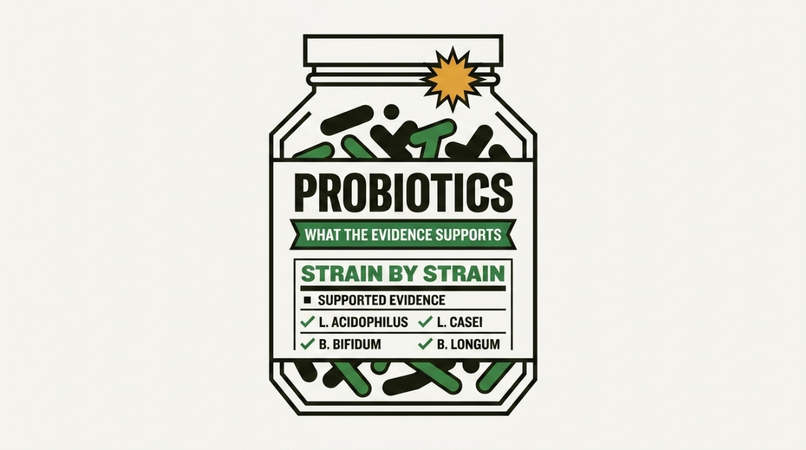
Short answer: probiotics work for specific conditions with specific strains, and much less well as a general wellness product. The strongest evidence is for antibiotic-associated diarrhoea and some irritable bowel syndrome symptoms. Buying a generic multi-strain capsule to improve gut health broadly is not well supported by the research.
The strain specificity problem
This is the single most important thing to understand, and the thing marketing consistently obscures. Probiotic effects are strain-specific, not species-specific and certainly not category-wide.
A probiotic is identified by three parts: genus, species and strain, for example Lactobacillus rhamnosus GG. The evidence attaches to that full identifier. Findings for Lactobacillus rhamnosus GG do not transfer to a different Lactobacillus rhamnosus strain, any more than findings about one medication transfer to a different drug in the same class.
Practical consequence: a product listing only Lactobacillus acidophilus, with no strain designation, is telling you almost nothing about what it does.
Where the evidence is reasonably strong
- Antibiotic-associated diarrhoea. The best-supported use. Meta-analyses find reduced incidence, particularly with Saccharomyces boulardii and Lactobacillus rhamnosus GG.
- Clostridioides difficile prevention in some at-risk hospitalised populations, though guidelines vary and this is a clinical decision.
- Acute infectious diarrhoea, where some strains modestly reduce duration, mainly studied in children.
- Irritable bowel syndrome. Some strains reduce symptoms in some patients. Results are inconsistent and effects are modest.
- Lactose digestion, where cultures in yoghurt genuinely help break down lactose.
Where evidence is weak despite heavy marketing
- General gut health in healthy people. There is little evidence that probiotics meaningfully improve the microbiome of someone without a specific condition.
- Weight loss. Some small trials, no reliable effect.
- Immunity. Plausible mechanisms, inconsistent outcomes in trials.
- Mood and the gut-brain axis. Genuinely interesting research area, currently far ahead in marketing claims relative to evidence.
- Skin conditions. Early and inconsistent.
Major clinical bodies have been cautious here. The American Gastroenterological Association guidelines recommend probiotics only for a narrow set of situations and explicitly advise against routine use for several common conditions, including IBS outside of a trial context.
Do they even survive the journey?
Stomach acid kills a large proportion of ingested bacteria. Products address this with enteric coating, delayed-release capsules or simply high doses. CFU counts, colony forming units, on labels describe what was present at manufacture, not what reaches your colon alive, and not what remains at the end of shelf life unless the label specifies at expiry.
Colonisation is also generally temporary. Most studied strains do not permanently establish themselves; they pass through, exerting effects while present. Stopping usually means the effect stops.
Prebiotics versus probiotics
Prebiotics are fibers that feed the bacteria already living in you, principally inulin, fructooligosaccharides and galactooligosaccharides, found in onions, garlic, leeks, asparagus, bananas and chicory root. Feeding your existing microbiome has better general evidence than trying to add new organisms to it, which is the main reason dietary fiber outperforms probiotic capsules for general gut health.
The food-first approach to gut health and how to hit a fiber target.
How to choose if you have a specific reason
- Identify the strain, full genus, species and strain designation, and check what that strain was actually studied for.
- Match the dose to the research. Trials typically use between one and ten billion CFU daily, sometimes more.
- Check CFU at expiry, not at manufacture.
- Check storage requirements. Some strains need refrigeration; shelf-stable formulations exist but should say so.
- Give it four weeks and judge symptoms honestly. If nothing changes, stop rather than continuing indefinitely.
Safety notes
Probiotics are generally well tolerated in healthy people, with bloating and gas the common early complaints. They are not appropriate for everyone: people who are severely immunocompromised, critically ill, or have central venous catheters have experienced rare but serious infections attributed to probiotic organisms. That is a medical decision, not a shelf decision.
FAQ
Should I take a probiotic with antibiotics?
This is the best-supported use. Certain strains reduce antibiotic-associated diarrhoea. Discuss timing with your pharmacist.
Do probiotics work for IBS?
Some strains help some patients, with modest and inconsistent effects. Guidelines are cautious about routine use.
Is yoghurt as good as a probiotic supplement?
For general purposes, fermented foods have better evidence for microbiome diversity than generic capsules. For a specific studied strain, the supplement is the way to get it.
How long should I take probiotics?
Effects generally last only while you are taking them, since most strains do not permanently colonise. Judge over about four weeks.
Sources
- Su GL et al. AGA Clinical Practice Guidelines on the Role of Probiotics in the Management of Gastrointestinal Disorders. Gastroenterology, 2020.
- National Center for Complementary and Integrative Health. Probiotics: What You Need To Know. nccih.nih.gov
- Hill C et al. Expert consensus document: The International Scientific Association for Probiotics and Prebiotics consensus statement on the scope and appropriate use of the term probiotic. Nature Reviews Gastroenterology and Hepatology, 2014.
- Guo Q et al. Probiotics for the prevention of pediatric antibiotic-associated diarrhea. Cochrane Database of Systematic Reviews.
- NHS. Probiotics guidance. nhs.uk
- Suez J et al. Post-antibiotic gut mucosal microbiome reconstitution is impaired by probiotics and improved by autologous FMT. Cell, 2018.
General information, not medical advice. Probiotics are not appropriate for people who are immunocompromised or critically ill without medical supervision.
GramGoal Team. We build nutrition calculators and price-check the supplement market monthly. General information, not medical advice. See our methodology and affiliate disclosure.