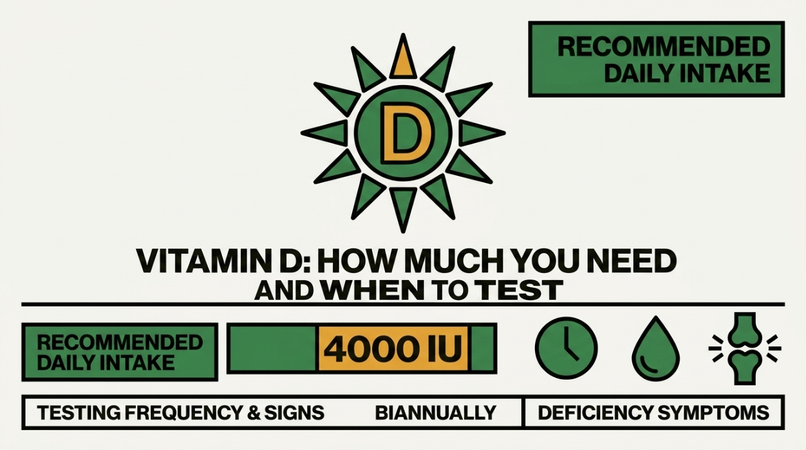
Short answer: vitamin D deficiency is genuinely common, particularly at higher latitudes and in winter, among people with darker skin, and among those who spend most of their time indoors. A typical maintenance supplement is 1,000 to 2,000 IU daily. Testing before supplementing high doses is sensible, and more is not better.
Why deficiency is so widespread
Vitamin D is produced in skin exposed to UVB light, and very little comes from food. Several factors reduce production: living above roughly 37 degrees latitude means little to no synthesis through winter months, darker skin requires substantially longer exposure for the same production, sunscreen blocks the relevant wavelengths, and indoor work removes the opportunity entirely.
Ageing also reduces the skin capacity to produce it, and obesity sequesters vitamin D in fat tissue, lowering circulating levels at the same intake.
What it actually does
- Calcium absorption and bone health. The best-established role, and the reason deficiency causes rickets in children and osteomalacia in adults.
- Muscle function. Deficiency is associated with weakness and, in older adults, higher fall risk.
- Immune function. Plausible mechanisms and some supportive evidence, though large trials of supplementation for preventing respiratory infection have produced mixed results.
- Mood. Association studies link low levels with low mood; supplementation trials in people who are not deficient have largely not shown benefit.
The pattern across the literature is consistent: correcting a deficiency helps, supplementing someone already sufficient generally does not.
Testing and interpreting levels
The blood test measures 25-hydroxyvitamin D. Commonly used thresholds are below 30 nmol/L (12 ng/mL) for deficiency and 50 nmol/L (20 ng/mL) as sufficient for bone health, though definitions vary between authorities, which is a genuine source of confusion.
If you are supplementing at modest doses, testing is optional. If you are considering high doses, or you have symptoms, testing first is the sensible route rather than guessing.
Dosing
- General maintenance: 1,000 to 2,000 IU (25 to 50 mcg) daily suits most adults, particularly through winter.
- Form: D3 (cholecalciferol) raises blood levels more effectively than D2.
- Take with fat. It is fat-soluble, so absorption improves with a meal containing some fat.
- Vitamin K2 is often bundled with D3 on the theory it directs calcium to bone. The evidence is suggestive rather than established.
- Upper limits exist. Chronic very high intake can cause hypercalcaemia. This is not a supplement where more is better.
Food sources
- Salmon, 100 g: roughly 400 to 600 IU
- Mackerel, 100 g: roughly 350 IU
- Egg yolk: roughly 40 IU
- Fortified milk, 250 ml: roughly 100 IU
- UV-exposed mushrooms: variable, sometimes substantial
Hitting 2,000 IU from food alone is difficult unless you eat oily fish regularly, which is why supplementation is common in winter.
FAQ
How much vitamin D should I take daily?
1,000 to 2,000 IU covers most adults for maintenance. Correcting a diagnosed deficiency may require more, under medical guidance.
Can you take too much vitamin D?
Yes. Sustained very high doses can raise blood calcium to harmful levels. Stay within recommended limits unless a doctor directs otherwise.
Is D3 better than D2?
D3 raises and maintains blood levels more effectively, and is the usual choice. Vegan D3 from lichen is available.
Do I need a blood test first?
Not for modest maintenance doses. Test before high-dose supplementation, or if you have symptoms or risk factors.
General information, not medical advice. Vitamin D interacts with some medications and needs care in certain conditions, including kidney disease and sarcoidosis.
Estimate your shortfall risk and maintenance dose.
GramGoal Team. We build nutrition calculators and price-check the supplement market monthly. General information, not medical advice. See our methodology and affiliate disclosure.