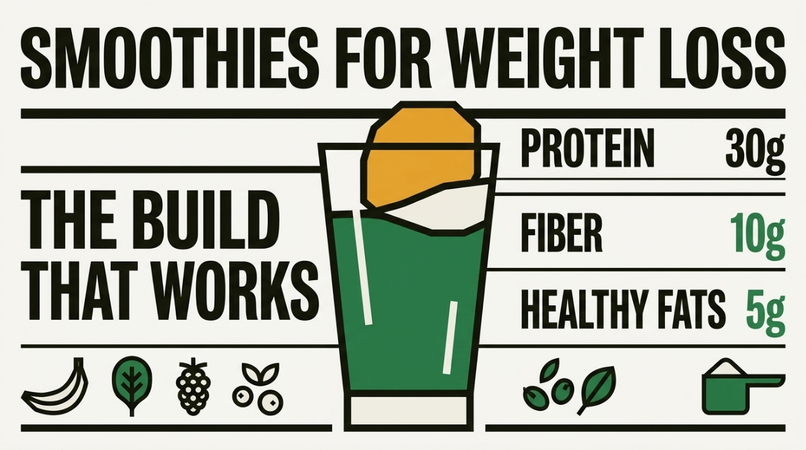
Short answer: a smoothie helps with weight loss when it replaces a higher calorie meal and contains enough protein and fibre to keep you full. It works against you when it is fruit and juice blended into a 500 calorie drink you finish in ninety seconds. The difference is entirely in the build, and most recipes marketed for weight loss get it wrong.
Work out what a meal should contain for your targets.
Why most weight loss smoothies fail
Three problems, and they compound.
- Liquid calories are less satiating. Research consistently finds that calories consumed as liquid produce weaker fullness signals than the same calories eaten as solid food, and are less well compensated for at later meals.
- Fruit-heavy recipes are calorie dense. Banana, mango, dates, juice and honey add up quickly. A typical smoothie-bar recipe can exceed 500 calories with under 10 g of protein.
- They are consumed fast. Eating rate affects satiety. A drink finished in ninety seconds registers differently from a meal eaten over fifteen minutes.
None of this makes smoothies bad. It means an unstructured smoothie is a dessert with a health halo.
The build that actually works

Treat a smoothie as a meal and hold it to the same standard. Four components:
- Protein, 25 to 40 g. Whey, Greek yoghurt, skyr, cottage cheese, soy or a pea-rice blend. This is the component most recipes skip and the one that decides whether it keeps you full.
- Fibre, 5 to 10 g. Berries, spinach, chia, flax or oats. Volume and slower digestion.
- A little fat, 5 to 15 g. Nut butter, seeds or avocado. Improves satiety and palatability. Easy to overshoot.
- Volume from something free. Water, ice, unsweetened milk alternative, spinach. Bulk without calories.
What to keep small: fruit juice as a base, dried fruit, honey, agave, sweetened yoghurt and more than one banana.
Three builds compared
| Build | Contents | Calories | Protein | Fibre |
|---|---|---|---|---|
| Typical smoothie-bar style | Mango, banana, apple juice, honey, yoghurt | About 520 kcal | 8 g | 4 g |
| Balanced meal replacement | Whey, 150 g berries, spinach, 15 g chia, water | About 320 kcal | 32 g | 11 g |
| Low calorie snack | Whey, spinach, half banana, water, ice | About 220 kcal | 26 g | 4 g |
The first and second are both smoothies. One supports a deficit and one quietly fills a third of your daily calories with almost no protein.
Ingredient reference
| Ingredient | Amount | Calories | Protein | Notes |
|---|---|---|---|---|
| Whey protein | 1 scoop, 30 g | 120 | 24 g | Best protein per calorie |
| Greek yogurt 0% | 170 g | 100 | 17 g | Thickens well |
| Frozen berries | 150 g | 75 | 1 g | High fibre, low sugar |
| Spinach | 50 g | 12 | 1 g | Free volume, no taste |
| Banana | 1 medium | 105 | 1 g | Easy to overuse |
| Chia seeds | 15 g | 73 | 2 g | Roughly 5 g fibre |
| Peanut butter | 1 tbsp | 94 | 4 g | Calorie dense |
| Orange juice | 250 ml | 112 | 2 g | Use water instead |
| Honey | 1 tbsp | 64 | 0 g | Unnecessary |
| Oats | 40 g | 152 | 5 g | Good for a full meal |
Where smoothies genuinely earn their place
- Breakfast, the meal where most people fall furthest short of protein. A 30 g protein smoothie fixes that in two minutes. Per-meal target.
- Suppressed appetite, including during GLP-1 medication use, where protein density per millilitre matters. GLP-1 protein calculator.
- Getting fruit and vegetables in for people who genuinely will not eat them otherwise.
- After training, where convenience matters and appetite is sometimes blunted.
Blending, juicing and fibre
Worth separating two things that get conflated. Blending retains the fibre; juicing removes it. That is a meaningful difference, because fibre is doing much of the satiety work and slows the absorption of the sugars alongside it.
The claim that blending destroys fibre or makes fruit sugar behave like juice is overstated. Blended whole fruit still contains its fibre, though disrupted physically, and studies comparing whole and blended fruit find smaller differences in glycaemic response than the claim implies. Juice is the genuine problem, not the blender.
Practical rules
- Add the protein first and build around it.
- Use water or unsweetened milk as the base, not juice.
- One piece of fruit, not three.
- Add greens for volume you will not taste.
- Measure nut butter rather than spooning it in.
- Drink it slowly, ideally alongside something solid.
- Count it as a meal in your day, not as a drink on top of one.
FAQ
Are smoothies good for weight loss?
When they replace a higher calorie meal and contain 25 to 40 g of protein plus fibre, yes. As an addition to your normal food, they add calories.
What is the best smoothie for weight loss?
Protein source, frozen berries, greens, a little seed or nut fat, water. Roughly 300 calories with over 30 g protein.
Should I replace a meal with a smoothie?
It can work if the smoothie meets the same protein and fibre standard as the meal it replaces. Replacing a meal with fruit and juice does not.
Do smoothies spike blood sugar?
Fruit blended with protein, fat and fibre produces a much smaller response than juice. Removing the fibre by juicing is the bigger issue.
Is a smoothie better than eating the food?
Solid food is generally more satiating for the same calories. Smoothies win on convenience and when appetite or time is limited.
Sources
- Mattes RD, Campbell WW. Effects of food form and timing of ingestion on appetite and energy intake. Journal of the American Dietetic Association, 2009.
- Rolls BJ. The relationship between dietary energy density and energy intake. Physiology and Behavior, 2009.
- Flood-Obbagy JE, Rolls BJ. The effect of fruit in different forms on energy intake and satiety at a meal. Appetite, 2009.
- Leidy HJ et al. The role of protein in weight loss and maintenance. American Journal of Clinical Nutrition, 2015.
- Institute of Medicine. Dietary Reference Intakes for Energy, Carbohydrate, Fiber, Fat, Fatty Acids, Cholesterol, Protein, and Amino Acids, 2005.
General information, not medical advice.
GramGoal Team. We build nutrition calculators and price-check the supplement market monthly. General information, not medical advice. See our methodology and affiliate disclosure.