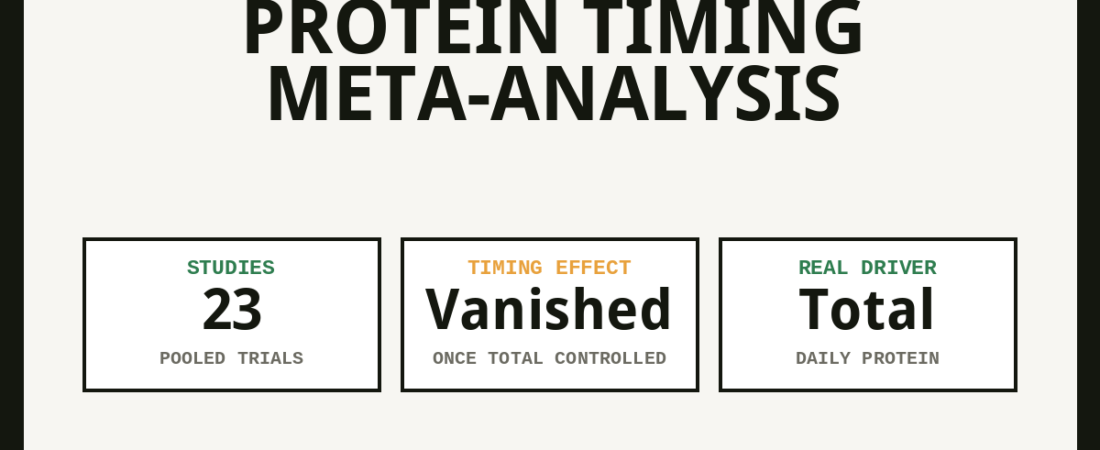
Short answer: Schoenfeld, Aragon and Krieger 2013 pooled 23 studies on protein timing and found that the apparent benefit of consuming protein close to training largely disappeared once total daily protein intake was controlled for. The studies showing a timing effect had also given the timing group more protein overall.
What the study did
It was a meta-analysis and meta-regression of randomised controlled trials comparing protein consumed near training against protein consumed at other times, in the context of resistance training. Twenty-three studies met inclusion criteria.
The critical step was the meta-regression. Rather than simply comparing timing groups, the authors tested whether total daily protein intake explained the differences observed, because many timing studies had inadvertently varied both.
The finding
A simple analysis showed a small significant effect favouring timing. When total protein intake was entered into the model, that effect became non-significant, and total intake emerged as the variable actually driving results.
In other words: the studies that appeared to show timing mattered were mostly studies where the timed group ate more protein. Once you account for that, the timing signal disappears.
What it did not show
Worth being precise, because this study is often over-claimed in both directions. It did not show that timing is irrelevant in all circumstances. It showed that in these trials, at these intakes, timing did not independently predict hypertrophy or strength gains.
Distribution across the day, which is different from proximity to training, does have supporting evidence from other work such as Mamerow 2014. And pre-sleep protein has its own literature. The finding is specifically about the minutes-after-training window.
Why it mattered
This meta-analysis is largely responsible for the shift in mainstream advice away from the 30 minute post-workout window. It gave a quantitative answer to a claim that had been repeated for a decade on the strength of acute studies.
The practical consequence: if you are worried about whether your shake was 20 minutes or 90 minutes after training, the evidence says you are optimising the wrong variable while your daily total sits unexamined. Set that total first.
FAQ
What did Schoenfeld 2013 find about protein timing?
The apparent timing benefit disappeared when total daily protein intake was controlled for in the meta-regression.
How many studies were included?
Twenty-three randomised controlled trials.
Does this mean timing never matters?
Not quite. It means proximity to training did not independently predict gains in these trials. Distribution across the day has separate supporting evidence.
What should I do instead?
Hit your daily total and spread it across three to five feedings of 25 to 40 g.
Sources
- Schoenfeld BJ, Aragon AA, Krieger JW. The effect of protein timing on muscle strength and hypertrophy: a meta-analysis. Journal of the International Society of Sports Nutrition, 2013.
- Kerksick CM et al. ISSN Position Stand: nutrient timing. JISSN, 2017.
- Mamerow MM et al. Dietary protein distribution positively influences 24-h muscle protein synthesis. Journal of Nutrition, 2014.
- Aragon AA, Schoenfeld BJ. Nutrient timing revisited: is there a post-exercise anabolic window? JISSN, 2013.
General information, not medical advice.
Part of The Research — studies and position stands explained plainly.
GramGoal Team. We build nutrition calculators and price-check the supplement market monthly. General information, not medical advice. See our methodology and affiliate disclosure.