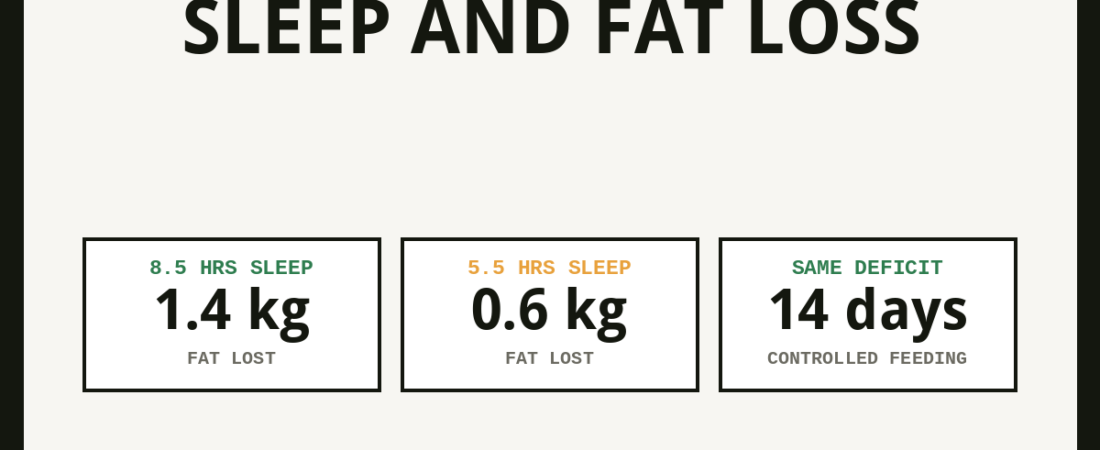
Short answer: Nedeltcheva and colleagues 2010, published in Annals of Internal Medicine, put participants on an identical calorie deficit and varied only sleep. At 8.5 hours they lost 1.4 kg of fat. At 5.5 hours they lost 0.6 kg of fat and considerably more lean mass. Same diet, same deficit, roughly half the fat loss.
The design
This was a randomised crossover study conducted in a laboratory setting, which is what makes it unusually strong for a nutrition finding. Ten overweight adults completed two 14-day periods of moderate calorie restriction, once with 8.5 hours in bed and once with 5.5 hours.
Because it was a crossover, each participant served as their own control. Because it was conducted in a clinical research unit, food intake was controlled rather than self-reported, which removes the largest source of error in diet research.
The results
| Outcome | 8.5 hours sleep | 5.5 hours sleep |
|---|---|---|
| Total weight lost | About 3.0 kg | About 3.0 kg |
| Fat lost | About 1.4 kg | About 0.6 kg |
| Fat-free mass lost | About 1.5 kg | About 2.4 kg |
| Hunger ratings | Lower | Higher |
| Ghrelin | Lower | Higher |
Note the first row. Total weight loss was nearly identical, which is why a scale alone would have shown no difference. The composition of that loss was completely different.
Why it happens
- Hormonal shift. Ghrelin rose in the short-sleep condition, increasing hunger and reducing the drive to expend energy.
- Reduced muscle protein synthesis, which explains the greater lean mass loss.
- Lower spontaneous activity, since tired people move less throughout the day.
Limitations
Ten participants over 14 days. That is small, and the study cannot tell us what happens over months. The sleep restriction was also severe and abrupt, rather than the chronic mild deprivation most people live with.
What makes it persuasive despite the size is the design: controlled feeding, crossover, laboratory setting, and a mechanism supported by separate hormonal work such as Spiegel 2004. Subsequent research has broadly supported the direction of the finding.
What to do with it
If you are dieting and sleeping badly, sleep is not a secondary concern to address after your macros are perfect. On this evidence it is one of the primary variables determining whether the weight you lose is fat or muscle. Practical steps.
FAQ
What did the Nedeltcheva sleep study find?
At an identical calorie deficit, 5.5 hours of sleep produced about half the fat loss of 8.5 hours, with more lean mass lost.
How many people were in the study?
Ten, in a randomised crossover design with controlled feeding.
Does sleep affect fat loss that much?
In this controlled setting, yes. The effect size is larger than most supplements produce.
Was total weight loss different?
No, and that is the point. Only the composition differed, which a scale would not reveal.
Sources
- Nedeltcheva AV, Kilkus JM, Imperial J, Schoeller DA, Penev PD. Insufficient sleep undermines dietary efforts to reduce adiposity. Annals of Internal Medicine, 2010.
- Spiegel K et al. Brief communication: sleep curtailment in healthy young men is associated with decreased leptin levels, elevated ghrelin levels, and increased hunger and appetite. Annals of Internal Medicine, 2004.
- Dattilo M et al. Sleep and muscle recovery. Medical Hypotheses, 2011.
General information, not medical advice.
Part of The Research — studies and position stands explained plainly.
GramGoal Team. We build nutrition calculators and price-check the supplement market monthly. General information, not medical advice. See our methodology and affiliate disclosure.