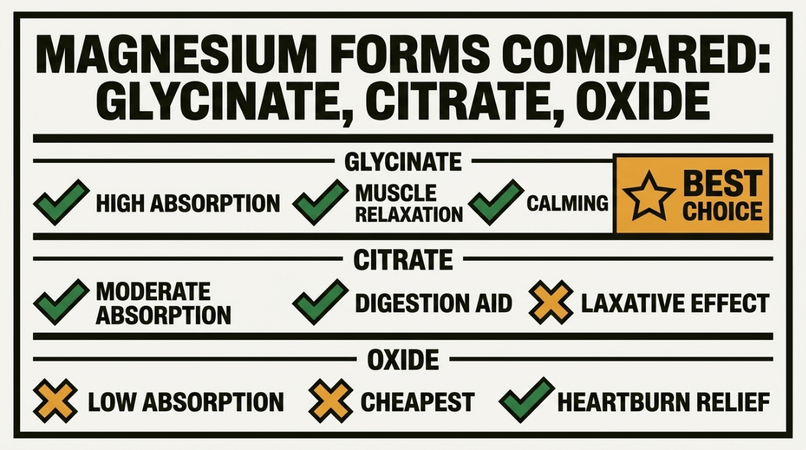
Short answer: for general supplementation, magnesium glycinate is the default choice because it absorbs well and rarely upsets digestion. Citrate is a good cheaper alternative with a mild laxative effect. Oxide is the cheapest, the worst absorbed, and the one filling most bargain multivitamins.
Why the form matters so much
Magnesium is always bound to something else in a supplement, and that partner molecule determines how much you actually absorb and how your gut reacts. Two products both labelled 400 mg of magnesium can deliver very different amounts into your bloodstream.
There is also a labelling trap. Some products list the weight of the whole compound rather than elemental magnesium, so a 500 mg magnesium glycinate capsule may contain only around 50 to 100 mg of actual magnesium. Look for the elemental figure.
The forms, ranked by usefulness
- Glycinate (bisglycinate). Bound to the amino acid glycine. Well absorbed, gentle on the stomach, and the form most often recommended for general use and for taking in the evening. The main downside is bulk: you often need two or three capsules for a meaningful dose.
- Citrate. Well absorbed and inexpensive. Draws water into the bowel, which is why it is also sold as a laxative. If you tend toward constipation this is a feature; otherwise it is a reason to take less.
- Malate. Bound to malic acid. Reasonable absorption, often marketed for energy and muscle discomfort. The evidence for those specific claims is thinner than the marketing suggests.
- Threonate. The premium form, marketed for cognition on the basis that it crosses into the brain more readily. The supporting research is early and largely preliminary, and it costs several times more per milligram.
- Taurate. Bound to taurine, sometimes promoted for cardiovascular support. Limited human evidence.
- Oxide. Very high magnesium by weight but poorly absorbed, with much of it passing through and causing loose stools. Cheap, common in supermarket multivitamins, and the reason many people think magnesium upsets their stomach.
- Sulphate. Epsom salts. Used in baths, where the absorption evidence is weak, and clinically by injection.
How much do you need?
Adult recommendations sit around 310 to 420 mg of elemental magnesium daily depending on age and sex. Average intake in many countries falls short, which is why supplementation is common, but food should still do most of the work.
Food sources
- Pumpkin seeds, 30 g: about 150 mg
- Spinach, cooked, 100 g: about 87 mg
- Almonds, 30 g: about 80 mg
- Black beans, cooked, 100 g: about 70 mg
- Dark chocolate, 30 g: about 65 mg
- Avocado, one medium: about 58 mg
A supplement typically supplies 100 to 200 mg, filling a gap rather than replacing dietary intake. Taking very large doses does not help; absorption efficiency falls as the dose rises, and the excess mostly causes digestive symptoms.
Practical choices
- General supplementation or evening use: glycinate.
- On a budget, and constipation is not a problem: citrate.
- Constipation is a problem: citrate, deliberately.
- Cognitive claims: threonate, understanding you are paying a large premium for early evidence.
- Avoid: oxide as your main source, unless cost is the only consideration.
Interested in the topical versions? The evidence for magnesium sprays and creams is much weaker than for oral forms.
FAQ
Which magnesium is best for sleep?
Glycinate is the usual recommendation, partly for absorption and partly because glycine itself has some sleep-related research. Evidence for magnesium improving sleep in people who are not deficient is modest.
Can I take magnesium every day?
Yes, within normal supplemental doses. Supplemental upper limits are around 350 mg of elemental magnesium daily for adults, separate from food intake.
Why does magnesium give me diarrhoea?
Usually the form. Oxide and citrate both draw water into the bowel. Switching to glycinate resolves it for most people.
Should I take magnesium in the morning or at night?
Either works for correcting intake. Evening is common because of the relaxation association, but timing is not critical.
General information, not medical advice. Magnesium can interact with some antibiotics and other medicines, and doses need care in kidney disease.
Estimate your magnesium gap and the elemental dose you need.
GramGoal Team. We build nutrition calculators and price-check the supplement market monthly. General information, not medical advice. See our methodology and affiliate disclosure.