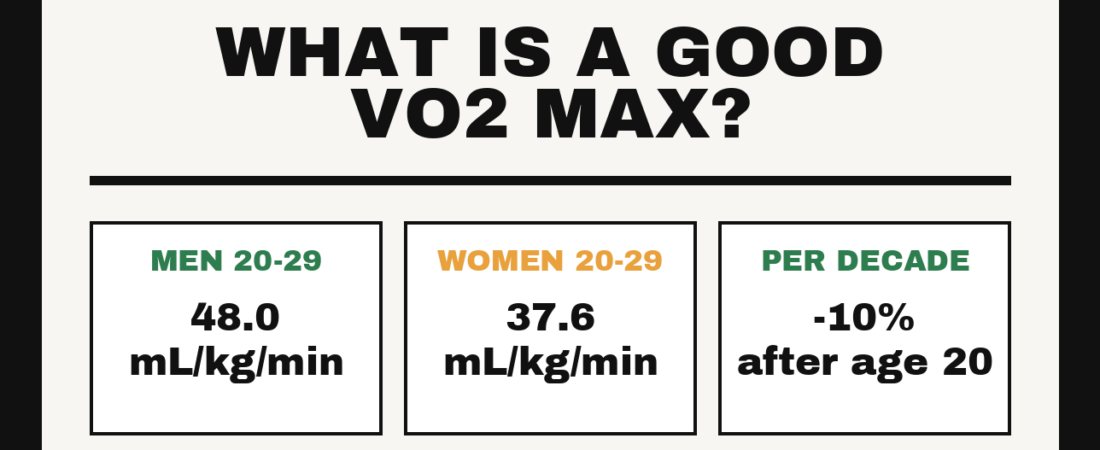
Short answer: in the largest US database of laboratory-measured tests, the median VO2 max is 48.0 mL/kg/min for men aged 20 to 29 and 37.6 for women in the same decade, falling by roughly 10 percent of that starting value every decade after. “Good” only means anything against your own age and sex, and against a number measured properly. A median man in his forties sits at 37.8, which is almost exactly where a median woman in her twenties sits.
What the number actually measures
VO2 max is the highest rate at which your body can take in oxygen, move it to working muscle and use it, expressed per kilogram of bodyweight per minute. It is the ceiling on sustained aerobic work. Because it is divided by bodyweight, it moves when your weight moves, which is worth remembering before you credit a training block for a jump that came from a cut.
It is also only half the picture. The other cheap whole-body marker with comparable mortality evidence behind it is grip strength, which tracks strength rather than aerobic capacity.
The reference numbers below come from FRIEND, the Fitness Registry and the Importance of Exercise National Database, which pooled maximal treadmill tests with respiratory gas analysis from laboratories across the United States in apparently healthy adults. These are measured values, not estimates. A 2022 update expanded the registry to 22,379 tests and extended it to age 89.
VO2 max by age and sex
Treadmill values in mL/kg/min, from the FRIEND reference standards. The 50th percentile is the median for that age and sex, so half of tested adults fall below it.
| Age | Men 25th | Men 50th | Men 75th | Women 25th | Women 50th | Women 75th |
|---|---|---|---|---|---|---|
| 20-29 | 40.1 | 48.0 | 55.2 | 30.5 | 37.6 | 44.7 |
| 30-39 | 35.9 | 42.4 | 49.2 | 25.3 | 30.2 | 36.1 |
| 40-49 | 31.9 | 37.8 | 45.0 | 22.1 | 26.7 | 32.4 |
| 50-59 | 27.1 | 32.6 | 39.7 | 19.9 | 23.4 | 27.6 |
| 60-69 | 23.7 | 28.2 | 34.5 | 17.2 | 20.0 | 23.8 |
| 70-79 | 20.4 | 24.4 | 30.4 | 15.6 | 18.3 | 20.8 |
Two things stand out. The first is how steep the age slope is: men fall from 48.0 to 24.4 across five decades and women from 37.6 to 18.3, roughly halving in both cases. The FRIEND authors put that at about 10 percent per decade. The second is how wide the spread is within a single decade. For men aged 40 to 49, the gap between the 25th and 75th percentile is 13.1 points, which is larger than the entire drop from the 40s to the 60s at the median. Age sets the trend; training sets your position on it.
If you want to place yourself, the VO2 max calculator estimates it from a field test or resting heart rate, and the target heart rate calculator converts that into training zones.
What a high number predicts
This is the part with the strongest evidence behind it. Mandsager and colleagues followed 122,007 patients referred for treadmill testing at the Cleveland Clinic over 1.1 million person-years, with 13,637 deaths. Risk-adjusted all-cause mortality fell steadily as fitness rose, and the elite performers had an adjusted hazard ratio of 0.20 against the low-fitness group, a fivefold difference. The authors reported no observed upper limit of benefit.
The American Heart Association reached a similar conclusion in its 2016 scientific statement, arguing that cardiorespiratory fitness is a stronger predictor of mortality than smoking, hypertension, high cholesterol or type 2 diabetes, and recommending it be treated as a clinical vital sign.
Both are observational. Fitter people differ from less fit people in many ways beyond their fitness, and neither study randomised anyone to a VO2 max. The association is large and consistent enough to take seriously, but it is not proof that raising the number by five points buys you the corresponding slice of the survival curve.
How much you can move it
Milanovic, Sporis and Weston meta-analysed 28 controlled trials in 723 healthy adults with a mean starting VO2 max of 40.8. Against no-exercise controls, endurance training raised VO2 max by 4.9 mL/kg/min and interval training by 5.5. Head to head, intervals beat steady work by 1.2 mL/kg/min, a small edge rather than a different category of result.
| Comparison | Change in VO2 max | Read as |
|---|---|---|
| Endurance training vs no exercise | +4.9 mL/kg/min | Large |
| Interval training vs no exercise | +5.5 mL/kg/min | Large |
| Interval vs endurance training | +1.2 mL/kg/min | Small |
| Lower starting fitness, intervals | +3.2 extra | Beginners gain most |
Five points is roughly one decade of age-related decline reversed, and the least fit gained the most. The practical reading is that the choice between intervals and steady aerobic work matters far less than doing either one consistently.
Where the number gets soft
The table above is laboratory data. Most people meet VO2 max through a watch, and those estimates are a different thing. Engel and colleagues compared a Garmin Forerunner 245 against laboratory gas analysis in 35 endurance athletes. The watch underestimated by about 4 to 5 mL/kg/min on average, with a mean absolute percentage error of 7.2 to 7.9 percent. Accuracy split by training level: in moderately trained runners the error was 2.8 to 4.1 percent, but in highly trained athletes the watch was out by 6.3 mL/kg/min, around 10 percent.
An earlier comparison of five wrist devices by Passler and colleagues was harsher, with errors above 10 percent for almost every device and estimate tested. So a watch number is reasonable for tracking your own trend over months, and poor for deciding whether you cleared a percentile line. If your figure sits within a few points of a boundary in the table, treat the boundary as blurred.
FAQ
What is a good VO2 max for men?
Above the 50th percentile for your decade, which in the FRIEND data is 48.0 in your twenties, 42.4 in your thirties, 37.8 in your forties, 32.6 in your fifties and 28.2 in your sixties. The 75th percentile, roughly 6 to 7 points higher in each decade, is a reasonable target if you train.
What is a good VO2 max for women?
The median is 37.6 in the twenties, 30.2 in the thirties, 26.7 in the forties, 23.4 in the fifties and 20.0 in the sixties. Women’s values run roughly 10 points below men’s in early adulthood, largely from differences in haemoglobin mass and body composition, so comparing across sexes tells you nothing useful.
What is a good VO2 max by age?
Use the table above rather than a single threshold. The decline is about 10 percent of the starting value per decade, so a 30 in a 60 year old and a 30 in a 25 year old are describing very different people.
How do I increase my VO2 max?
Consistent aerobic training of either type. Controlled trials show gains of around 5 mL/kg/min against doing nothing, with the largest gains in those who started least fit and in programmes that ran longer. Intervals hold a small edge over steady work, not a decisive one.
Is my watch’s VO2 max accurate?
Accurate enough to track direction, not to settle a percentile. Validation work puts typical errors between 3 and 10 percent, and they are largest in the fittest users, where watches tend to underestimate.
If you are training for a distance rather than a number, the race time predictor turns a recent result into realistic targets.
Sources
- Kaminsky LA, Arena R, Myers J. Reference standards for cardiorespiratory fitness measured with cardiopulmonary exercise testing: data from the Fitness Registry and the Importance of Exercise National Database. Mayo Clinic Proceedings. 2015;90(11):1515-1523.
- Kaminsky LA, Arena R, Myers J, Peterman JE, Bonikowske AR, Harber MP, Medina Inojosa JR, Lavie CJ, Squires RW. Updated reference standards for cardiorespiratory fitness measured with cardiopulmonary exercise testing: data from FRIEND. Mayo Clinic Proceedings. 2022;97(2):285-293.
- Mandsager K, Harb S, Cremer P, Phelan D, Nissen SE, Jaber W. Association of cardiorespiratory fitness with long-term mortality among adults undergoing exercise treadmill testing. JAMA Network Open. 2018;1(6):e183605.
- Ross R, Blair SN, Arena R, et al. Importance of assessing cardiorespiratory fitness in clinical practice: a case for fitness as a clinical vital sign. A scientific statement from the American Heart Association. Circulation. 2016;134(24):e653-e699.
- Milanovic Z, Sporis G, Weston M. Effectiveness of high-intensity interval training (HIT) and continuous endurance training for VO2max improvements: a systematic review and meta-analysis of controlled trials. Sports Medicine. 2015;45(10):1469-1481.
- Engel FA, Masur L, Sperlich B, Duking P. Validity of VO2max estimates from the Forerunner 245 smartwatch in highly vs. moderately trained endurance athletes. European Journal of Applied Physiology. 2026;126(1):591-603.
- Passler S, Bohrer J, Blochinger L, Senner V. Validity of wrist-worn activity trackers for estimating VO2max and energy expenditure. International Journal of Environmental Research and Public Health. 2019;16(17):3037.
GramGoal Team. We build nutrition calculators and price-check the supplement market monthly. General information, not medical advice. See our methodology and affiliate disclosure.